
|
Foolscap Press ~ California |
||||
| Foolscap Press: "We started Foolscap Press in 1990 after many years in the business in order to publish books under our own imprint. All of our books are designed, printed and bound at the press and distributed directly to our customers. … Our goal is to produce finely-made hand crafted books of literature and other works with which we hope to surprise and delight institutions and individuals who collect our books." | ||||
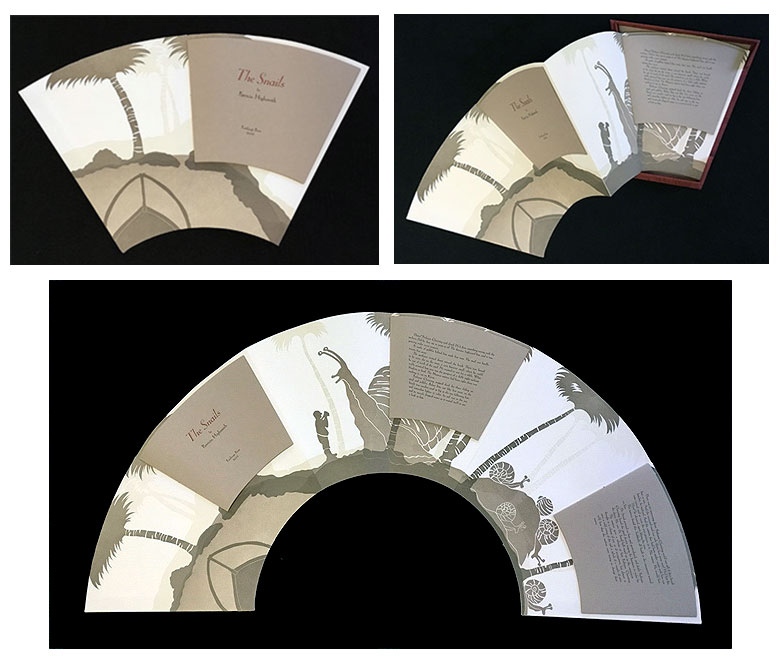
The Snails 9.25 x 8.25" closed; 38 half pages (8 x 5.5") of text; 6 full pages of illustration including pastedowns. Text printed letterpress in Koch Antiqua type on Lettra and Zerkall German Ingres paper. Illustrations by Peggy Gotthold printed directly from the linoleum blocks. Accordion fold bound in cloth-covered boards with snail illustration on front board. Text pages sewn in folds of illustration pages. Accordion extends to a semi-circle. Laid in a cloth-covered box with a cast-paper sculpture. Numbered. Foolscap Press: "Throughout her writing career Patricia Highsmith returned again and again to the short story, publishing eight collections in her lifetime. 'The Quest for Blank Claveringi' (the slightly awkward name was simplified to 'The Snails' for its publication in the Saturday Evening Post) is from her first collection in 1970 called Eleven. The subject was gastropods—on its face a strange choice of subjects—but a natural one for the author, she had a thing for snails. Patricia Highsmith kept snails by the hundreds as pets. She was known to take snails (presumably very special ones) to parties on leaves of lettuce in her handbag, and she smuggled her pet snails into France where she lived for many years. "For this story Patricia Highsmith scaled up her snails to monster size giving them teeth that would, in the real world, only threaten a leaf of lettuce. They now had the ability to saw through tree branches. And then she enhanced their speed just a bit, enough to put them in harmony with their great size. Next she placed them on an uninhabited island with just enough vegetation to leave them slightly hungry. And then she dropped in Avery Clavering, an out-of-shape professor determined to capture a giant snail and have his name go down in the scientific journals as a great discoverer. The somewhat arrogant intruder finds himself a little unprepared for such a heroic task. Perhaps Patricia Highsmith was getting a little bored with her pets. Her reimagined favorites were sent out on a hunt of their own—with a notion to run down Avery Clavering and secure, if not a trophy, certainly a good meal." |
|
|||
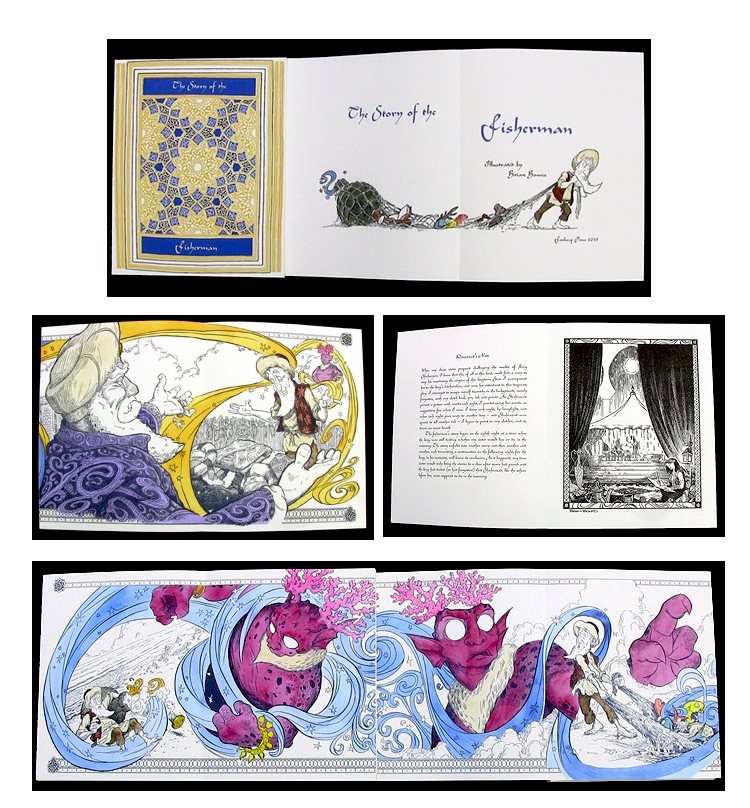
| The Story of the Fisherman illustrated by Brian Bowes Santa Cruz, California: Foolscap Press, 2015. Edition of 117. 9.875 x 8.3"; 80 pages. 18 illustrations including the illustrated title page. Printed on Lettra from Crane & Co. and set in Legend, a type designed in 1937 by L.H. Schneidler. Pochoir. Hand bound at the press. Laid in four flap cloth covered portfolio with magnet closure. Signed by the artist Brian Bowes. The Story of the Fisherman is taken from the Arabian Nights and is translated by Edward William Lane (1801-1876). Foolscap Press: "The Story of the Fisherman is part of a much larger collection of folklore and literature popularly known as the Arabian Nights or The One Thousand and One Nights. The stories originated from ancient Persian, Indian, Egyptian and Mesopotamian sources collected over hundreds of years during the Islamic Golden Age, that is, from the eighth to the thirteenth centuries. These stories reflect the enormous, highly civilized Islamic world that existed at the time. And it was a time when a traveler could wander through an extensive portion of the known world speaking Arabic, studying and praying in mosques, and being a stranger yet sharing a familiar culture. "There is a frame story common to all the editions of the Arabian Nights that involve the ruler of the Persian Empire, King Shahrayar, and his bride Shahrazad. The core scene is the bedchamber of King Shahrayar. His new bride for the night is Shahrazad, daughter to the king's own vizier. She is one more virgin destined to die at sunrise after spending just a single night in the king's bed. The king has sworn to work his way through all the virgins of his kingdom, putting each to death the following morning because his former queen (and therefore all women, in his view) was without virtue. So he decreed that the young women in the kingdom would pay the ultimate penalty for their queen's transgressions. "The Arabian Nights is a collection of stories told against death. Starting with the frame story of Shahrazad and King Shahrayar, the stories unfold, stories within stories, many of them with the intention of prolonging the life of the one telling the story. This present book, titled The Story of the Fisherman, is typical of the Arabian Nights stories in that it is a series of stories tucked within the opening story. "For this edition, illustrator Brian Bowes has transformed Shadrazad's narration into a panorama of imposing images setting before the reader a visual extravagance of place and time and character. Mr. Bowes is the former Illustrator Coordinator for San Francisco North & East Bay Region of the Society of Children's Book Writer's and Illustrators (SCBWI). He is an illustrator, graphic designer and art instructor. Once printed, the illustrations are hand colored in a French method called pochoir where paint is applied with a brush through cut-out stencils. "This edition of The Story of the Fisherman has evolved both as a story of words and, at the same time, a story told in graphic art form. Due to the accordion nature of the binding, the book can be opened to display the story in images and the reader will discover visual connections between the linked illustrations. "The illustration on the front and back covers is based on an illuminated page from a Koran made for Sultan Uljaytu Hamadan in 1313 by Abdallah ibn Muhammad al-Hamadani." $775 |
|
|||
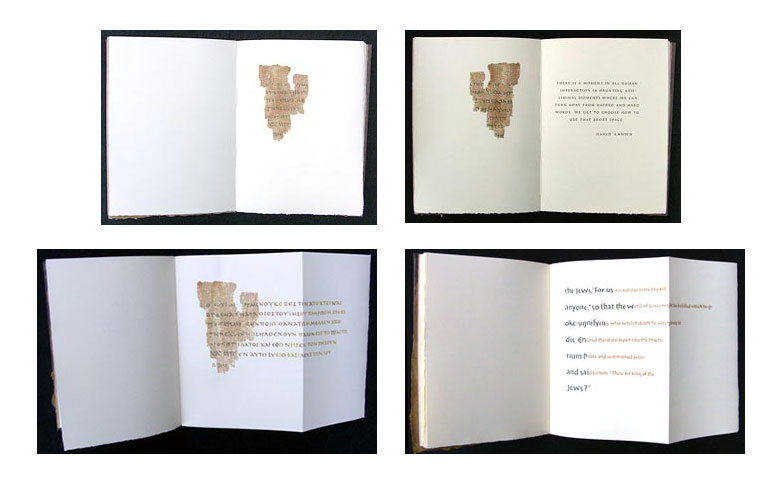
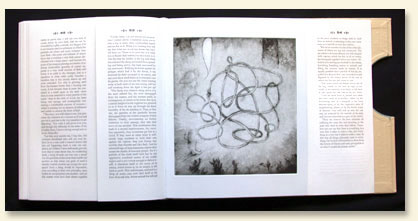
The Saint John's Fragment "This book is a collaboration between Anglo-Welsh poet, critic and publisher David Annwn and the celebrated San Francisco calligrapher Thomas Ingmire. Originally, they created a truly remarkable one-of-a-kind book with the subject matter Saint John's Fragment. This was great for the owner, but leaves nothing for the rest of us. We've gone back to the collaborative drawing table with David and Thomas to create our own edition, the result of a second collaboration, and although still sharply limited, it allows something for those of us who want an echo of their astounding original work. |
|
|||
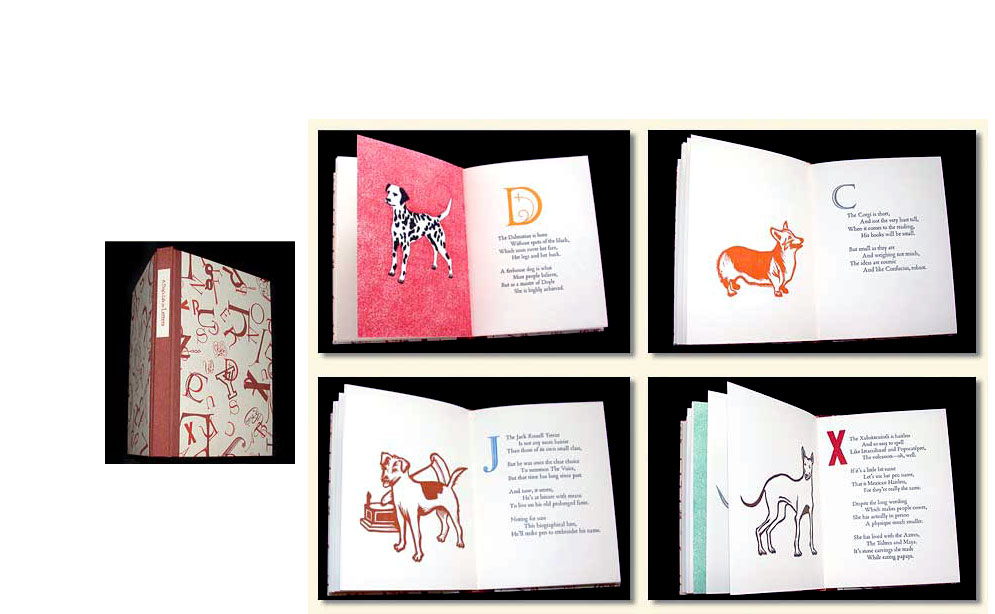
A Dog's Life in Letters
$120 |
|
|||
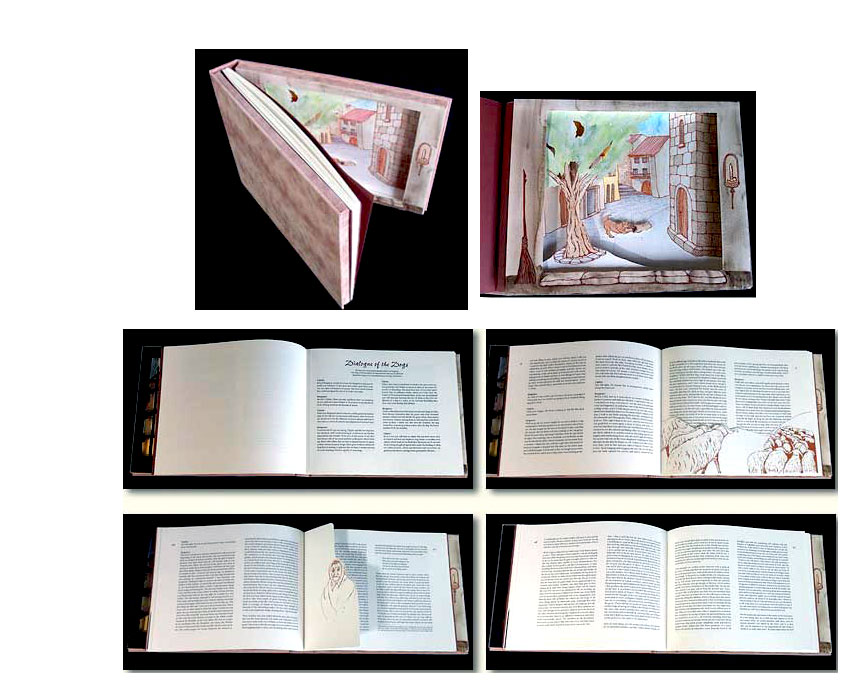
Dialogue of the Dogs 9.25 x 11.5"; 52 pages. Printed letterpress on Magnani Revere paper. Set in Dante and Pepita types. Full-page scenes set in a three-dimensional diorama on inside of the front and back covers create a box-like structure around the text. Drawings by Peggy Gotthold. Cloth bound. Design, printing, and binding by Lawrence G. Van Velzer and Peggy Gotthold. Foolscap Press: "Readers know that it is Cervantes who wrote Don Quixote, but not so many realize that Cervantes, during the period of years between parts I and II of Don Quixote, was writing a collection of shorter pieces called in English, Exemplary Novels; a collection according to Professor Rudolph Scheville, late of U.C. Berkeley 'One of the most precious documents that we posses for becoming acquainted in detail with Spanish culture and customs of the age in which Cervantes lived.' "Of the twelve stories in Exemplary Novels 'Dialogue of the Dogs' stands out as a novel that would have 'provided an enduring base for Cervantes’s fame as a great prose writer and incomparable painter of his fellowmen,' according to Professor Scheville. "In this story, the large mastiff Berganza, along with his mat-mate Cipión, unexpectedly finds himself with the ability to speak. The two dogs have a lot to say and may have only one short night in which to say it, as it is unknown when this gift of speech might be taken away. "Our edition is translated by Harriet de Onís (1899-1969) who was considered one of the best translators of Spanish and Portuguese literary works into English. In her introduction to Six Exemplary Novels (1961) she points out that, 'In the case of the novella or short story, prior to Cervantes the procedure had been for a person, or several persons, as in The Arabian Nights, the Decameron, and The Canterbury Tales, to narrate a series of stories linked together by a common thread. Each of the Exemplary Novels is complete in itself, diverse in theme and form, completely independent of the others.' "In his prologue to the Exemplary Novels, first published in 1613, Cervantes wrote, 'I am the first to essay novels in the Castilian tongue, for the many which go about in print in Spanish are all translated from foreign languages, while these are my own, neither imitated or stolen. My genius begat them, and my pen gave them birth—and they have grown in the arms of the printing press.' "If that statement has the air of literary arrogance, it is only that he speaks the simple truth. This story by Cervantes has grown in our hearts and has embraced our own antiquated printing presses to give rebirth to the Spanish gentleman’s 'Dialogue of the Dogs.' We hope it gives you pleasure, as well. " |
|
|||
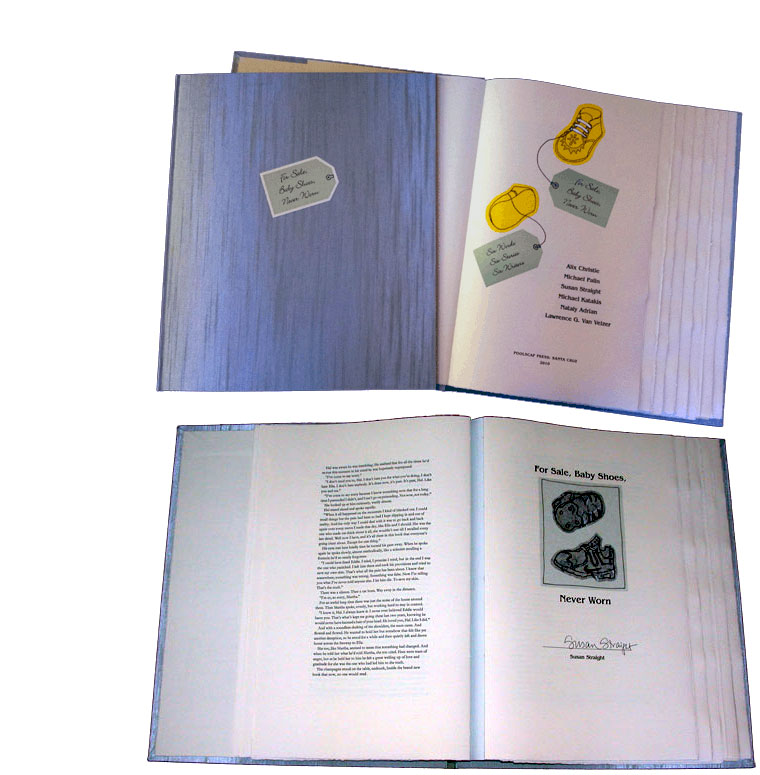
For Sale, Baby Shoes, Never Worn 15 x 13"; 60 unpaginated pages. Printed letterpress on Frankfurt Cream text paper using handset Garamond type. Six stories, each with title page decorated with collaged prints of baby shoes by Peggy Gotthold on Kitakata paper. Bound in light green Japanese cloth. Sewn onto a modified accordion structure designed so that each story is presented individually. Foolscap Press: "As a journalist Ernest Hemingway was trained to cut to the story's essentials, leaving out those words that stand between the writer and his intent. And so we have a Hemingway principle of good writing – the well-hewn sentence. It is said that Ernest Hemingway was challenged to write the shortest of short stories: the ultimate example of brevity in storytelling. Though perhaps apocryphal - no one can tell us who challenged him or on what occasion - this was the result: "For Sale, Baby Shoes, Never Worn." Writers have attempted to equal this six-word short story with six of their own, but no one has clearly beaten the master. Those six words are just too good. Foolscap Press commissioned six writers each to write a six-page story where only the title was supplied. The writers were free to do whatever they chose within those parameters. We invited three women and three men in order to balance personal experiences and writing styles. "The response is these six extraordinary stories stocked with a captivating cast of characters. And, yes, there is a distinction between the men and women writers. And what happens when it comes to dealing with an unmitigated loss (as the title might suggest)? You can read for yourself these six creations spun from six very different imaginative worlds, all in response to those six tantalizing words. "Alix Christie is a journalist and writer whose work has appeared in the Washington Post Magazine, San Francisco Chronicle, Other Voices, Salon.com, and The Economist, among other publications. "Michael Palin, actor, travel writer, screenwriter, documentarian, and comedian, is the author of many books, including travel books, an autobiography, diaries, fiction, children's books, and a play. "Susan Straight is the author of Aquaboogie, I Been in Sorrow's Kitchen and Licked Out All the Pots, Blacker than a Thousand Midnights, The Gettin' "Michael Katakis is a photographer as well as the author of The Vietnam Veterans Memorial, Sacred Trusts: Essays on Stewardship and Responsibility, Despatches, Traveller, and A Time and Place Before War. "Nataly Adrian lives and writes in Paris. She is the author of The Destiny Book, and The Secret in the Shell. "Lawrence G. Van Velzer is the author of Desert Dreams, Tower of the Winds, and Herakles and the Eurystheusian Twelve-Step Program and many short pieces. " |
|
|||
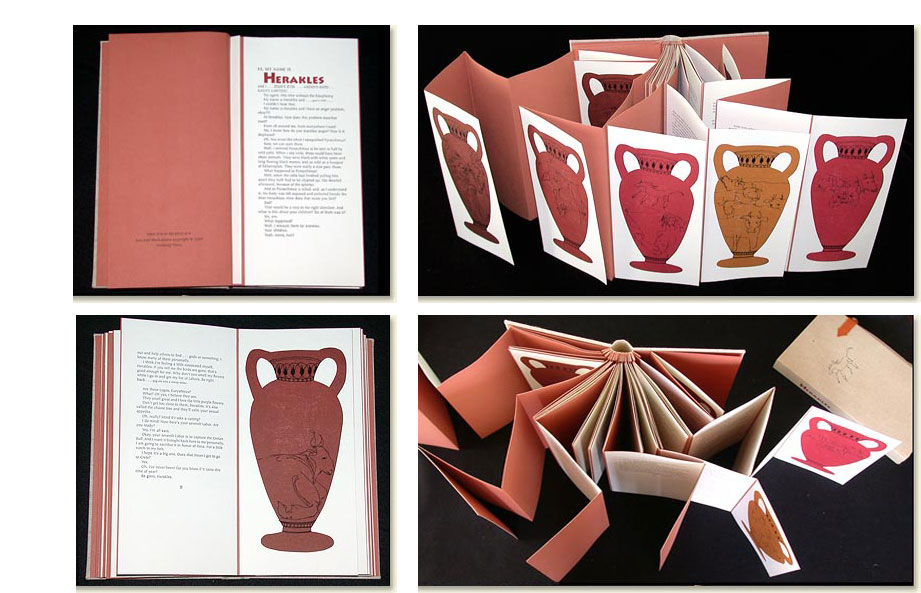
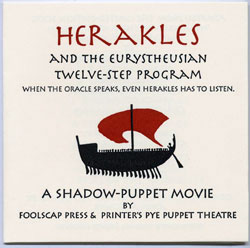
Herakles and the Eurystheusian Twelve-Step Program 6 x 11.25"; 51 pages. Letterpress printed on Curtis Holcomb text and Hahnemühle Bugra. Illustrated by Peggy Gotthold. Clothbound boards with paper title inset on front board. Binding designed to separate the twelve Steps or Labors into single pages that fold out and terminate in an illustrated vase. Enclosed in paper wrapper with leather and cord closure. Author, interview: "Well, what could be a better time to learn something from our past? Half of us are in some kind of twelve-step program and the other half should be. Our economy needs a twelve-step program; ditto the environment, our congress and the policy wonks driving our foreign policy. ... If you read your Greek mythology you’ll find that everything I’ve written about Herakles is true. The twelve-step program I’ve written about is what at the time would have been called a set of Labors. Eurystheus didn’t have a lot of research to fall back on. He had to make it up as he went along. You have to give the man credit." Parenthesis 19, review by David Schoonover: "This book is one of the most enjoyable press books I have read in my career. The dialogue is wickedly funny, very revealing of the personalities of Herakles and Eurystheus before, during, and after the treatment." |
 Click image for more |
|||
Herakles and the Eurystheusian Twelve-Step Program
$20 |
 |
|||
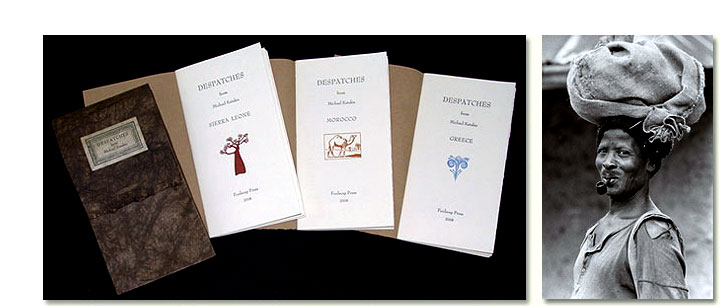
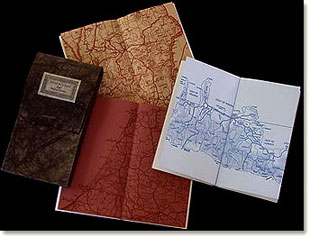
Despatches 4.5 x 8"; 3 books, 24 pages each. Printed letterpress on Magnani Vergata paper. Each book wrapped in Camel Hahnemühle Ingres paper covers. In the center of each book is a map of that country. Each set of three books Foolscap Press: "Originally written as journal entries, Despatches is a selection from many years’ travels and remembering from Michael Katakis. These writings bring the immediacy of an eyewitness report even as they convey a perceptive reflection of his own past. The deliberate spelling of Despatches pays homage to T. E. Lawrence, Gertrude Bell and Mungo Park, who, says Michael, 'Helped a solitary little boy dream of deserts and faraway places.' "These are not travel guides but are more personal, as if we were reading letters from the most desirable sort of friend. The friend who, though far away, carries you with him as he meanders through the medina in Fez, or strides along in the tall elephant grass of Sierra Leone. His voice is such that you can almost smell the herbs and dusty soil in Crete as you read." The journal entries Foolscap Press has chosen for publication are from Sierra Leone, Morocco, and Greece. They appear in three separate books, each with a map of the country at its center. The three books slip into a ‘dispatch case,’ which can be carried to an exotic location or placed within arm’s reach of the would-be traveler’s armchair in the library. Michael Palin, actor, travel writer, author, film documentarian and recipient of letters from Michael Katakis writes of his friend: “In both his letters and in his journal, Michael has an infectious ability to sense the essence of place and transmit it to the reader. Michael has two other vital qualities for a good traveler. Curiosity and a conscience." Mr. Katakis is the author of The Vietnam Veterans Memorial and Excavating Voices: Listening to Photographs of Native Americans. He is the editor of Sacred Trusts: Essays on Stewardship and Responsibility. His photographs appear in The Aesthetics of Action and in 75 Years of Leica Photography. |
|
|||
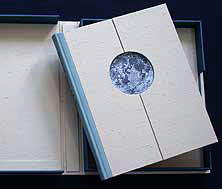
Other Worlds: Journey to the Moon 9 x 11.25" bound in quarter goat skin leather and housed in a custom made box. Printed letterpress on Hahnemühle Bugra. The direct-gravure etchings are printed on 300 gram Pescia. In this unusual binding "half pages" are opened revealing an etching in nearly every section of the book. The edition is limited to 120 numbered copies plus eight printer's proofs numbered i-viii. Signed in the colophon by both the translator and artist. Written by the poet, Cyrano who was, indeed, a brave soldier. He was wounded in battle twice, and was an excellent swordsman. But, most important, he left behind a work that influenced many writers who followed. Cyrano was an satirist, a man ahead of his time who dared to challenge the orthodoxies of both contemporary astronomy and the Church. This work is translated by Geoffrey Strachan who won the Scott Moncrieff Prize for his translation of Makine's Le Testament Français. In his informative introduction of Journey to the Moon he speaks of "pataphysics," a term used by Alfred Jarry meaning the science of imaginary solutions. Mr. Strachan states, "If ever there was a classic example of pataphysics in action it is surely Cyrano's decision to resolve his contemporaries' disputes about the nature of the moon by penning an imaginary flight there—in order, as it were, to see for himself: a perfect marriage between empirical method and poetic imagination." |
|
|||
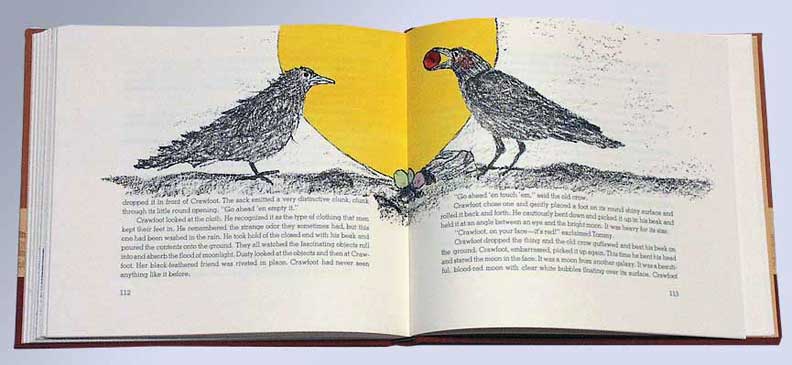
Desert Dreams 8 x 9 "; 144 pages. Type and multicolored illustrations printed letterpress on Legion Letterpress paper. Bound in Japanese cloth over boards. Illustrations by Peggy Gotthold. A tale by Lawrence G. Van Velzer taken from the heart of the Great Middle Desert where three of its rather unusual denizens inhabit an arid and enchanting land. Tommy is a young tumbleweed with a longing to travel to the distant horizon and learn about the mountains that so intrigue him; Dusty is a dust devil whose array of hats are fashioned from fine sand and who considers herself the desert's foremost detective; and, finally there is Crawfoot, a crow caught between his desire to remain within his familiar surroundings and the unexpected opportunity to add to his formidable collection of shiny things. Fate has thrown the three together and theirs is the story of life, of companionship, of exploration, of travel and discovery. One could say it is a book for youth for it is a story filled with a youthful sense of adventure. One must also say it is for those with a youthful spirit that sometimes reappears after a sobering brush with adult life. |
|
|||
|
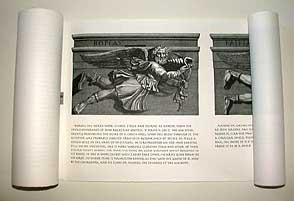
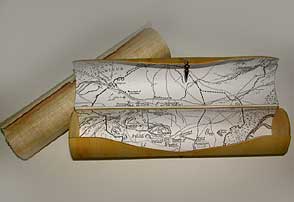
Tower of the Winds A cylindrical case, yellow-dyed to the appearance and feel of an unusual bark, and lined with a map of Ancient Athens, comes into the hands like an artifact out of time. Tucked tightly inside is a papyrus-wrapped scroll. The text follows the written history and compiled science of an intriguing building, the so-named Tower of the Winds, that was constructed both as a monument and in order to house the most advanced scientific instruments of the day. The octagonal tower was built by one Andronikos of Kyrrhos to reckon the eight winds. On each side of the marble tower, he wrought a relief figure to represent the wind which blew upon that face. Atop the structure he placed a weathervane figure of Triton which turns with the winds and stops, pointing his wand at the figure below, when he directly faces one of the eight directions. Although its mechanical and spiritual functions have been explained by scholars since antiquity, the Tower remains mysterious and enchanting. |
|
|||
| Foolscape Press SOLD / Out of Print Title: | ||||
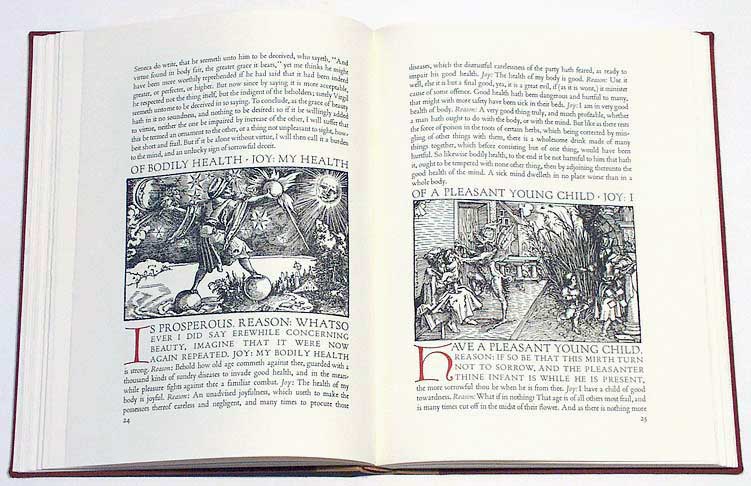
Phisicke Against Fortune: Forty-six Dialogues 12 x 9" Designed, handset and hand-sewn by Peggy Gotthold and Lawrence G. Van Velzer. Translated by Thomas Twyne. Illustrated by Hans Weiditz (from the German edition of 1532). Francesco Petrarca (1304-1374) inspired the Renaissance in Italy. He set patterns and standards for the revival of learning and, at the same time, was a powerful advocate for the preservation of valuable manuscript material. His original manuscript, "De remediis utriusque forunae," is a work of prose consisting of two hundred and fifty three dialogues that he completed near the end of his life. It represents a distillation of his moral philosophy arranged as a treatise that shows how our ideas and actions help us create either true happiness or sorrow and disillusionment. Foolscap selected forty-six of these dialogues for this edition. One of the books in the New York Public Library's exhibition "Ninety From The Nineties" in the Illustration section: "For this 1993 edition of Petrarch's dialogues, Lawrence Van Velzer and Peggy Gotthold made photo engravings from the 16th-century woodcuts by the "Master of Petrarch." |
 Click image to enlarge |
|||
| The Travels of Sir John Mandeville: Beyond the Holy Land | ||||
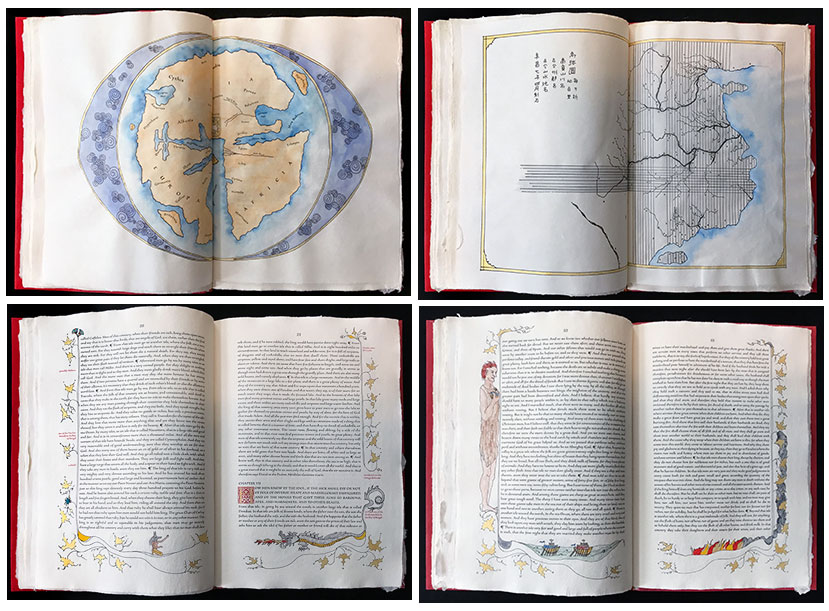
By Patricia Highsmith 9 x 12.75"; 104 pages including five double-page maps printed on handmade linen paper from Papeterie St. Armand. Printed letterpress by Lawrence G. Van Velzer on handmade Chancery paper produced at the University of Iowa's Center for the book. Bound with a handmade paper from Cave Paper. Contained in a cloth-covered box. Hand-applied illuminations by Peggy Gotthold. Binding and box by Peggy Gotthold. Numbered. Signed by Peggy Gotthold and Lawrence G. Van Velzer. Foolscap Press: "The Travels of Sir John Mandeville: Beyond the Holy Land follows a journey that began in 1322 and continued on for more than thirty years. This edition commences as Mandeville leaves the Holy Land and travels east to the lands beyond Egypt, which were mostly unknown to Western Europeans at that time. It is a strange journey and one that has kept his book alive and in print since it was first published in manuscript form in 1357. "No one really knows who John Mandeville was though he claims to be an English knight. In fact, there is no real proof that he actually traveled at all although scholars believe he did go at least as far as the Holy Land and Egypt. "Whether or not he traveled as far as he claimed has little importance today because to historians of literature this 'fabrication' of a travel book, this creation of imaginary travels, is a literary achievement of the highest order. His was a piece of European literature rather than a history of exploration. It is a book read by Cervantes, by Rabelais, and Montaigne and was found within the personal library of Leonardo da Vinci. The book was carried aboard ship by Christopher Columbus and others on their voyages of discovery, adding to their confidence that they could safely circumnavigate the globe. "Our edition is illustrated and illuminated by Peggy Gotthold following Mandeville’s observations of strange flora and fauna and the remarkable beings he encountered; and especially of the wondrous and powerful kingdoms he chanced upon, which held more gold and jewels and strange customs than his contemporaries could imagine; here are kings and emperors with power at their fingertips beyond the reach of any autocratic ruler in Medieval Europe. ”Our text is based mainly on the Cotton MS, a translation that was first edited in 1725 and continues to be a starting point for serious study of Sir John Mandeville. Though imperfect, it adheres very closely to the original. 'The Travels of Sir John Mandeville' was a popular manuscript book written in French, which literate English layman could more easily read that Latin. "As no inventive travel book should be made without including a map or two, we have supplemented Mandeville’s narrative with five imaginative maps created for this edition. These are maps that would make sense to a fellow traveler of Mandeville’s time. They are not modern maps where one might expect to identify one’s place on land or the sea. There are no precise coordinates of latitude and longitude. These maps are also narrative and allow the reading traveler to follow Sir John Mandeville, whoever he was, through an unfamiliar landscape. The modern reader will also discover the bizarre and unexpected in the world and share in Mandeville’s amazement and curiosity while traveling alongside him." |
|
|||

Home | About Us | Contact Us | New Arrivals | Fine Press & Artists' Books | Broadsides |Resource Books | Order/Inquiry
Copyright © 2021 Vamp & Tramp, Booksellers, LLC. All rights reserved.