
|
Art Hazelwood ~ California |
Share this page: |
| Simon Blattner, 2011: " The amount of art that Arthur Hazelwood has produced in the last ten years is simply astonishing. Not only has it been voluminous in quantity but also the quality and variety of his art has to be seen to be imagined. While he is primarily known as an artist with a strong lefty political bent his work covers the map in its grasp of history, depth of information and formidable energy." | |
Literary based works |
|
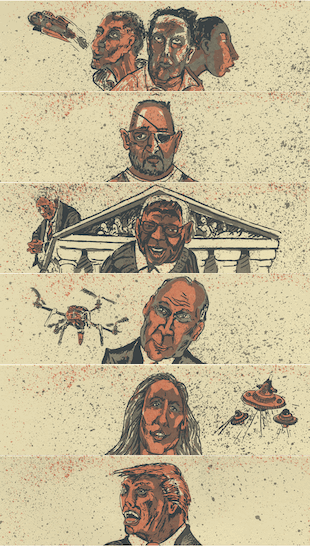
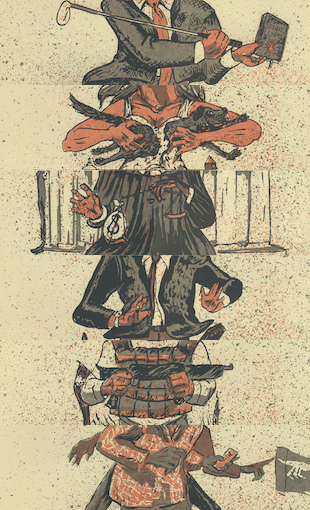
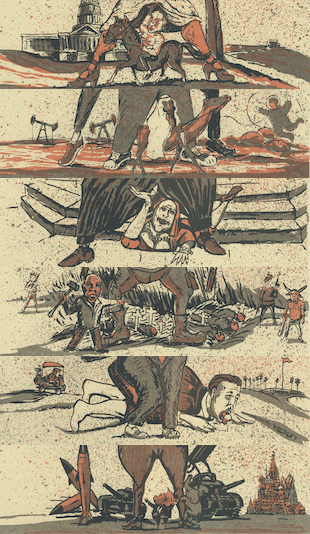
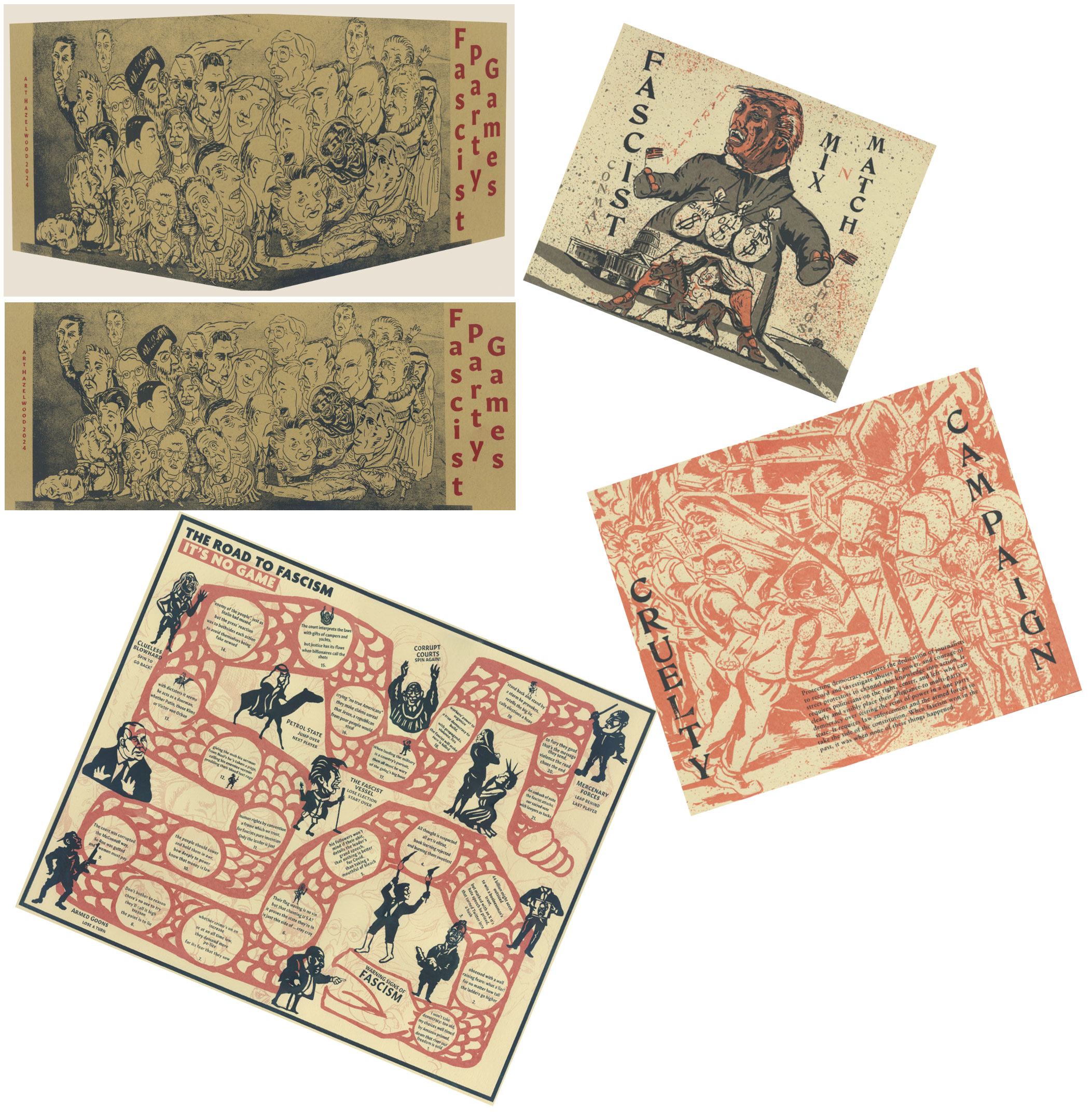
Fascist Party Games: 9" x 10.75" x .75”l 25 pages plus 6 pages, a board game and Jigsaw puzzle. Mix ‘n Match. Screenprint. Bound with screenprint cover, front and back. Created during the years 2022-2024 and bound by the artist in early 2025. Art Hazelwood: “While I had hoped it would be irrelevant, by the time this project was printed in 2024 and complete in March of 2025 it had already become clear that the US is on a fascist track, an ally of dictatorships and a nation in love with hate. Included in the book is a mix of mockery and seriousness. Quotes from Congressional testimony of the January 6 coup attempt, political cartoon like imagery created from chalkboard drawings, six pages of Fascist Mix 'n Match split images, a board game called It's No Game and a Jigsaw puzzle, showing the interlocking pattern international fascists and their corporate oligarch buddies. … “The book is divided into sections; the first, a series of illustrated quotations with text from the Committee to Investigate the January 6th Attack citing examples detailing the clear fascist threat these attacks embodied. Interspersed with these are images that evoke an older tradition of political satirical cartoons. The images for these (along with the cover image) were created from blackboard chalk drawings, which when inverted have an appearance that resembles a lithograph. Also included is a three way horizontally split section of the book that allows (among several options) the mixing of the head of Clarence Thomas with the torso of Vladimir Putin and the legs of Marjorie Taylor Greene - Fascist Mix 'n Match. A folder in the back cover of the book contains the board game, ‘The Road To Fascism - It's No Game, as well as a Fascist Jigsaw Puzzle. “ |
|
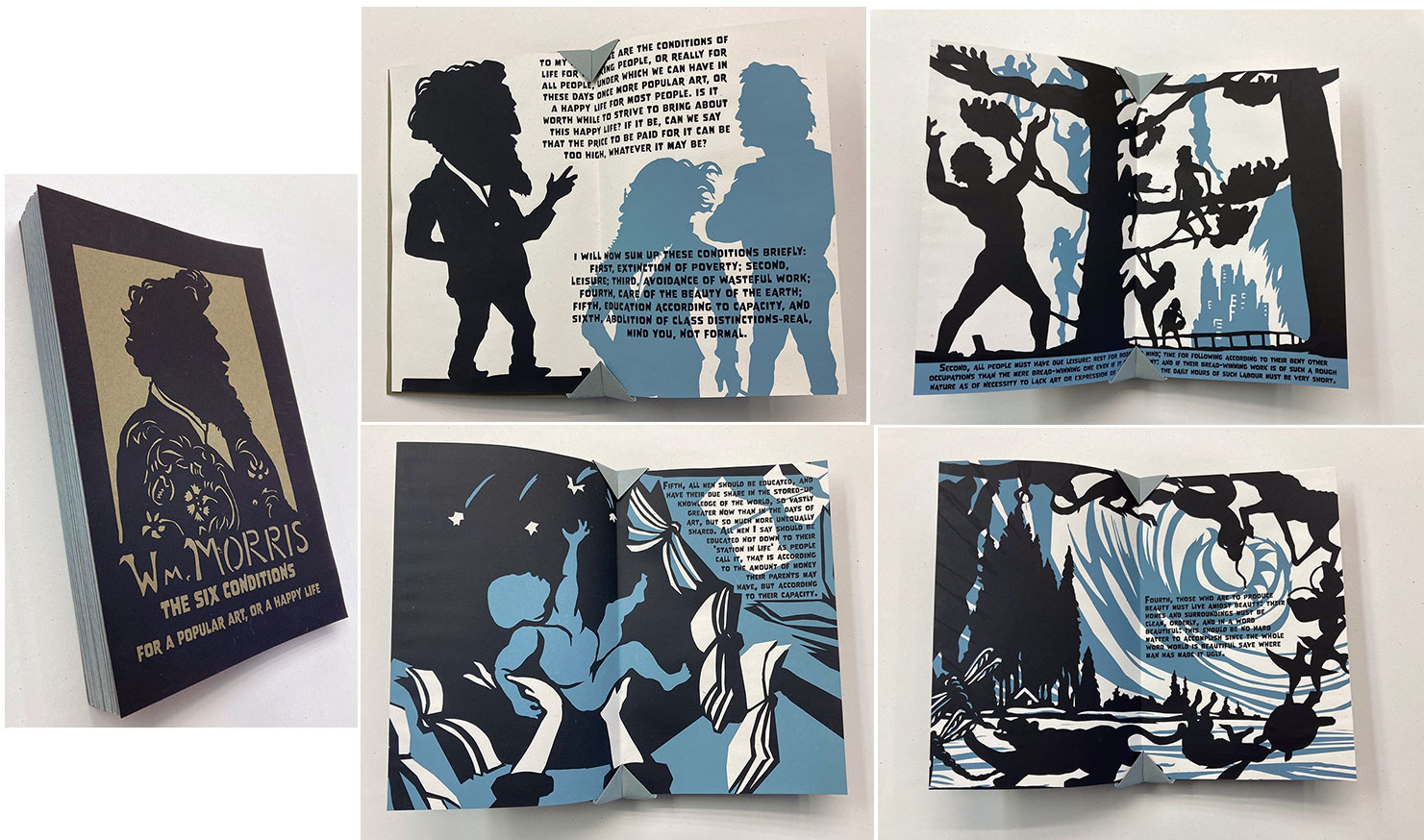
Wm. Morris: 9.5 x 6.5 x 1"; 28 pages. Blizzard binding. Book size spreads printed bleed two color 9 3/8 x 6. Cover printed front and back. Screenprinted by the artist. Binding by Asa Nakata. Signed and numbered by the artist. Art Hazelwood: "Text is from William Morris, ‘The Origins of Ornamental Art’, 1872 in which he presents the six conditions to create a livable world based on his beliefs in the value of craft and socialism. The rise of mutual aid groups during Covid-19 led me to William Morris writings and the restrictions of access to art studios led me to paper cut as the media that is here used as the basis for the prints.” The six conditions from Morris in brief are Extinction of Poverty; Leisure; Avoidance of wasteful work; Care of beauty of the earth; Education according to capacity; and, Abolition of class distinctions. Text excerpts:
$450 |
 Click image for more |
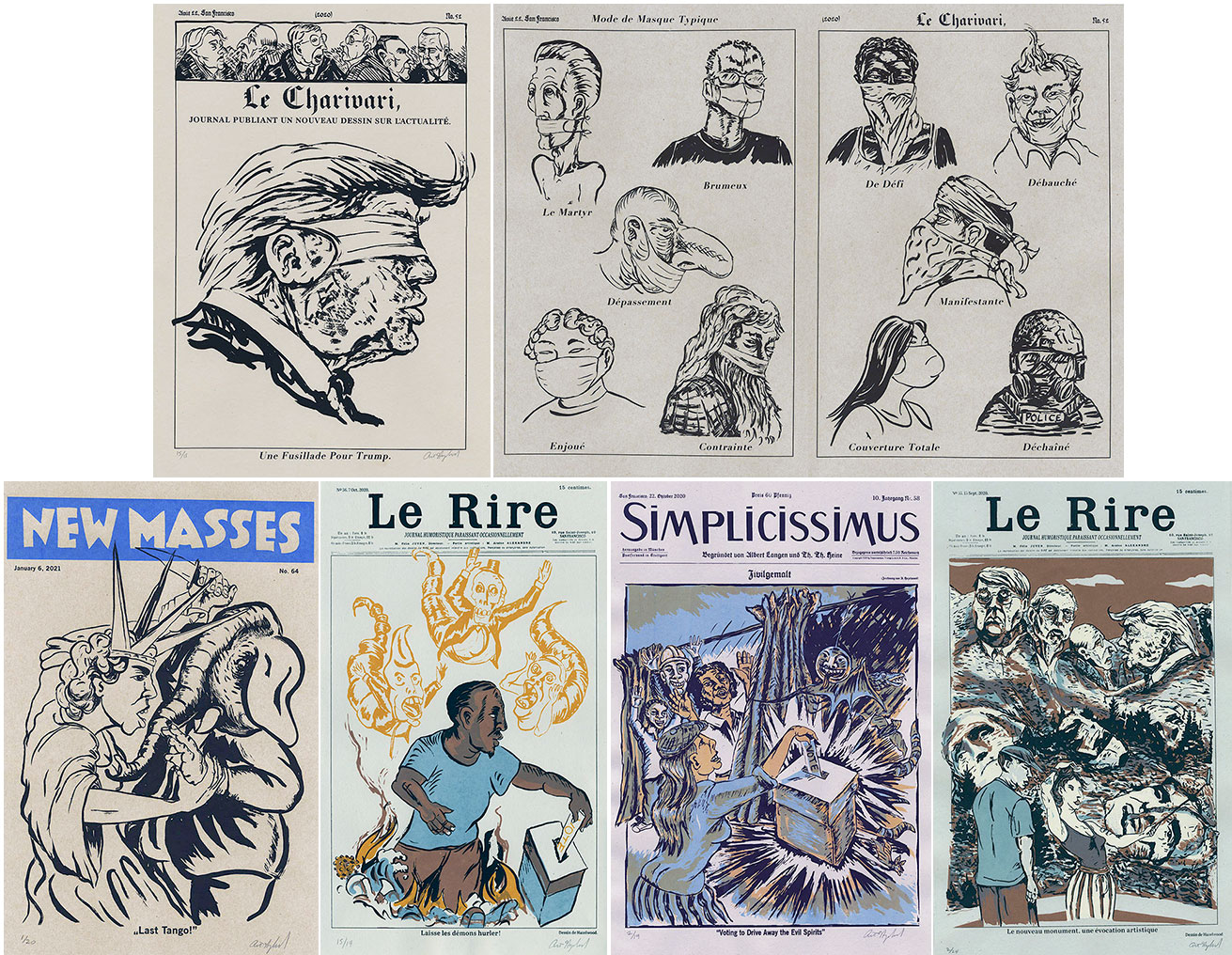
Pandemonium 2020: Satirical Covers Portfolio 19 x 12.5"; 23 prints. Screenprint,. Various French Paper Company papers. Folded portfolio printed inside and out. Le Charivari #52 cover and spread. Back is #66 Interior spread #52. Twenty three prints laid in printed portfolio. Art Hazelwood: "2020 unleashed the apocalypse on the world in the form Covid-19, fascist leaders, climate disaster. It removed the veil from the face of racism, inequity, and economic injustice. As we came face to face with so much disaster both personal and global my response was to reach for satire. Using an array of historical satirical magazine mastheads I created a running commentary on the state of our pandemic pandemonium. Starting with ‘Gaceta Callejera’ the magazines included ‘Charivari’, well known as the vehicle for Daumier's satirical lithographs, and on to ‘Harper's Weekly’, ‘Le Rire’, ‘Die Aktion’, ‘Simplicissimus’, ‘Die Pleite’, the ‘New Masses’. “The covers were designed somewhat in the spirit of the historical period. They were sent by email on the date of each publication. So the January 6, 2021 magazine cover with ‘New Masses’ masthead was sent out on that day. The use of historical magazines was done in part to give perspective on the ‘great times’ we are living through, in part to enjoy the way satirical art history plays an ongoing role after its ostensible subject has withered away. Later these images were screenprinted on French Paper and made into a portfolio.“ Art Hazelwood comments on portfolio images: Charivari #52: “ Masque Publiér/The Mask Issue. Cover Une Fusillade Pour Trump, and spread, Mode de Masque Typique, both showing appropriate and inappropriate mask wear. Mode de Masque Typique/Typical Mask Fashions, Fusillade has a long history in journalism, not as commonly used today… but a broadside or barrage all with military origins. For a simple translation - Le Martyr/The Martyr, Brumeux/Foggy, Dépassement/Exceeding, Enjoué/Playful, Contrainte/Constraint, De Défi/Defiance, Débauché/Debauchery, Manifestante/Protester, Couverture Totale/Total Coverage, Déchaîné/unleashed.” Le Rire #55: “Le nouveau monument, une évocation artistique. The new monument, an artistic interpretation. The sky has a touch of blue in it in San Francisco today, a time to catch up on the recent items that seem to have fallen over the event horizon. Trump wanted to add himself to Mount Rushmore, but why not reimagine the entire façade!“ Le Rire #56: “Laisse les Démons Hurler! Let the Demons Howl! Overcoming the obstacles to voting put in our way by anti-democratic forces. The GOP convention projects a long shadow, with a distinctive shape to it.” Simplicissimus #58: “Voting to Drive Away the Evil Spirits. Overcoming the obstacles to voting put in our way by anti-democratic forces.“ New Masses #64: “Last Tango. Today, the GOP in an assault on democracy takes the logic of decades of authoritarian impulses to its newest level of madness. Led by sycophants and opportunist collaborators the Grand Ole Party sinks into denial that any victory for Democrats can be legitimate, and eggs on conspiratorial fascists.” |
|
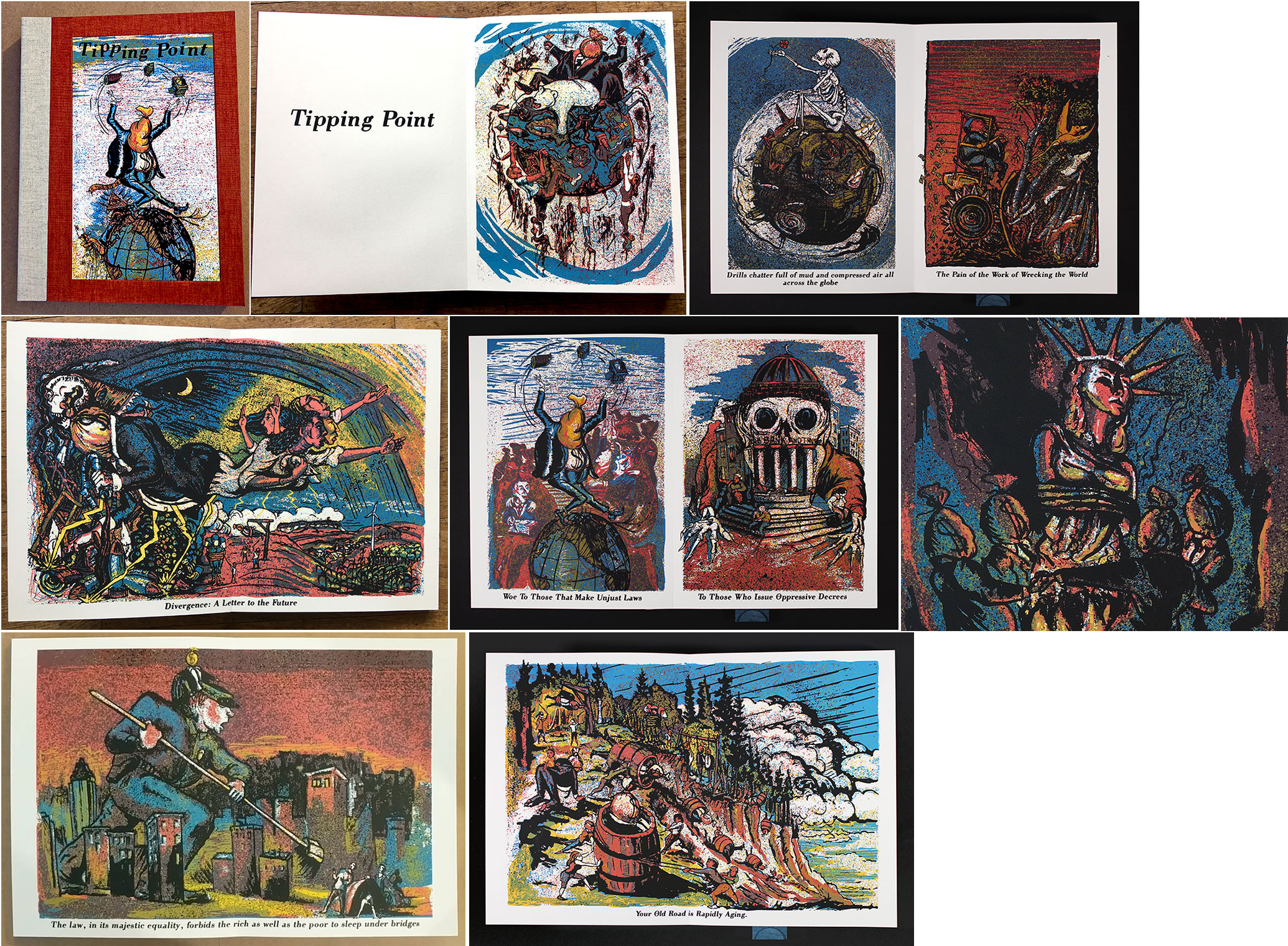
Tipping Point 12" x 9" x 1 3/8", 44 pages. Conceived, drawn, & screenprinted by Art Hazelwood. Book binding & design by Asa Nakata. Pull tab on back pastedown performs the action of a guillotine. In slipcase. Signed and numbered by Hazelwood. Art Hazelwood: "Conceived just before the pandemic this artist book of twenty nine screenprint images spanning forty four pages was put into book form with the skill and design of Asa Nakata. “The moneybag-headed capitalist, the one-eyed pyramid dollar, and the Klan mask are used here as shorthand for the destructive powers arrayed against the people and the planet at this critical moment of economic inequality, racist xenophobia and environmental disaster. But a growing alternative power is also at play. It's a power that can challenge the fascists if only the sleeping giant can arise to overthrow these forces and create a world that embraces all life. The big punch in the end is a moveable guillotine - leading to hours of fun decapitating capital. ‘Tipping Point’ uses satire to make its point but the goal is to move towards a vision of transformation, a tipping point to something better. “Text accompanying the images includes the following quotations: Isaiah 10 1-2, Anatole France, The Red Lily, Gary Snyder, Dillingham, Alaska, the Willow Tree Bar, Frederick Douglass, West India Emancipation speech, Bob Dylan, The Times They Are A-Changing, Walt Whitman, Starting From Paumanok, Gary Snyder, Mother Earth: Her Whales.” Artist’s Books Unshelved / We are the 99% : “This episode .. offers a passionate critique of income inequality and its disastrous effects. “ |
 Click image for more Click here for the link to vimeo video andvideo of Tipping point final page Click here for the link to Instagram |
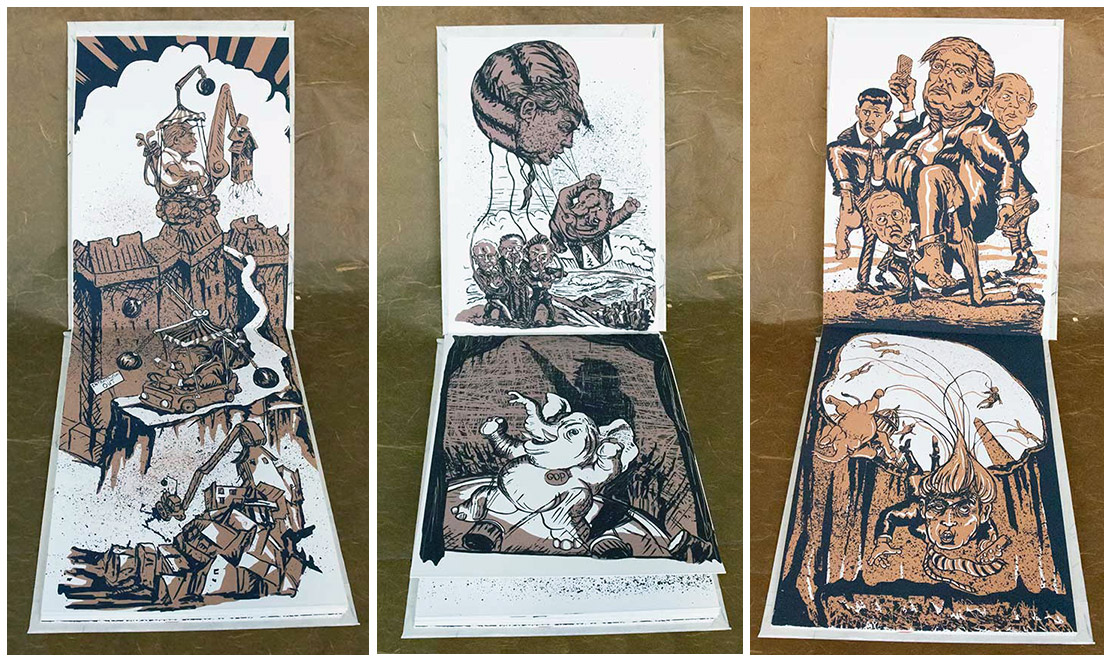
The Great Sinkhole 13 x 9.5" with 12.375 x 9"page size; 17 pages including one horizontal fold-out. Printed on Mohawk Superfine Cover. Two-color screenprints. Vertical accordion fold. Printed front and back covers. Signed and numbered by the artist. Art Hazelwood: "The Great Sinkhole is an artist book drawn from a year and a half of political street posters in opposition to the Trump madness. The images form a broad narrative including the GOP convention, Trump's open embrace of the fascist right in Charlottesville, the response to Hurricane Maria, attacks on public assistance, and Playboy models. The Republican elephant is shackled to the president and careening towards some kind of end point, whether an end point of Trump or an end point of democracy is still in question. Volume two is immediately under way." |
|
| Helpers of the Southwest: A Guide for Young Travelers / | |
| Ayudantes Animales del Sudoeste Un Guía Para Viajeros Jóvenes | |
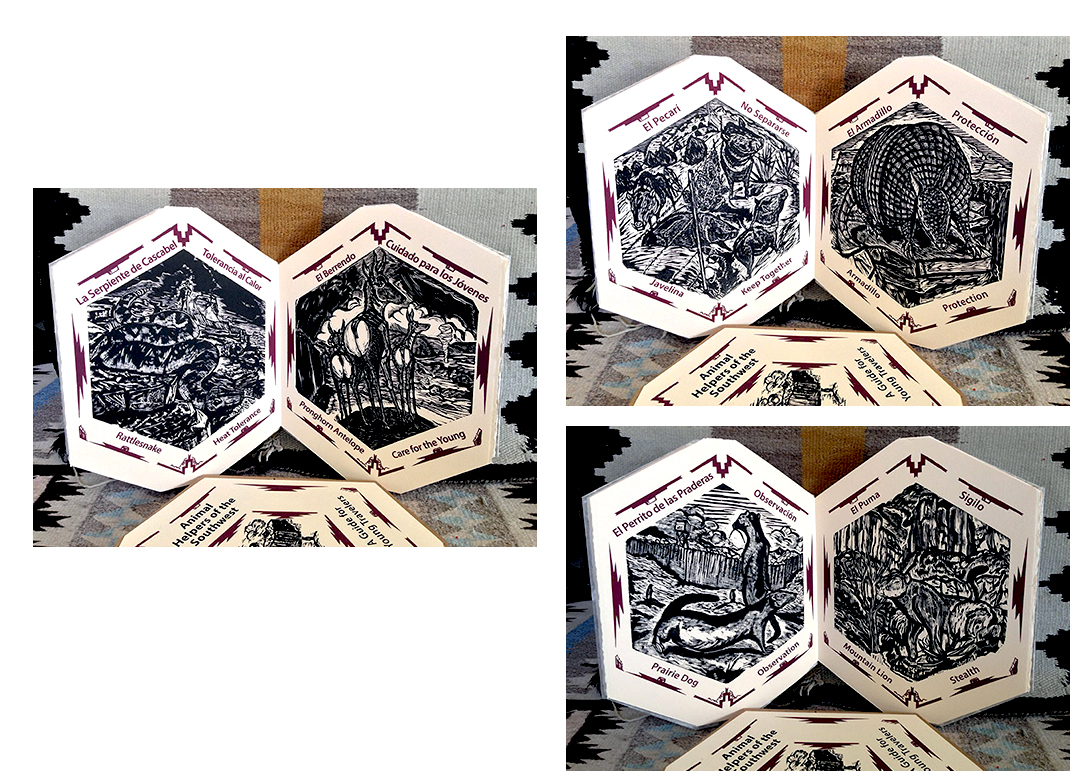
| By Art Hazelwood Richmond, California: Art Hazelwood, 2015. Edition of 25. 12 pages; 14.25 x 11.25". Octagonal shaped. Text bilingual (Spanish and English). Printed on Banks Cream Long Grain papers. 12 woodcuts with screenprinted borders and texts. Hand bound by the artist with decorative covers and screenprinted cover title. Art Hazelwood: "This handprinted book in Spanish and English text offers the viewer a series of allies in the ever more threatening passage across the desert regions of the US Mexico border. Ayudantes Animales del Sudoeste - Un Guía Para Viajeros Jóvenes, Animal Helpers of the Southwest - A Guide For Young Travelers is a book inspired both by the struggles of people as they are driven to take dangerous risks in this harsh environment, and also by the native cultures of the Southwest. "I have lived on the Zuni Reservation in New Mexico off and on for the last four years and the tradition there of small carved animal figures, called fetishes, carry with them a suggestion of protective animal spirits. The animals were not drawn from photos or direct observation. It was my intention to visualize the animal I could see in my mind, that I could see in dreams. Like the animal fetishes these animal helpers offer their specific aid. The Desert Tortoise provides water, the Kangaroo Rat night vision. As surveillance and the border wall grow out from more populous areas it drives migrants to cross in ever more dangerous places. The heat tolerance of a Rattlesnake and the guidance of a Coyote are needed. "For all the young travelers now seeking to reach family or escape other dangers at home I offer this small fetish object - a book of twelve animals in woodcut with screenprinted text and borders." $600 |
 Click image for more |
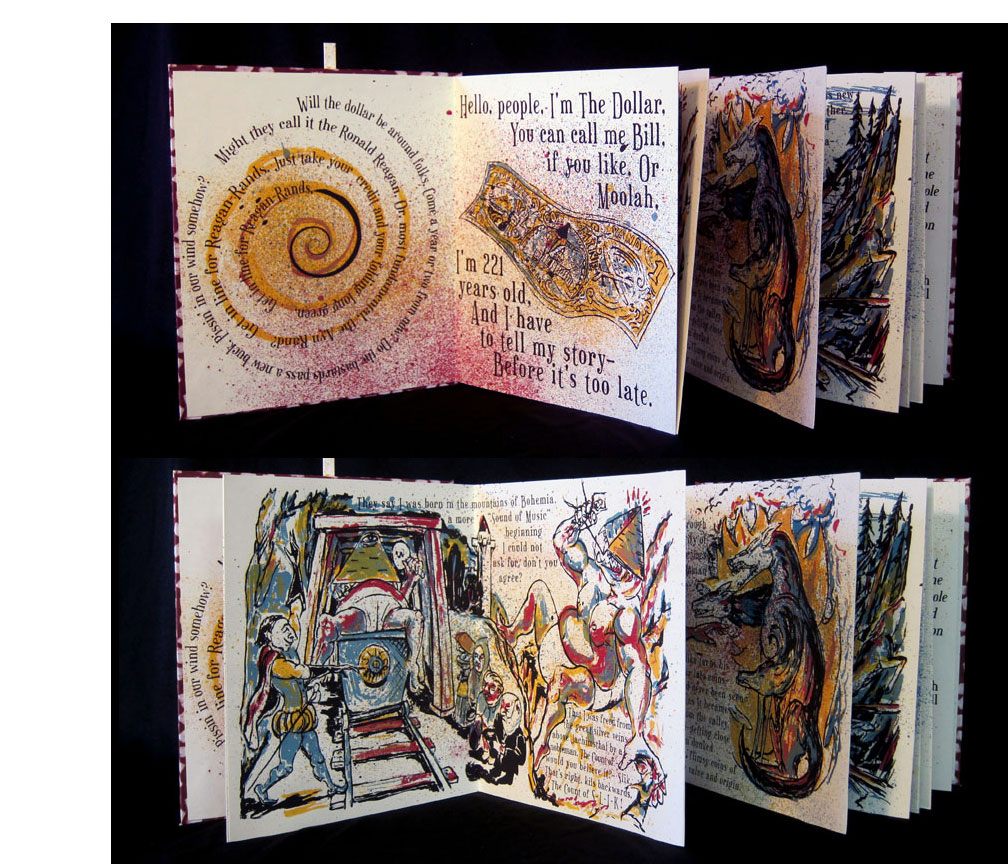
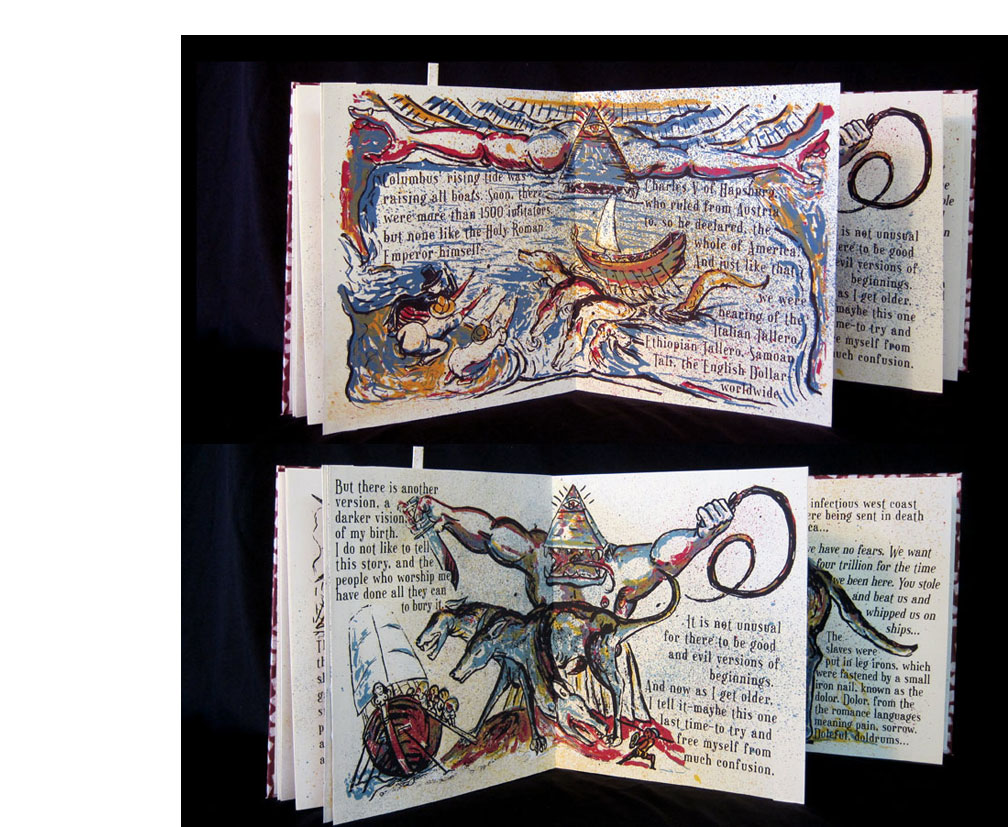
| The Dollar from Death to Birth Text by Arnie Passman Richmond, California: Art Hazelwood, 2013. Edition of 28. 8.75" x 7.75"; 16 pages. Eight full-page spreads on 16 pages. Screenprint images and text. Accordion fold with sliding (pull tab) cover image. Paper: Rising Stonehenge White. Screenprint covers. Art, design, and binding by Art Hazelwood. Signed and numbered by the artist. Art Hazelwood: "Berkeley poet Arnie Passman created a self-conscious Dollar, aware of its own dark past and uncertain future, in his text, 'The Dollar: From Death to Birth.' The Dollar speaks of its mysterious and dark roots as it prepares for a final rest. Art Hazelwood, seeing a parallel in Passman's writings and in his own obsession with the personification of moneybags and dollar bills has created an artist book that contains equal parts farce and monstrosity. The book cover incorporates the moveable head of the Dollar, which slides up and down devouring the various inhabitants of its domain. The one eyed Dollar – an American Cyclops – rampages through 500 years of history with all the savageness of the new currency on the block." $450 |
|
| Visual interpretations based on literary works | |
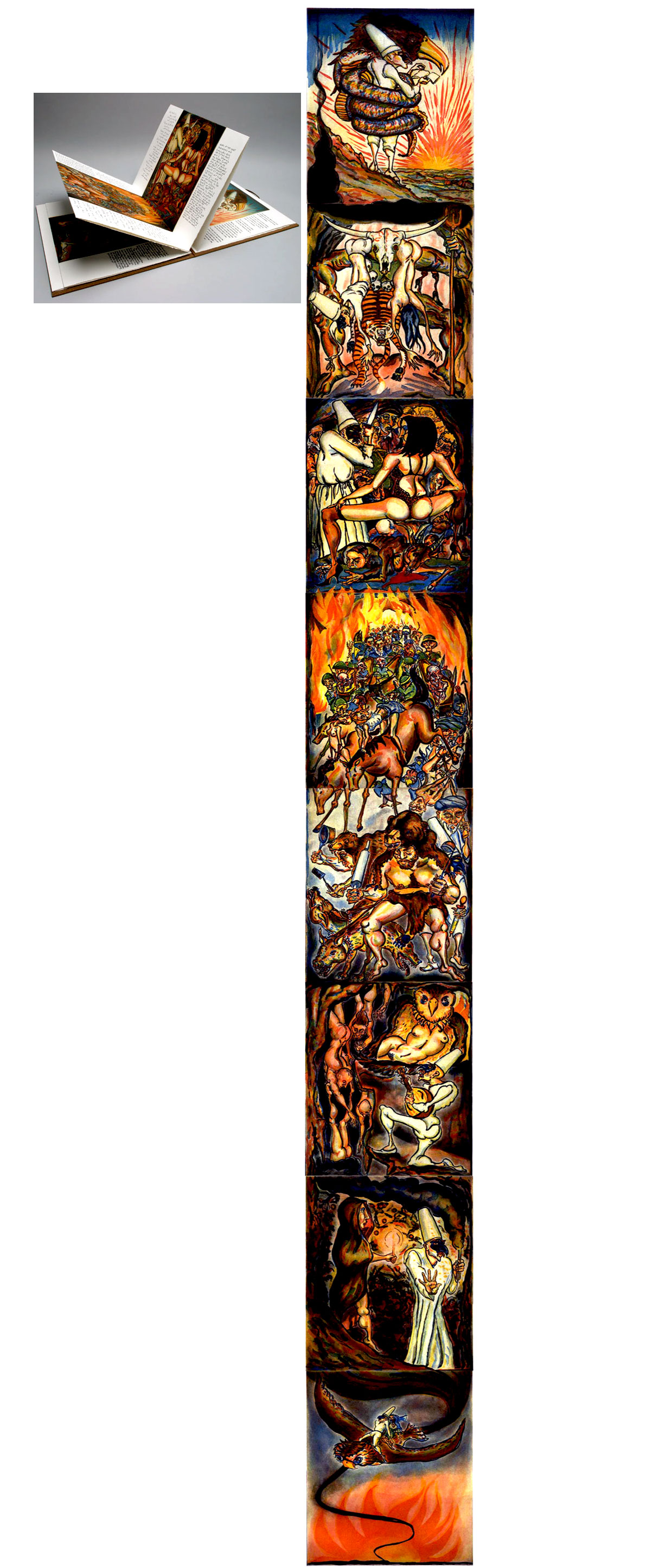
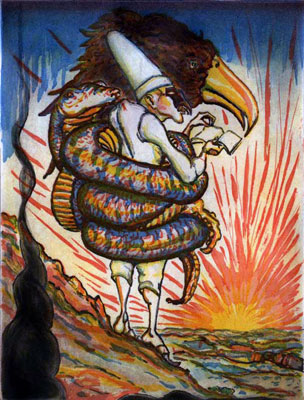
| Pulcinella in Hades By Art Hazelwood Sonoma, California: Eastside Editions, 2006. Edition of 20. 16.5 x 13" closed, opens to over 8 feet; 10 pages. Vertical accordion fold with loop for hanging and removable spine. Eight feet of continuous four-color sugar lift and spit-bite aquatint etchings printed on Hahnemühle Copperplate paper. Marginalia printed letterpress from handwritten text. Includes booklet with linocut print covers, elucidating the marginalia. Art Hazelwood: "Pulcinella in Hades is a decent into Hades in the form of an eight foot tall accordion book. The borders of Pulcinella in Hades contains marginalia texts by historical authors, written in longhand by 17 contributors. The text refers to the underworld from different writings. Pulcinella from the Commedia dell'Arte is here a stand in for Orpheus or Christ in a comic harrowing of hell… "The idea of a comedy in Hades hit me when I heard an excerpt from the comic opera Orpheus in the Underworld. Why an underworld journey should be treated as a comedy can perhaps best be explained by the tremendous amount of literature to back up the view that Hell is a merry place. Comic journeys to Hell and Hades are long standing traditions. Comedy goes to Hell…. "Seventeen people were asked to write in their own hand the literary marginalia selected to accompany the text. Many complained that their handwriting is terrible. Many were correct. " Art Hazelwood, Marginal Note on Marginalia: "In the Middle Ages written texts came in the form of manuscripts, and marginalia were an important component of the process of textual transmission. It was accepted that readers would add comments, notes and even drawings to illustrate and comment on what they were reading. In some cases, the marginalia in medieval manuscripts overwhelm the main text….Perhaps the greatest instance of marginalia gone mad is the Renaissance French philosopher Michel de Montaigne, who published an edition of his famous Essays in 1580, then went back and added comments and reflections, which he integrated into the main body of his text when he republished the book in 1588. A later edition repeated the same process. So, for Montaigne we can say that his book was literally made up out of its own marginalia.… In most early printed books there were few indexes, so marginal notes were often printed right in the text which alluded to certain sources or outlined in abbreviated form what the main text was saying. Indeed, no reader of early books can fail to be struck by the delightful marginal ciphers, comments, and drawn hands with pointing fingers used to call attention to certain important passages. Through the study of marginalia we can draw closest to the thoughts of readers from earlier ages – perhaps even more than through the study of the books themselves.… The margins are the place where the reader speaks back to the text, where alternative ways of thinking spring up around the language of 'official' knowledge." $3,000 |
|
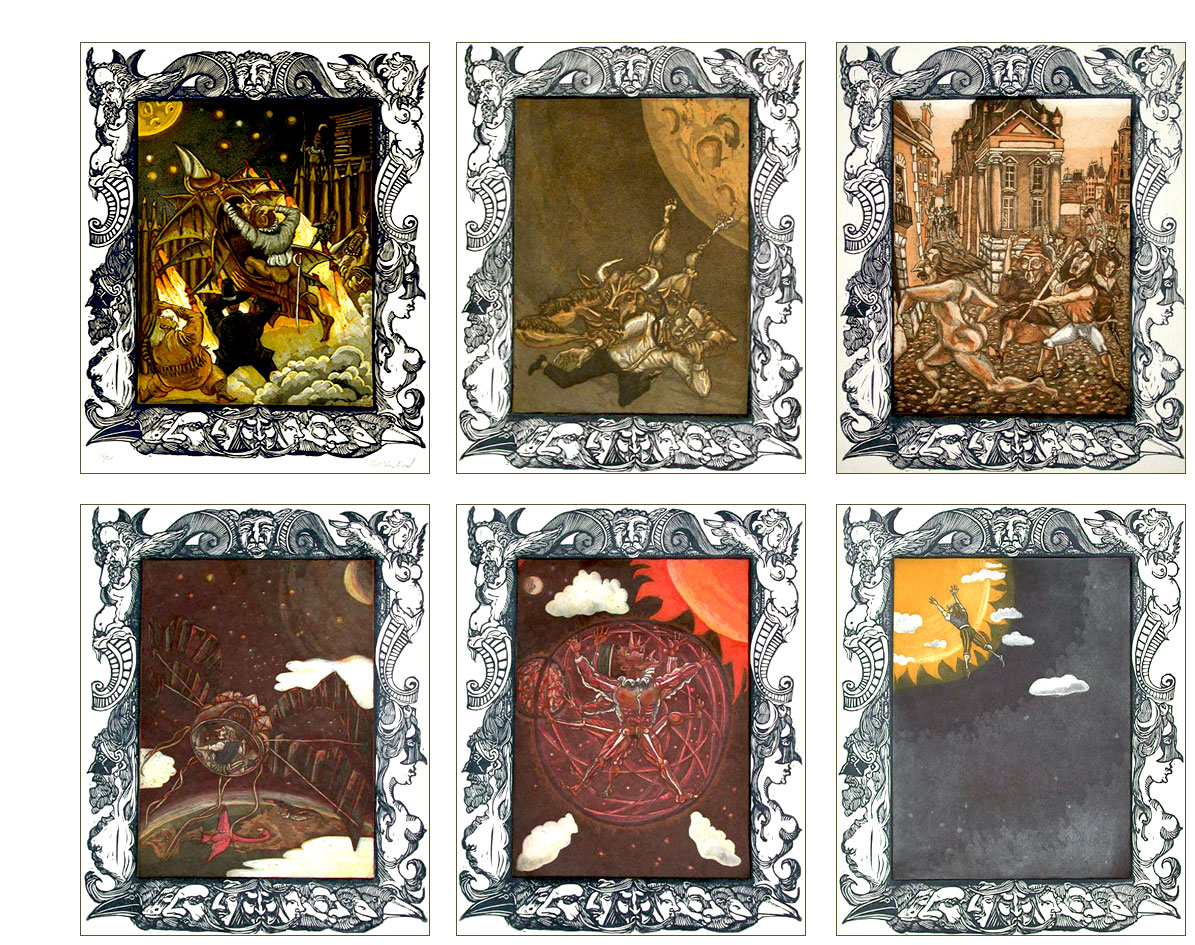
Journeys to the Moon and Sun 22 x 17"; 28 pages. Letterpress printed. Twelve multiple-plate color Colophon: "Cyrano De Bergerac was the true life inspiration for the romantic figure of Edmond de Rostand's 19th century plan and one of the more curious thinkers in early modern Europe. He was a satirist, swordsmen, poet, and philosopher who indeed had a prodigious appendage. The book, excerpts of which are translated here under the title Journeys to the Moon and Sun, consist in equal parts of sci fi, philosophical speculation, metaphysical drama, theological humor, and freak show satire. The scales of the world are turned upside down and found to be wanting. " David Berona, Image & Narrative, "Art Hazelwood: A Graphic Witness of America," 2005: "Hazelwood's third project of prints on a literary theme is based on the book, Journeys to the Moon and Sun by Cyrano de Bergerac, with twelve color etchings with linocut borders and twelve pages of text in a new translation by Timothy Hampton from the original French edition of 1662. This lively translation works hand-in-hand with Hazelwood's illustrations, which are comparable to the illustrations of the American book illustrator Howard Pyle with his bold colors and stylized figures. This imaginative interim from the previous two highly political works demonstrates the versatility of Hazelwood's draftsmanship in stylized borders that are reminiscent of the border designs by Aubrey Beardsley and William Morris." |
 Click image for more |
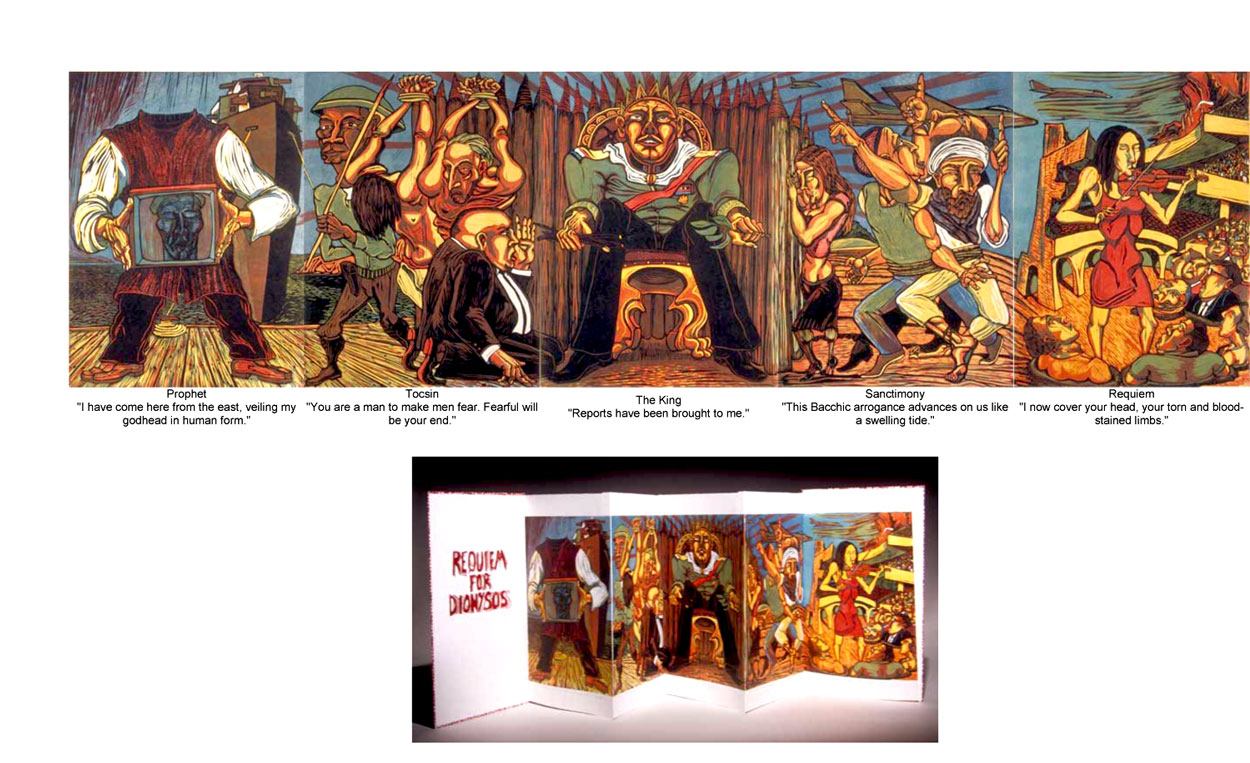
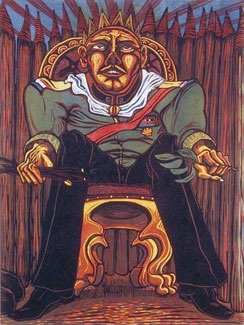
Requiem for Dionysos Art Hazelwood: "Requiem for Dionysos is inspired by Euripides' play The Bacchae and uses it as a launching point for a treatment of the current US war on terrorism. In the play the king of Thebes suspects a foreigner is inciting the people to madness and in his zeal for control he vows to uproot the evildoers. Like the current regime in the US the king believes the only logic the enemy understands is force. The king's own hubris in the end leads to the destruction of himself and his empire. "The five panels of the print are titled individually - Prophet, Tocsin, The King, Sanctimony and Requiem. A quote from The Bacchae accompanies each. While no attempt has been made to tell the story of The Bacchae in pictures the accompanying text does have resonance with the images. "In Prophet – 'I have come here from the east, veiling my godhead in human form' – a headless man holds a television with a screaming head inside. Our source of information – headless man. But the message of the text is ambivalent and points to several interpretations. The prophet is at once a metaphor for mass media and also a prophet like John the Baptist calling out for attention. And again 'veiling my godhead' suggests the secrecy of terrorism. "Tocsin carries the theme of torture and detention with the pointed message from the text: 'You are a man to make men fear. Fearful will be your end.' "In The King – 'Reports have been brought to me' – he listens to the news brought to him by victims and sycophants. He clutches the olive branch of peace in one hand and the bundle of sticks of fascism in the other. He exists in an armed camp surrounded by a fortress while his army carries out his missions. "In Sanctimony – 'This Bacchic arrogance encroaches on us like a rising tide' – three world religions bound together with a rope argue and point in opposite directions while a woman stands with head bowed pleading for help. Fighter Jets fly overhead. "In Requiem – 'I now cover your head, your torn and bloodstained limbs' – the results are seen. A stadium half destroyed stands as a metaphor for culture, while a violinist plays a tune for a half buried audience. This book was completed before the war in Iraq began but the ramifications of cultural destruction continue. "Dionysos the god of wine and joy is also the bearer of chaos and madness. He has two faces. Without him humanity is locked in a joyless life of drudgery. He reveals the depths of the soul through madness and ecstasy. Reason unrestrained by humility is madness. The irrational untethered to the ritual of tradition is chaos. Rationalism received its greatest impetus in Ancient Greece, but the limits of rationalism were also explored in the great literature of that period. In this print I have used the text of Euripides as a touchstone for our own battling dualities." |
|
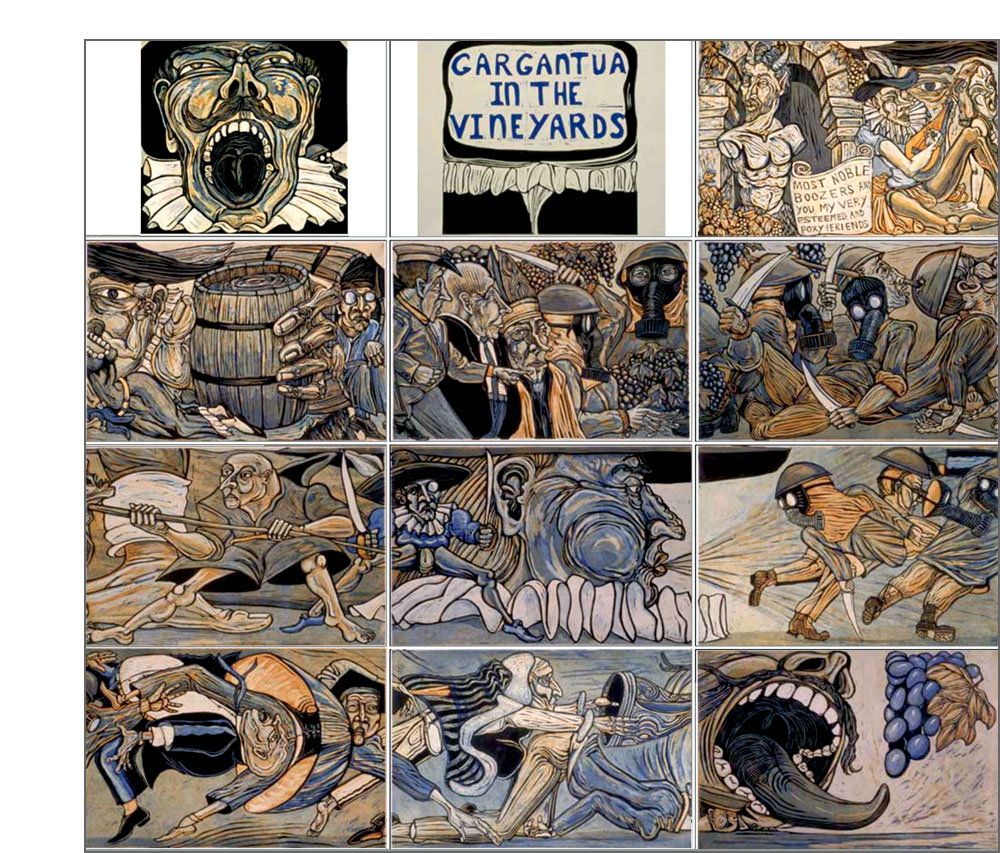
Gargantua in the Vineyard 18 x 18" closed, 18 x 270" extended. Accordion format. A continuous image book made up of 10 separate prints (multiple plates, mixed etching and linocut) joined together into one, as well as a cover image, title page, and colophon. The image area measures 12" x 180" (inches). Printed on handmade Abaca paper. Cloth covered boards with 12 x 12" image of Gargantua inset on front board. Slipcased. Art Hazelwood: "Francois Rabelais (1490-1553) and his satirical writings on the illustrious giants, Gargantua and Pantagruel, were the inspiration for this book of prints. Rabelais was a scholar of erudition, a mocker of manners, a defender of appetites, an adherent of wine, and a champion of laughter." Colophon: "This visual interpretation was inspired by an episode in Book I, Chapter XXVII: Friar John, a monk of considerable thirst, is outraged by the invading army's destruction of the grape harvest. The giant Gargantua and his allies join the battle and drive the enemies of wine, wit and wisdom from the vineyard." David Berona, Image & Narrative "Art Hazelwood: A Graphic Witness of America", 2005: "Gargantua in the Vineyards (2001) is a large color print, consisting of a linocut over two etching plates that measures 12 x 180 inches and folded into an accordion book that was published by Eastside Editions on paper, handmade in the studio. This project was aimed at storytelling within the format of an extended image....The content of this panel focuses on a literary text.… "What is visible, on the first inspection of the individual prints, is the "To appreciate the power of Hazelwood's narrative these prints should be viewed in the entire, scrolling form. The use of analogous color in these prints, the migration of figures and objects from one print to the next print, and the actions of Gargantua such as when he is holding a vat of wine in his hand, blowing away the monk's enemies, or catching a bunch of grapes inside his mouth provides points of narrative continuity." Timothy Hampton, Professor of French and Comparative Literature, University of California at Berkeley, "Rabelais in the Vineyard" 2002: "There is something about laughter that scares authority. Perhaps it is an element of violence, of a particularly potent and intimate form of violence, which erupts from within us. The uncontrolled blast of energy we call laughter fractures the surface of reality. It reminds us that our experience of the everyday world is governed by convention. We are only serious and obedient out of habit. And if our everyday world is mere habit, so is our acceptance of those who rule over us. For this reason, the great jokers of history have been seen as dangerous. "François Rabelais was a great joker. He was also the greatest writer of the French Renaissance – the French Shakespeare, if you will – and the source book for countless later writers and artists from Sterne to Balzac to Joyce, from Doré to Derain. And nowhere is the proximity of laughter and violence explored with more intensity and breadth of vision than in Rabelais's 'chronicles' of the adventures of the two giants Gargantua and Pantagruel, which Art Hazelwood has interpreted in the [Gargantua in the Vineyards]….Hazelwood's scenes set before us the dissonance between the pompous authority figures whom Rabelais lampoons and the out-sized heroes themselves, whose very bodies frequently become the stage where the tales are enacted. His images overlap and intertwine on several planes at once. They suggest both the zoom-like leaps of Rabelais's narrative, as it shifts location and context from episode to episode, and the sensual complexity of his energetic prose style. "But Rabelais is not only interested in satire. His writing cuts much deeper than mere wit, to explore the vanishing point where the destructive voice of satire leads to a vision of transformation, where laughter becomes violence and violence is undone by laughter. Rabelais haunts those places where words explode into excess or chaos, where images overflow their boundaries and change shape-permutations signaled here by the metamorphic energy of Hazelwood's forms, which seem to unfold, one from another. "It is beautifully appropriate that these images should come to us in book form. For, as one of the first European writers to exploit the technology of the printing press, Rabelais understood the power of the book and the danger contained in words and images. He also knew that the best art is art which can't be easily categorized or contained. Rabelais's books are like their exorbitant protagonists, oversized and exaggerated, filled with lists, puns, and jokes. They blend the learned and the popular, the epic and the trivial. Hazelwood's figurative style evokes Rabelais's linguistic exorbitance. And it bridges the historical gap between Rabelais and our own moment, suggesting certain features of Renaissance book illustration while rendering them completely contemporary…. "In Gargantua [in the Vineyard] the fragility of community is represented in the beautiful image of the vineyard and the motif of wine which runs throughout the work. Wine in Rabelais may be interpreted in any number of ways – as the nourishment of body and spirit (going back to the Song of Songs), as the elixir which binds community at any meal, as the sacramental blood of Christ which founds Christian Europe. The garden-like vineyard and the life force which it represents are constantly in danger in Rabelais's world. Still, they may be the only thing worth dying for. The confrontation between Rabelais's giants and the forces of reaction and dogmatism as they battle for the vineyard speaks directly to all moments in history – not least to our own, when cliché, doctrine, and false piety threaten the power of laughter and creation. Hazelwood's panorama renders, in stark fashion, the stakes of the Rabelaisian battle. The dynamism of the presentation – with its puffs of wind, bursts of laughter, and the pulse of appetite reaching for the succulent grape – directs us beyond battle, to the creative force that heals community." |
|
| Hazelwood's artistic journey began with his extensive travels throughout Asia, Europe, North Africa and the United States. | |
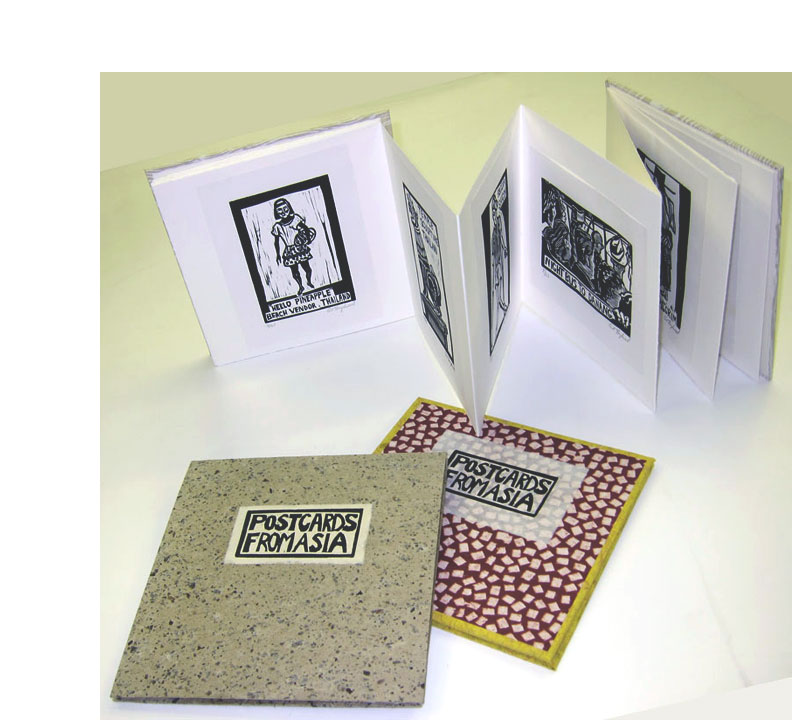
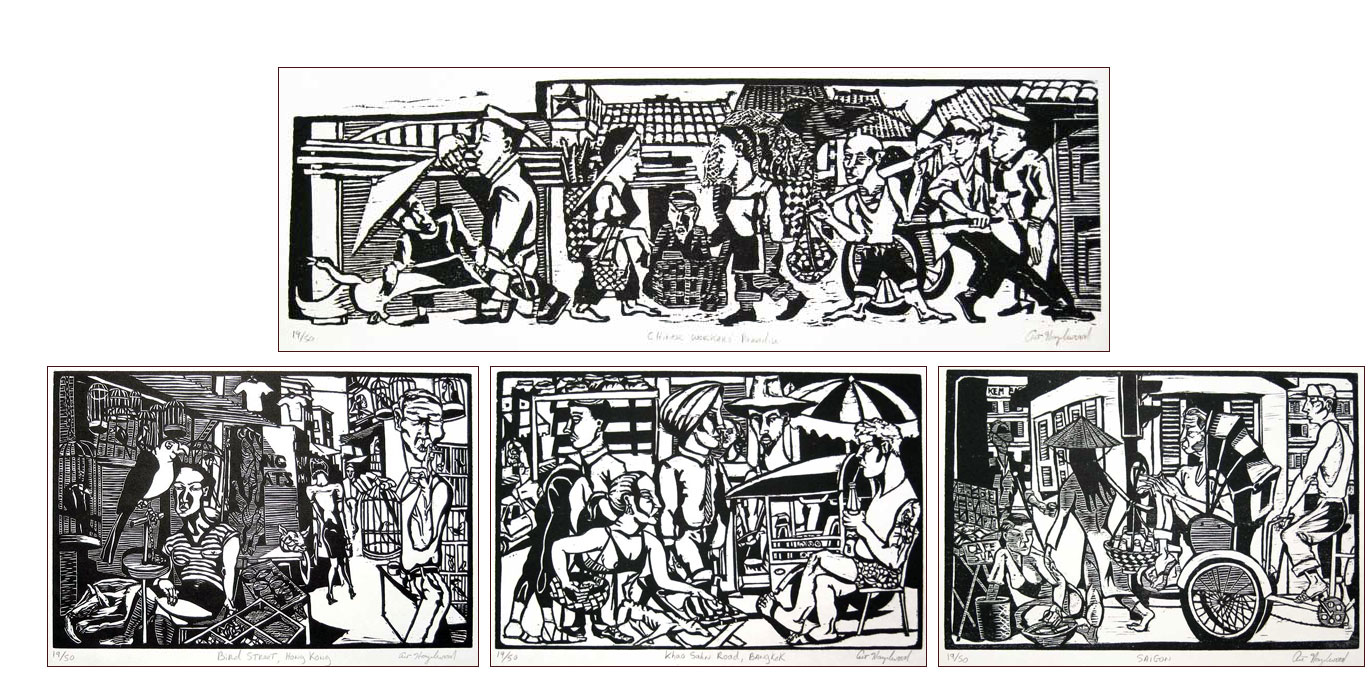
Postcards from Asia 9.5 x 9.5" closed, extends to 108"; 12 pages. Accordion structure. Woodcut images printed on white paper, which has been tipped onto heavyweight cream wove support paper. Bound in wood-grain design Japanese paper-covered boards. Each image signed and numbered by the artist. An accordion-folded collection of woodcuts by Art Hazelwood of images of people and scenes from Asia. This book is an offshoot of his print series Walking Up and Down in Asia. Art Hazelwood: "From 1986 to 1993 I traveled around the world, living in Europe and Asia and in various parts of the States. My primary interest however was traveling in Asia. The intensity of travel lured me on to see more and more. Experiences of people and places left their mark and I have tried to give back some of that feeling. The Tibetan nomads, Vietnamese 'cyclo' drivers, Japanese 'salary man,' Sikhs, Thais, and Uyghurs that make up this series are the actors on an impossibly crowded world stage. It is this sometimes overwhelming encounter with the world that these prints seek to express. "Prints in this series include images of the following countries: China, Tibet, Hong Kong, Macau, Japan, Singapore, Vietnam, Thailand, India, and Pakistan. The production of this entire series makes up a period of 14 years from first trip to bound book, although the body of the prints were cut in the mid to late 90's." "Review of Walking Up and Down in Asia," Berin Golonu, Artweek July/August Edition 2000: "When people embark on their travels, they often record their adventures in snapshots or in travel journals. Art Hazelwood has taken a more time-honored approach to recording the memories of his travels throughout Asia. After sketching his observations on drawing pads, Hazelwood creates woodcuts of his impressions in a graphic folk style. Flattened perspectives give added emphasis to an all over patterning, with crowded compositions that fill every square inch of the picture frame. Hazelwood's dynamic genre scenes and landscapes at once emphasize the frenetic activity of a dense urban metropolis such as Tokyo or Hong Kong, while at the same time, capturing the more leisurely way of life led by the region's rural inhabitants." |
 Click image to enlarge |
| Walking Up and Down in Asia Sixty Woodcuts By Art Hazelwood Richmond, California: Art Hazelwood , 2000. Edition of 10. 16 x 18"; 72 pages. Sixty woodcuts printed by the artist on Masa paper in editions varying in size from 25 to 50 of which numbers 11 - 20 were bound by the artist in a hand-sewn hardcover book format. Prints tipped onto Arches cover text paper. Each print numbered, titled, and signed. Art Hazelwood: "From 1986 to 1993 I traveled around the world, living in Europe and Asia and in various parts of the States. My primary interest however was traveling in Asia. The intensity of travel lured me on to see more and more. Experiences of people and places left their mark and I have tried to give back some of that feeling. The Tibetan nomads, Vietnamese 'cyclo' drivers, Japanese 'salary man,' Sikhs, Thais, and Uygurs that make up this series are the actors on an impossibly crowded world stage. It is this sometimes overwhelming encounter with the world that these prints seek to express. "Prints in this series include images of the following countries: China, Tibet, Hong Kong, Macau, Japan, Singapore, Vietnam, Thailand, India, and Pakistan. The production of this entire series makes up a period of 14 years from first trip to bound book, although the body of the prints were cut in the mid to late 90's." Berin Golonu, Artweek July/August Edition 2000, 'Review of Walking Up and Down in Asia': "When people embark on their travels, they often record their adventures in snapshots or in travel journals. Art Hazelwood has taken a more time-honored approach to recording the memories of his travels throughout Asia. After sketching his observations on drawing pads, Hazelwood creates woodcuts of his impressions in a graphic folk style. Flattened perspectives give added emphasis to an allover patterning, with crowded compositions that fill every square inch of the picture frame. Hazelwood's dynamic genre scenes and landscapes at once emphasize the frenetic activity of a dense urban metropolis such as Tokyo or Hong Kong, while at the same time, capturing the more leisurely way of life led by the region's rural inhabitants. "The artist first traveled to China in 1986, and has since developed somewhat of a love affair with Asia, having revisited the continent extensively over the past fourteen years. More than sixty woodcuts comprise Hazelwood's Asia series, on view at the Fetterly Gallery in Vallejo. The artist's enchantment with this region of the world and its people comes through in his images, which record travels in China, Hong Kong, Macau, Japan, Singapore, Vietnam, Thailand, India and Pakistan. Such sentiments prove to be infectious, for in looking at Hazelwood's woodcuts, we cannot help but be tempted to partake in a similar journey by following the artist's travel routes." $2,000 |
|
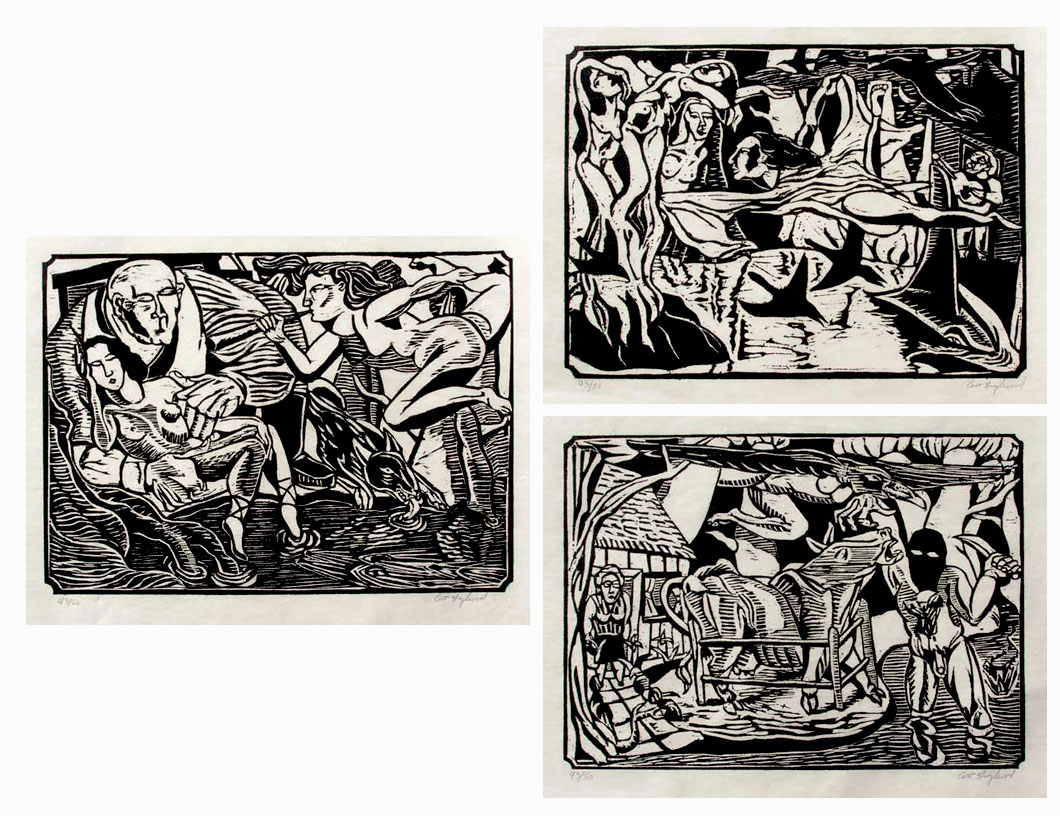
Forest Song 9.5 x 13"; 22 pages. Printed on Mulberry paper. Woodcuts. Marbled paper pastedowns. Bound in paper covered boards with cloth spine. Stab binding. Art Hazelwood: "Forest Song is a book of 12 woodblock print images and 11 woodblock text images describing a subconscious journey through illness to restored health. The prints grew out of a period of illness in India. I was traveling for several months in Asia and found myself quite sick in Dharamsala, India, home of the Tibetan government-in-exile. There I stayed for two months being treated by Tibetan doctors and living in a hotel/monastery so that every morning at 3 a.m. I would awaken to the sound of chanting monks. A mysterious environment to be sinking into the lethargy of illness. The slow recovery and its accompanying sense of inwardness is the feeling out of which this series came. Although it shows no outward reference to the surrounding environment or my illness the prints are psychologically representative. The text was written by me to add to the atmosphere of mystery rather than as explanation." |
 Click image for more |
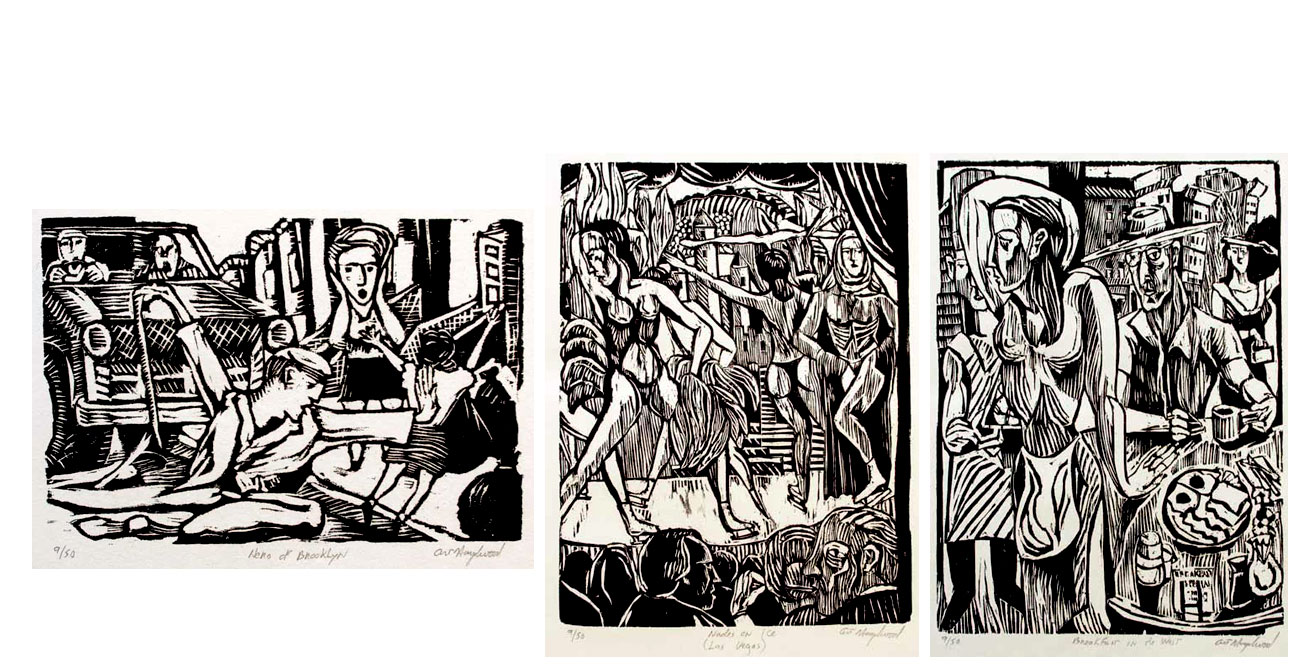
| Promenade - A Voyeurs Guide to America 26 Woodcuts By Art Hazelwood Santa Fe, New Mexico: Art Hazelwood / Epigone Press, 1989. Edition of 50. 10.75 x 16.9" ; 22 pages, one being a five-panel fold out. Printed on Masa paper. Bound in paper wraps with woodcut title illustration on front cover. Sewn binding. Each woodcut numbered, titled, and signed. Epigone Press: "This unconventional travel guide to America chronicles the experience of an artist on the road described through 26 woodcut prints. The prints range from events like a rodeo and happy hour, to Chicago on the day of the stock crash of 1987, to a jazz club in New York and a wrecking yard in Jamaica Queens, along the way it includes murders, car wrecks, and homecoming parades. Over the nine month period that the artist traveled around the country he camped in snow storms, and in swamps, worked as a janitor, and cut the wood blocks that make up this book." Judith A. Hoffberg, Umbrella, June 1994, Vol. 17 No. 2: "There is a nervousness to his line to generate the energy that America represents, and (the) reflection of the workers of America...makes this book surge with vitality and electricity ...Whether voyeur or witness, Hazelwood's eye is right on!" $900 |
 Click image for more |
| Art Hazelwood: “Does political art have an impact on the world? The right wing response is to say art never stopped a war, art didn't stop lynching, art didn't save the I-Hotel nor did it end repressive attacks on homeless people. But art does not exist in a vacuum. It is a part of culture. And political art that stands up to the repressive forces of society is a part of the culture of change. Political art does have effects in the real world, it is clearly part of the force, not the only force, but part of the force that keeps the human spirit alive. It keeps the flame of justice burning. It keeps memory alive. It moves with the struggles and moves those struggles forward.” | |
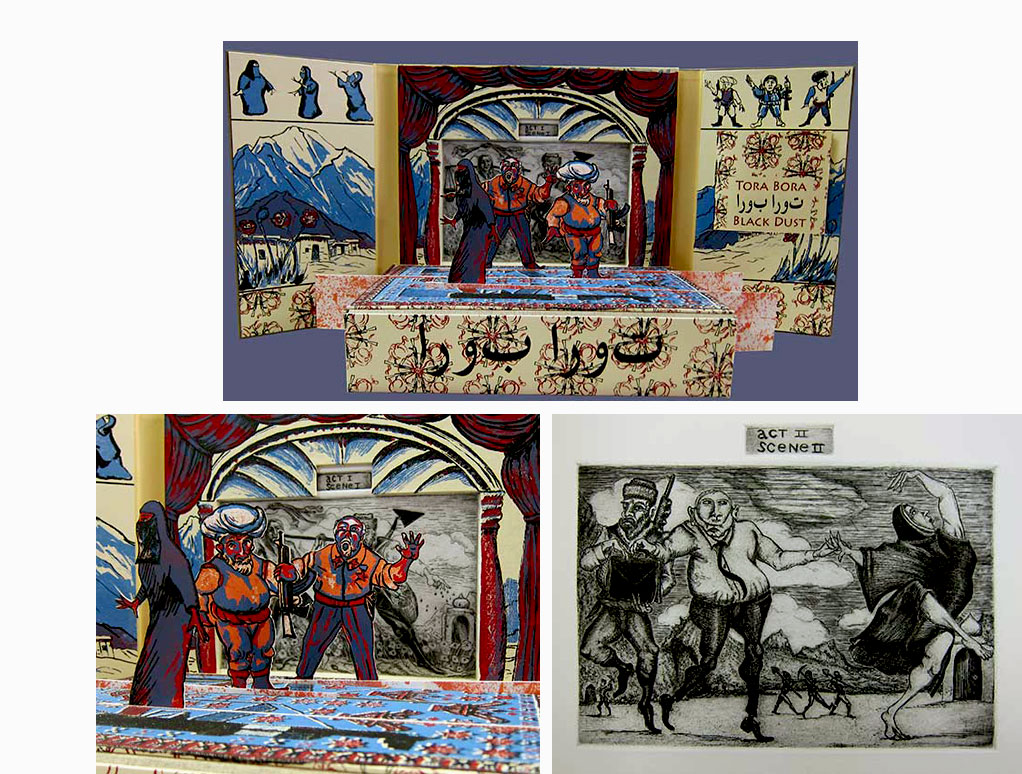
Tora Bora 12 x 13" fold-out boxed opera set with screenprinted covers. Includes miniature stage set, seven two-dimensional puppets that fit into groves in the stage floor, six engravings that act as changeable background drops, and a booklet with libretto. Engravings printed on Hahnemühle Copperplate paper and Lana Gravure paper. Screenprints printed on Hahnemühle Bugra paper and Arches Watercolor Hot Press paper. Booklet (8.5 x 5"; 24 pages) printed on Mohawk Superfine and set in Verlag, Chronicle Text, and Lithos Pro. Signed by Hazelwood. Art Hazelwood: "Tora Bora is a reverse engineered opera. The Seventeenth Century etcher Jacques Callot’s illustrations of scenes from operas inspired the thought—what if all that remained of an opera were etchings from a few scenes? How, for example, would the Magic Flute be reconstructed from that? With this in mind Art Hazelwood and Klaus-Ullrich Rötzscher began this collaboration. "Art Hazelwood engraved the six scenes from the opera Tora Bora. Tora Bora is the name of a mountain cave complex at the center of Afghan contemporary history. The CIA funded the expansion of the caves there to help the Mujahedeen fight the Soviets. The Taliban used them, and it was Osama Bin Laden’s last known address, from where he escaped capture by the US. Even now poppy production and Taliban activity is rampant in this rugged mountain area twenty miles from the Pakistan border. "The opera is presented in a fold out stage with screen printed covers. The viewer moves through the various scenes of the opera while reading the storyline and lyrics in an accompanying booklet and using seven puppets to enact the scenes. Should a full scale opera appear it will be staged on a larger stage." Two young Afghani lovers – Jaweed and Sitara – never have a chance. Buffeted by the storm of contemporary events – poppy growers, Soviets, Mujahideen, Taliban, CIA, Northern Alliance, US military – their doomed love is perfect opera material. |
|
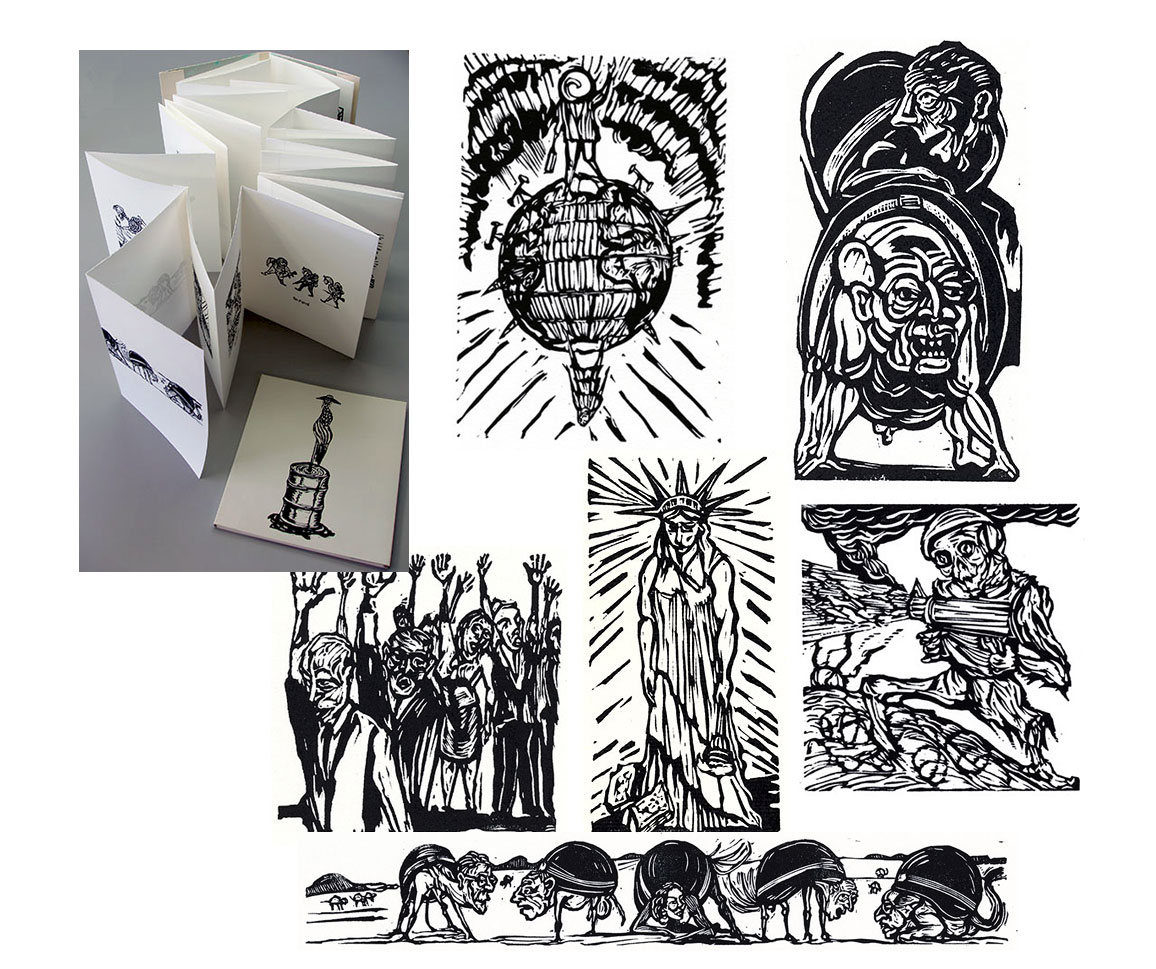
Into Iraq Art Hazelwood: "At the beginning of the Iraq war it seemed like a bad idea. At the end of George W. Bush's final term in office it was a bad idea that had fossilized. This bound set of prints is the bookend to Hubris Corpulentus, a series of engravings done in the first year of the war. Into Iraq consists of small linocut prints each one more full of bile than the previous. The subjects range from the battlefield to the media, to the neocons and the Congressional enablers in Washington. Oil Flag, Patriotic Tune, Sacrifice of Liberty, The President in his Labyrinth are some of the titles. "These linocuts were all created in the last years of the Bush administration. Several were used as the basis for posters. In the last months of the Administration during the 2008 elections the whole series was exhibited in Oakland at the now defunct Front Gallery. It took from that time to the present to print and bind the thirty books. But it is a good time for us to recall George W. Bush. It is a good time to recall the path that led the country on its downward cycle. It is a good time lest we think he or his ilk have disappeared or worse that they have any good ideas at all." |
|
| Art Hazelwood Out of Print Title: |
|
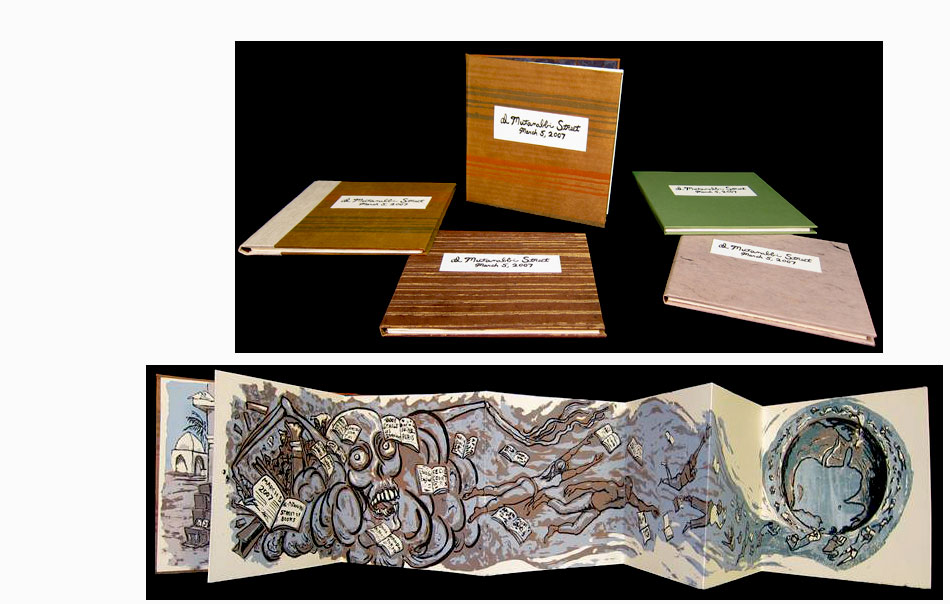
| Al Mutanabbi Street, March 5, 2007 By Art Hazelwood San Francisco: Art Hazelwood, 2011. Edition of 16. 7.5 x 7.75" closed; extends to 43"; 9 pages. Modified accordion fold. Bound book with screenprinted images and text. Unique cover for each book in the edition. Title label tipped on. Signed and dated by the artist. Art Hazelwood: "This book is based on the car bombing of a street of booksellers in Baghdad. Beau Beausoleil, a bookseller in San Francisco, initiated this project to memorialize this attack on the culture of the book and prevent it from slipping into forgetting among the many atrocities of the Iraq War. He's asked 130 book artists to contribute — the number of books matching the number of victims that day. This is my contribution. Three from the edition go to the project one of which will be offered to the Iraq National Library in Baghdad. "My book, starts with an image of the booksellers street. The next page begins a foldout which begins with the explosion in a death head cloud. Books flying are labeled with different bookseller areas of the world". (SOLD) |
 Click image for more |
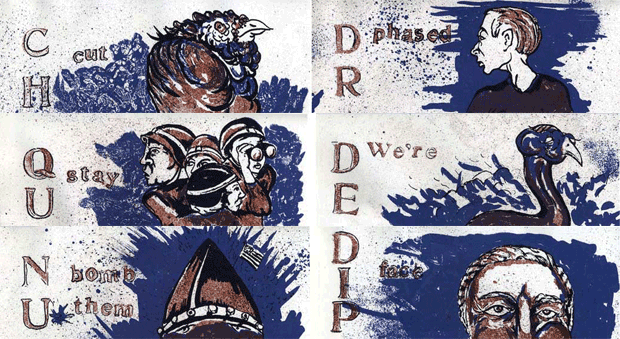
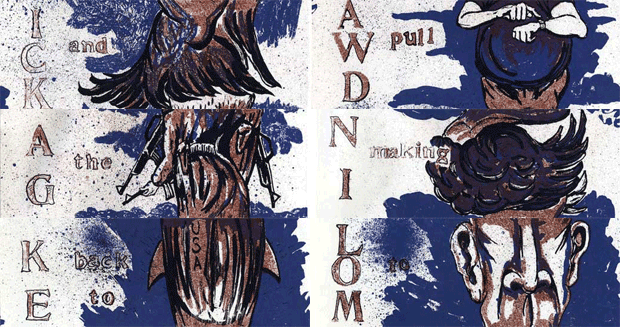
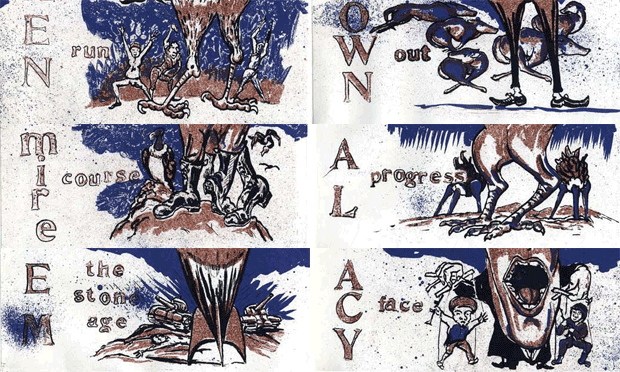
Exit Iraq 11 x 10.5"; 6 leaves. Split page mix and match book. Screenprinted. Sewn binding with screenprinted paper wraps. Signed, dated, and numbered by the artist. Each image is cut in thirds to be flipped and rearranged to the viewer's preferences. Art Hazelwood: "In 2007 the Bush Administration wouldn't accept the Baker/Hamilton Iraq Study Group Recommendations. They wouldn't accept the voters' recommendations. "It seemed a good time for a handy mix-n-match exit strategy guide. As it turns out ... this is exactly how the US got out of Baghdad. By the random interchange of six basic strategies: Cut and Run, Stay the Course, We're Making Progress, Phased Pull Out, Bomb 'em Back to the Stone Age, and Face to Face. "There are 216 possible exit strategies for Iraq created here." |
|
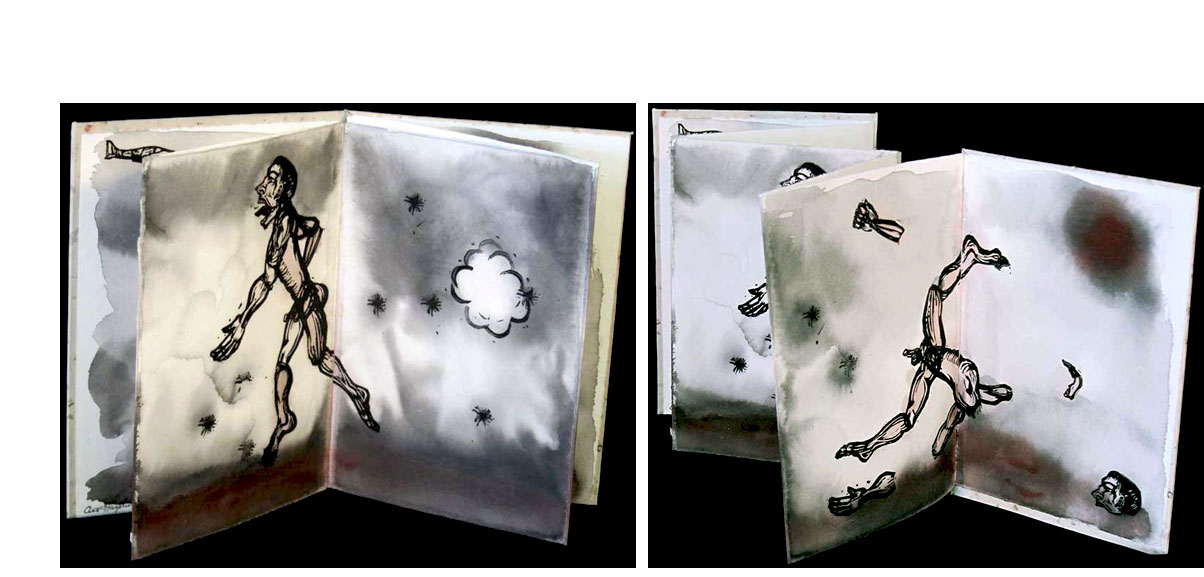
Three Airplanes Art Hazelwood: "Three Airplanes was one of four unique books made with rubber stamps carved by the artist in the early days of the Iraq War. The other books included 'Mission Accomplished' and 'We’re Making Progress'. All the books focused with irony on this great military blunder. The theme of this short book is the idiocy of war and the immediacy of death as seen in the sequence of a character running from the airplanes and then dismembered by the attack." |
 Click image for more |
Page last update: 04.05.2025

Home | About Us | Contact Us | New Arrivals | Fine Press & Artists' Books | Broadsides |Resource Books | Order/Inquiry
Copyright © 2021 Vamp & Tramp, Booksellers, LLC. All rights reserved.