
|
Share this page: |
|
Caren Heft: “My work is political in nature, as I worry about issues of equality, choices made by and for each of us and questions raised by those issues and choices. “As a letterpress printer, I am interested in type, paper, book forms, and text, not necessarily in that order. Type is increasingly difficult to obtain. I have a fair amount of type, but only a few fonts that I like to use for text. Type is idiosyncratic, usually somewhat worn or damaged (especially the wooden type) and beautiful for all of that.” |
||
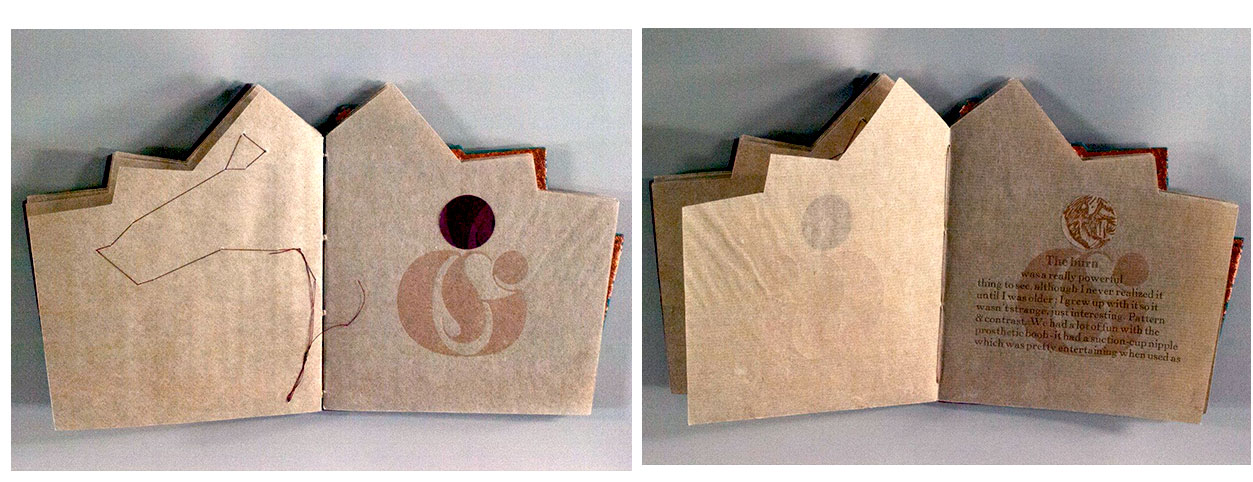
| BURN By Lisa Beth Robinson Steven Point, Wisconsin: Arcadian Press, 2014. Edition of 35. 5.25 x 6"; 32 pages. Letterpress printed with Michael Bixler's Cochin Light, Bodoni, and one wood letter. Handmade Root River Mill flax by Brian Borchardt, Jeff Morin, Lisa Beth Robinson, and Caren Heft. Paper-covered boards with jagged top edges. Copper breast made by blacksmiths Mindy and Mark Gardner attached to front board. Numbered. Lisa Beth Robinson relates the ordeal of her mother's breast cancer, which occurred in 1973 when Lisa Beth was five and her brother, Draco, was three-and-a-half: "a hard dose of radiation combined with a mastectomy and the removal of local lymph nodes" was the "cure" then. Watching her mother ("until I was a teenager I never saw a woman with two breasts") has had strong influence on Robinson's sense of her own body. $250 |
||
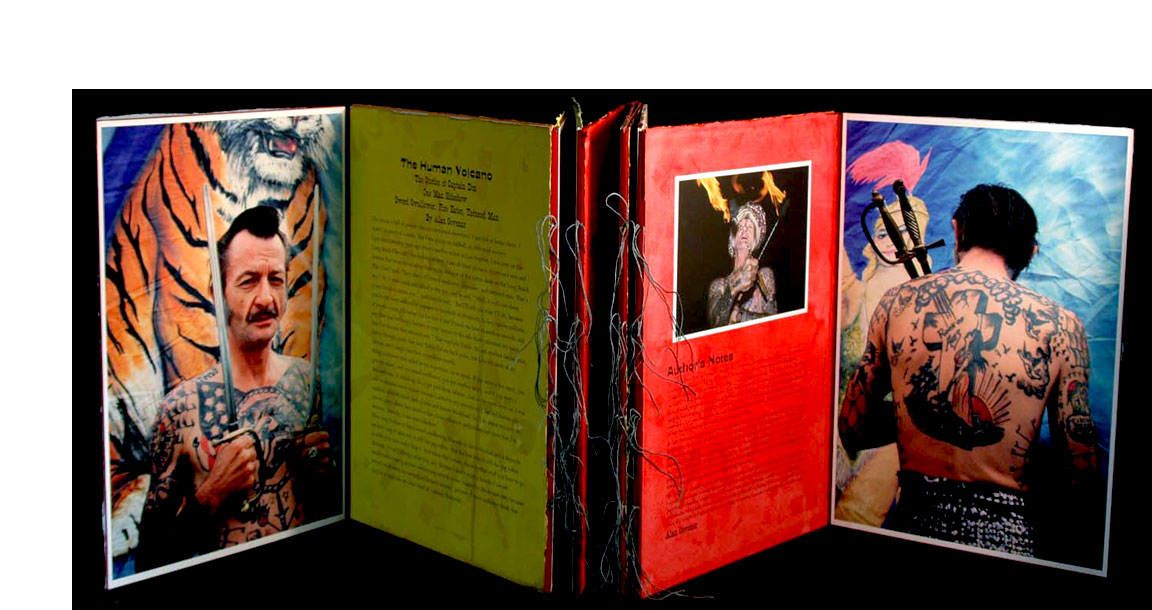
| The Human Volcano: the Stories of Captain Don, One Man Side Show, Sword Swallower, Fire Eater and Tattooed Man By Alan Govenar Racine, Wisconsin: Arcadian Press, 2013. Edition of 35. 10.25 x 15 x 1.5" double-sided accordion. Letterpress and photographs on handmade and altered papers. One side employs vintage wooden type. Presented in a bright orange wooden box that has been decorated by smoke. Laid into a niche in the box bottom is a DVD (10 ½ minutes) of Captain Don performing and talking about his career. Arcadian Press: "The is a documentation of Captain Don Leslie, a carnival midway sword swallower, tattooed man, fire eater (human volcano), block head, human pin cushion and others. Captain Don, December 26, 1937 - June 4, 2007, spoke extensively with [Alan] Govenar before his death about his life in the carnival and how it worked. For example, each act was paid, so several acts meant several paychecks. The text is a poignant glimpse into a world most of us have never considered. The book is accompanied by a DVD by Govenar featuring Captain Don." $1,800 |
||
| they were mean as snakes By Caren Heft Racine, Wisconsin: Arcadian Press, 2013. Edition of 15. 11.5 x 18" single sheet. Broadside letterpress printed on two different substrates: Root River Mill abaca by the artist and River Run Paper produced by the University of Wisconsin Stevens Point papermill for the art department. Intaglio print with a lino cut snake. Beading added. Signed by the artist. Broadsides produced by Caren Heft in an invitational monoprint workshop at University of Wisconsin - Stevens Point in the summer of 2013. The image is from a photograph of Heft's mother with her siblings. "My mother's siblings were mean as snakes. … I remember my mother coming home from all of her family gatherings weeping and my father saying, 'I told you not to go.'" $125 |
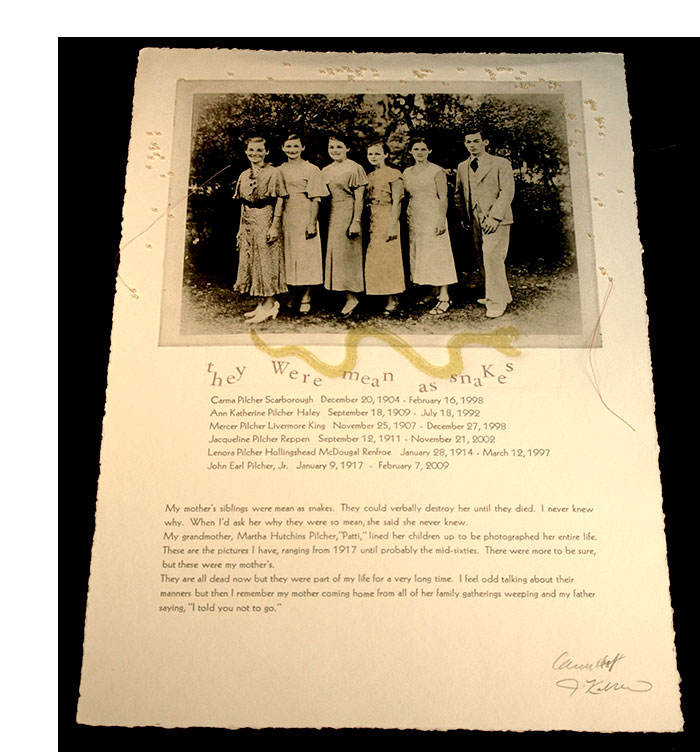 River Run Paper version Click image to enlarge |
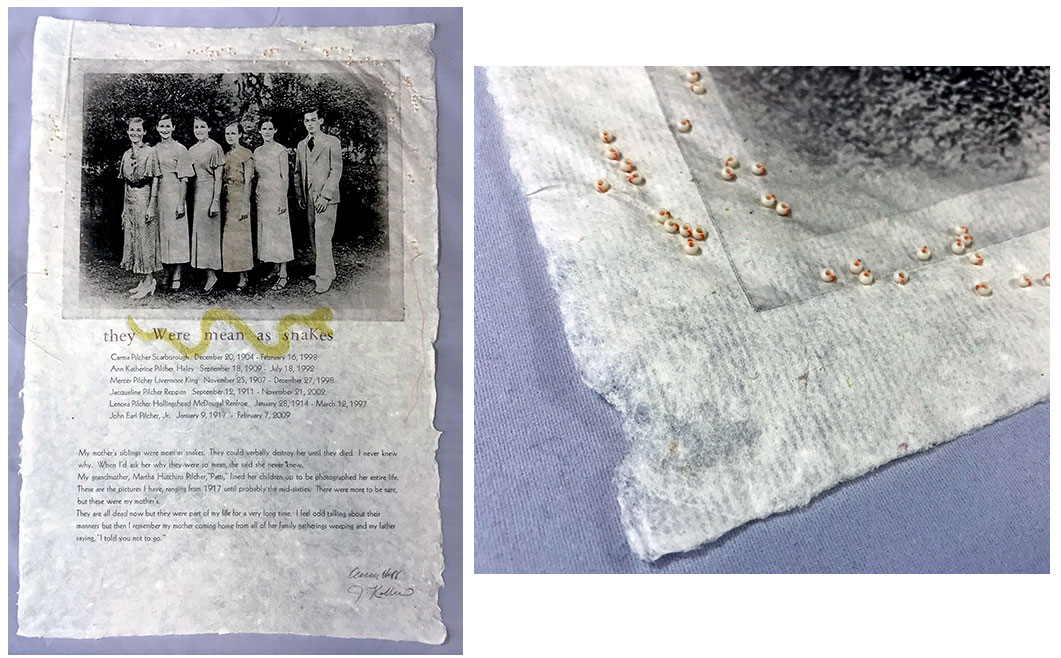 Root River Mill abaca version Click image for more |
| Crossing the Tigris By Caren Heft, Jeffrey Morin & Brian Borchardt Stevens Point, Wisconsin: Arcadian Press / sailorBOYpress / Seven Hills Press, 2011. Edition of 60. 6.75 x 10.5 x 2" box containing three books each with 36 pages. Letterpress printed. Type: Plantin. Collage and inclusion elements. Handmade paper. Handsewn binding. Four sided drop letterfold container with twine tie closure. Jeff Morin: "A narrative in three books recounting soldier's stories from the Iraq War. This is a collaborative project between Jeffrey Morin, Caren Heft, and Brian Borchardt. The collaborators each found stories in the media that recount horrific situations that are inconceivable to those who work regularly with current or former soldiers who happen to be students or artists." Statement by the presses: "The container for this collaboration is meant to embody the conundrum of this person who transforms into a beast capable of horrendous acts against innocents. The outside of the container is collaged in the same way that a boy might decorate his hiding place for treasures found. The elements, like currency, targets, or stamps, are in the realm of childhood values. The inside of the container sets the stage for juvenile battle. These are the props for pretend war. When confronted with the grittiness of war, do these ill-prepared young men simply break with reality? Are they taught that they are above the law? Or do they learn to devalue what is not obviously American? Neither the container nor the three books answer the questions posed above. We all know young soldiers who have served or those who could serve. This collaboration is intended to catalyze a conversation about the nature of change that allows potentially decent people to commit indecent acts." $2,100 |
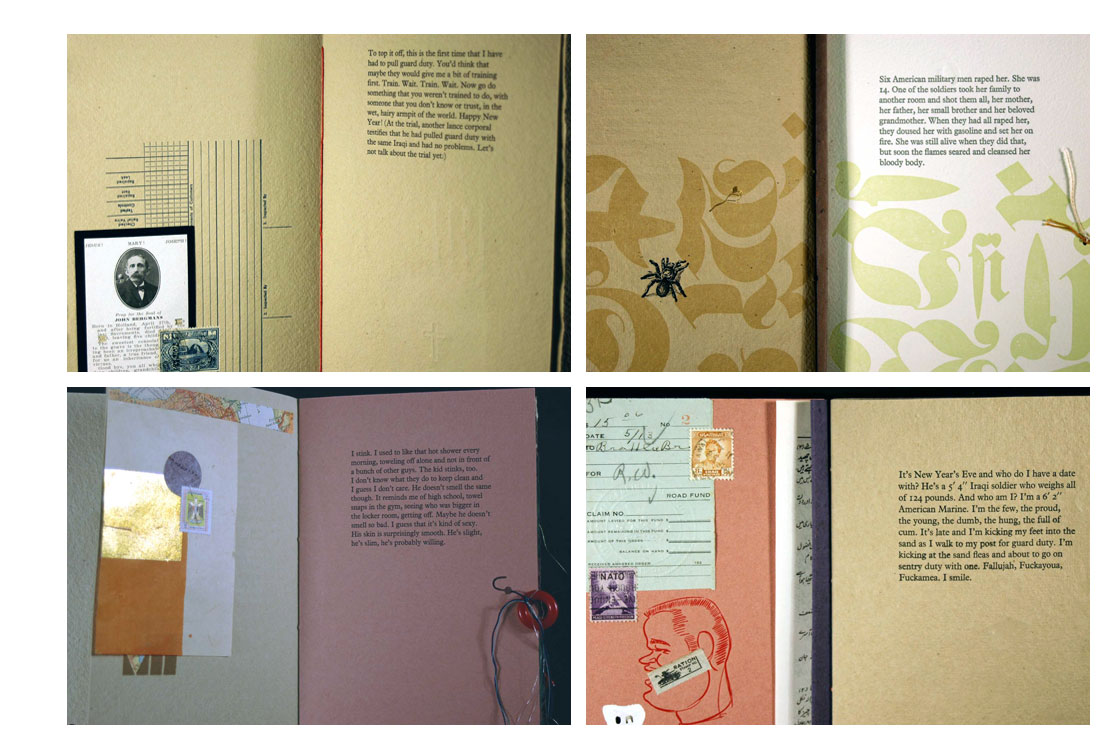 Click image for more |
|
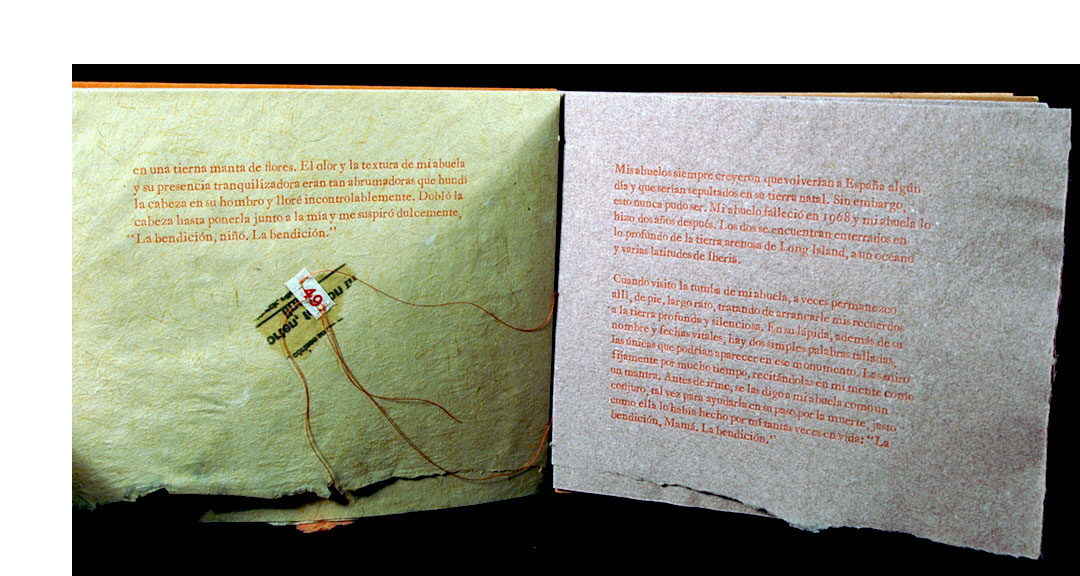
La Bendición 7.5 x 7 x 1.5"; 40 pages. Text in English and Spanish. Text type: M & H Caslon, purchased for the project (for the Spanish accents). Titling type: a variety of Caslon. Handmade papers. Exposed spine binding with glass covers. Laid in cloth covered clamshell box with suede lining. Colophon: "Max Yela is Head of Special Collections at the University of Wisconsin-Milwaukee Libraries. He is of Spanish and Guatemalan-Mexican descent, with a strain of Puerto Rican culture mixed in. La Bendición was told as an oral story for decades. When Caren Heft requested the story for the press in the mid-1990s, it proved particularly resistant to encoding. In 2005, Max recited an especially good rendition of the story to book artist and storyteller Leonard Seastone at the Artists' Book Conference in Wellesley, Massachusetts. Max determined to write the story as he told it to Seastone, and feverishly committed it to paper on the plane from Boston to Milwaukee." The sense of cobbled elegance in this presentation, which combines various handmade papers and inclusions along with Yela's story, pays proper homage to the matriarch of Max Yela's family, his grandmother – Herminia Rodriguez Sanchez (1898-1970). |
|
|
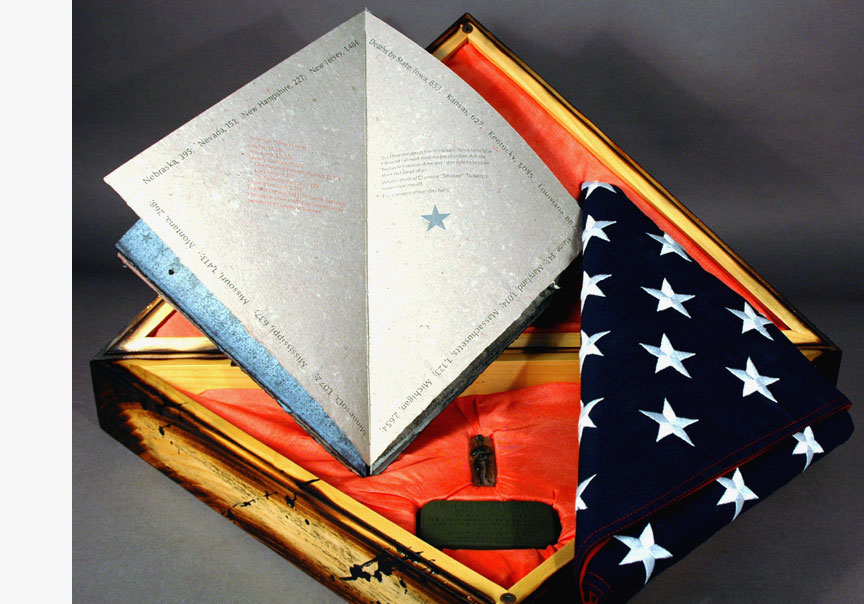
For Boys Who Dream of War 16 pages. Triangular book (17" spine x 12" x 12": 8.5" at its widest point resting in triangular box - 25" x 17.75" x 17.75": 12.5" at its widest point). Each page on Root River Mill Paper made by Jeff Morin, Brain Borchardt and Caren Heft, or Hahnemuhle paper sized and tinted. Type: Gill Sans. Open sewn spine with silver colored boards that are lightly marked to form a pattern with a cutout of an airplane in black and gray on the front board. Each different-colored page opens up as a square. Pages are edged with stars, the USA flag, or statistics relating to the Vietnam War. The book is laid in a scorched and black-paint-splattered triangular wooden box with magnet closure. The box is padded inside with soft reddish cloth. On the box’s top is a silver metal star, while on the inside is a plastic toy airplane. The book rests on top of an American flag (folded into a triangle). Set in the padded base of the box are a 2.75" glass figure of a wounded soldier (inscribed either with the number of American military dead in Vietnam or the number of Vietnamese civilians killed or wounded) and a small metal WWII first aid kit containing wound dressing, sulfa powder and instructions. This work bites its tongue, but the anti-war rage is barely in check. The left pages list the women who died in Vietnam. The right pages combine a mix of gung-ho-young-lad-playing-war and the story of LCDR Smokey Tolbert, much decorated flyer and Blue Angel, who was shot down over Vietnam. The official report of that downing seems questionable. Commander Tolbert’s remains were suddenly “discovered” by the Vietnamese and returned 16 years after his downing. He stands here for the waste and indignity that awaits “boys who dream of war.” Every statistic and story in this work repeats or is enveloped by its triangular shape, the shape the US flag that drapes coffins is folded into before it’s presented to the next of kin. |
||
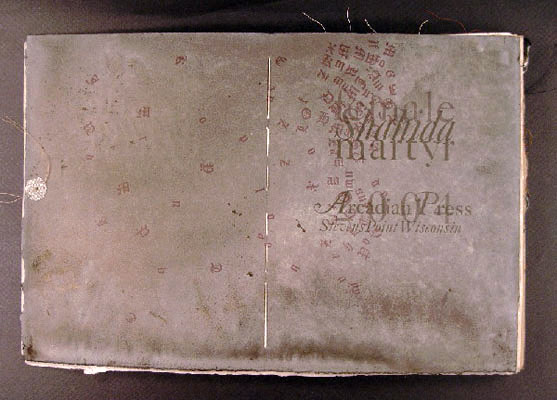
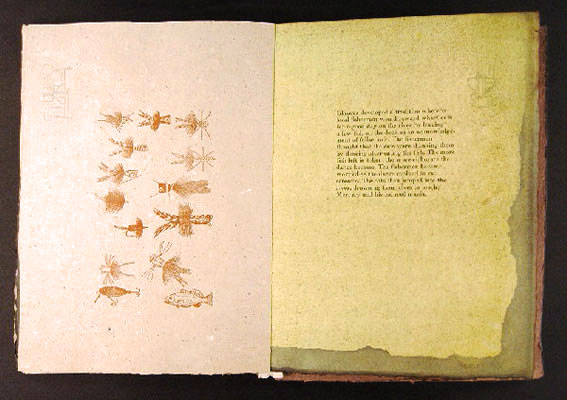
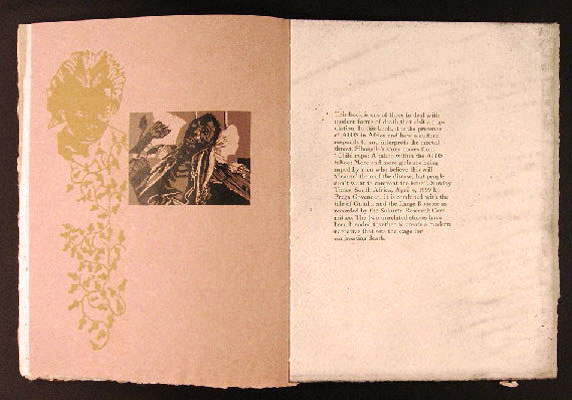
Martyr Mercury Rooster 12 x 8.75". Three individual books of handmade paper, housed in a 13 x 10 x 2.5" clamshell cloth covered box. Papers: Root River Mill cotton, Larroque, and Hahnemuhle. The Hahnemuhle gelatin sized (with pigment added-in). Typeface throughout: Cochin Light. This powerful, exquisitely rendered 3-volume collaboration between Caren Heft of Arcadian Press and Jeffrey Morin of sailorBOYpress is done in the spirit of the ars moriendi (the art of dying), 15th-century Christian texts with instructions about how to die well developed (perhaps) in response to the Black Plague. Heft and Morin use the format ironically to look contemporary scourges: suicide bombers, the destructive effect of mercury in the environment, AIDS. The woodcuts from the Middle Age-originals are replaced by an assemblage of tape, pins, stitchery, beads, and pieces of metal. The effect is powerful, even overwhelming. [From the colophons of the 3 volumes] "Suicide bombers are currently the weapon of choice for terrorist organizations. They are low-cost, use unsophisticated technology, are readily available, require little training and strike fear into the hearts of the population. Women have an added advantage, as in the Muslim world they are searched gingerly. World-wide, women are perceived as non-violent, adding an element of surprise. Suicide bombers attain extensive media coverage for their organizations as casualties are often high. Media coverage is a good recruitment tool and furthers political agenda." Mercury: "What child does not remember finding some excuse to play with mercury in a science class? That same child probably has some memory related to fishing. We all share the image that opened the Andy Griffith Show where father and son walk a country road on the way to their favorite fishing hole. Did anyone expect that today’s childhood memories would intertwine mercury and fishing in such a dangerous way? In most counties in Wisconsin, the Department of Natural Resources limits the consumption of fish as well as the daily catch limit." Rooster: "In fifteenth century Europe, the level of literacy had been on the decline. Ars Moriendi were picture manuals for one’s preparation to meet death. On one level they were intended to ease the transition and prepare one’s family for the coming loss. On another level, these manuals were a form of propaganda, advising the soon-to-be-departed to give heavily to the Church to guarantee a better place in Heaven or at least a seat further from the flames of Hell. "This book is one of three that deal with modern forms of death that visit a population. In this case it is the presence of AIDS in Africa and how a culture responds to and interprets the mortal threat. Sibongile’s story comes from 'Child rape: A taboo within the AIDS taboo; More and more girls are being raped by men who believe this will "cleanse" them of the disease, but people don't want to confront the issue," Sunday Times, South Africa, April 4, 1999, by Prega Govender. It is combined with the story of Gumha and the Large Rooster as told by the Sukuma Research Committee. The two unrelated stories have been blended together to create a modern narrative that sets the stage for confronting death." |
||
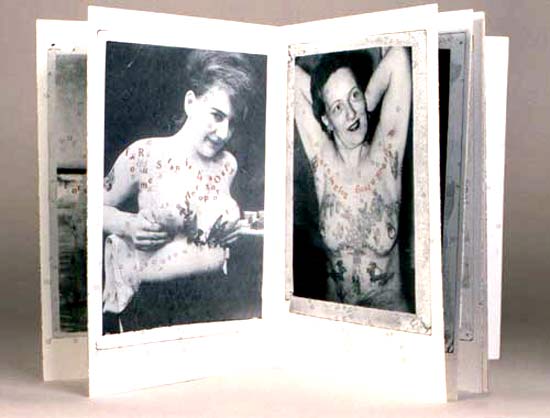
Cold Earth 14' x 18" x 11" open. It is a comment on relationships, the indelible marks they leave on us, how the fervor of passion leaves us changed but in a totally different way than the experience itself. The unerotic nature of the tattooed women mocks the passion that soft porn makes mockery of. The poem seems to be the last stanza of another relationship over, another spadefull of cold earth heaped on our desires. Caren Heft: "I see it as a continuation of my books about women. I am really interested in women and the choices they have been allowed and not allowed, how they have chosen to use their bodies ..." A large relief print letter press accordion fold book with a provocative and poetic anthropological illumination of women's tatooed breasts. |
|
|
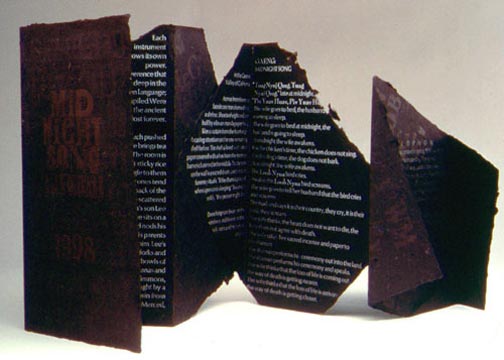
Midnight Song 7.5" x 14.5" Root River Mill paper by Michael Nitsch comprised of old Army shirts from 1959 and abaca. Inks are Handschy silver offset and Ernie's black. Type is Amos wooden type and Stempel 24 point Optima. Laid-in a fitted compartment in the cloth box is a CD "The Music of the Hmong People of Laos. Documentary Arts" by Boua Xou Mua. A six page narrative on Boua Xou Mua printed in an eclectic page size and design is laid-in.. An impression of a Hmong shaman, the spiritual leader of his people who was a mercenary for the French and the CIA in Laos. Pages are under printed in Hmong with one of the Shaman's poems. |
||
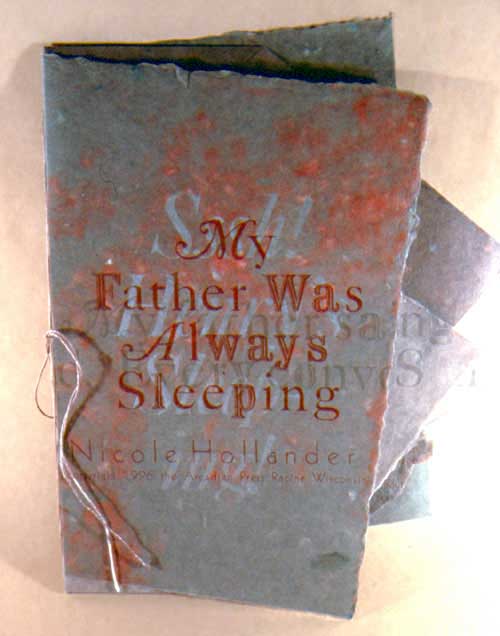
My Father Was Always Sleeping 11" x 13", 12 pages. Printed letterpress on Root River Mill abaca papers. Handsewn. Pages cut at angles so that the pamphlet isn't at right angles or squared. Fan shaped pamphlet then laid into the slipcase which has a cardboard inset with cutout for the pamphlet. Text by Hollander is about her search to find her father in memory; he died before she came to terms with him.
|
|
|
| Arcadian Press Out of Print and Sold titles: |
||
Cataracts Wrecks 7.5 x 10"; 32 pages. Accordion binding. Printed on handmade papers at the Arcadian Press using the Gill Sans from the Star Type Foundry and Rudolph Koch's Kabel Light. Sewn binding with paper over boards. Numbered. Caren Heft: "I am 77 years old now, struggling with the changes brought about by encroaching old age. In my quest to come to some sort of acceptance, I asked Walter Hamady to tell me about becoming blind. He sent the text used here. And when I asked Kristin Thielking the meaning of her shipwreck work, she wrote this text for me, at which point I decided to use the two texts together. "As usual, a book is a collaborative effort, almost like a neighborhood. Tim Vermeullen taught me how to dye paper with Indigo. Mark Brueggeman dyed the Root River Mill abaca and flax papers with me and together we learned to do rice paste resist stencils. Julie Sittler laser cut the stencils, extrapolated from Japanese kimono patterns. Lise Beth Robinson and Kristin Thielking developed the silk screens for their collaborative glass sculpture. Lise Hawkos showed me the binding. Collaboration, like-minded people working toward a common goal, is a joy that makes old age almost bearable." |
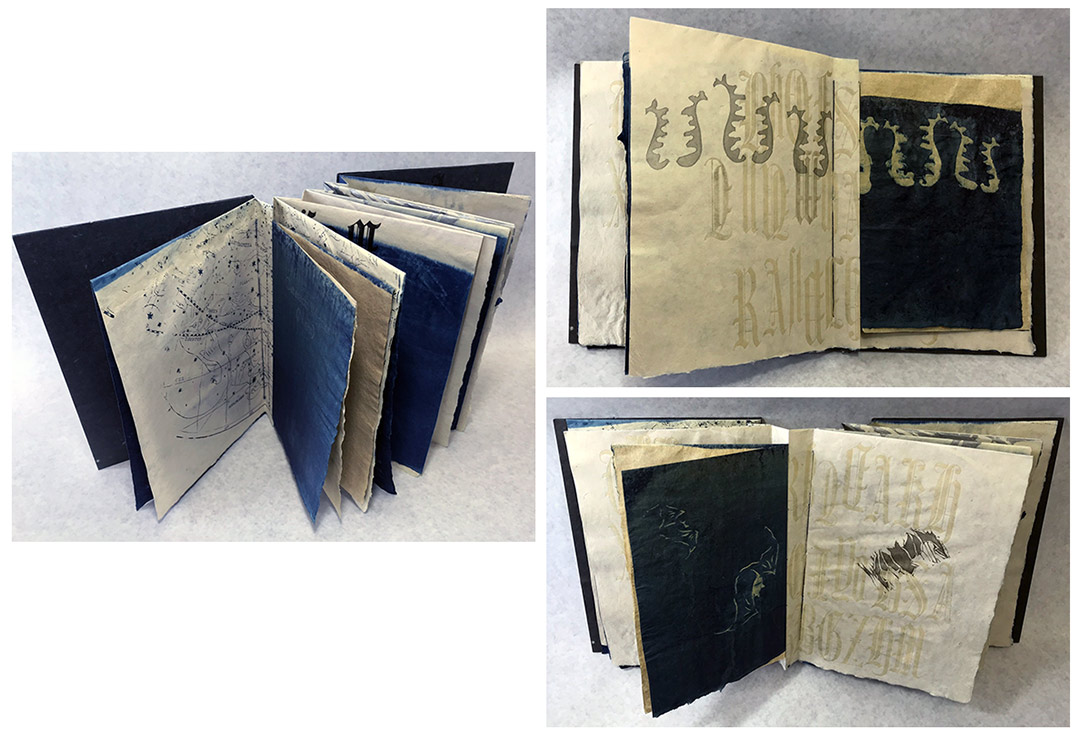 Click image for more |
|
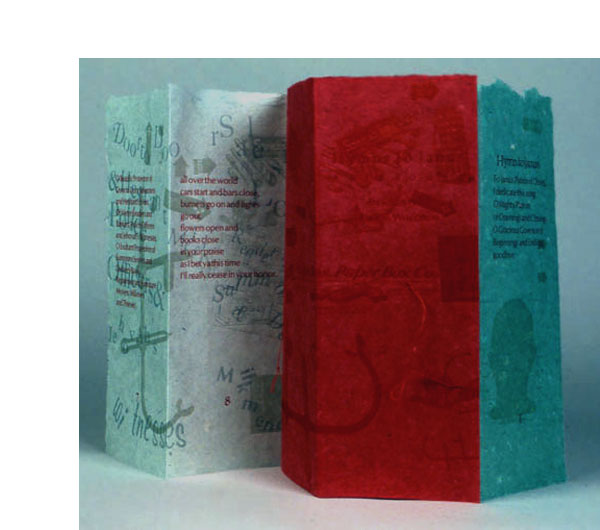
Hymns to Janus 33 x 14 cm; 9 pages. Text issued as two sheets folded into nine pages. Red sheet sewn and attached to back of textual sheets to serve as cover. Printed in red typefaces on turquoise and blue Root River Mill abaca papers. Type is Stempel Optima. Printed by Caren Heft. Issued in clamshell case covered with red cloth. Green papers cover support structure and front lining. Caren Heft: "Hymns to Janus came about when I began a friendship with Karl Young, the author. The way his poetry juxtaposes the contemporary world with the classical one is appealing to me. The paired phrases in this book are a wonderful device to hold the reader’s attention. To reflect the poet’s sensibility, I chose commercial printing images, from the last days of commercial letterpress printing—every small press has drawers of that stuff or has gotten rid of it. Those small ad blocks, overlaid with the paired phrases, seemed to me to reflect Karl’s sensibility. The binding, a non-traditional one that I more or less invented for this book, also reflects (at least to me) Karl’s sensibility. The layering of text, text, and image adds depth to the visual presentation of the book, again reflecting the poet’s work that can be read on a number of levels. The fact that the reader must struggle a bit to find the way through the book is also calculated to mirror Karl’s text and the complexity of contemporary poetry."
(Out of Print) |
|
|
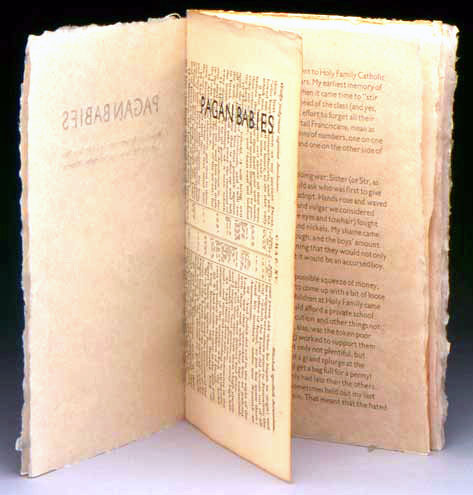
Pagan Babies 6 x 9" with 22 pages. Letterpress book on Root River Mill abaca paper with found pages of a letterpress printed Bible from the 1860s. Type is Gill Light from Horsfall & Sons Ltd. Printed by Caye Christensen. Root River Mill abaca made by Michael Nitsch. The hot foil stamping done by Fred L. Jaenecke of Commercial Rule in Milwaukee. The Bible pages are from The Holy Bible, containing The Old and New Testaments, Translated Out of The Original Tongues And With The Former Translations Diligently Compared and Revised, published in New York by the American Bible Society in 1862. "Pagan Babies" is an account of a missions fund-raising technique used by the Catholic Church in the 1940s and 1950s. Heft says the idea for the book came about when her colleagues at the Wustum Museum told pagan baby stories over lunch one day. Caren Heft: "Oral history has long been an interest of mine and of the press. It seems to me that not enough documentation is done on the small things which go into making each of us an adult human being. My grandmother, who died in the 1980s at 97 years old, used to take me to the backyard of her house, point out her huge mulberry tree filled with purple stained grandchildren and say "Someone must write this down, someone must tell people how it was." Unfortunately, I didn't realize how much I valued what she knew until she died." |
|
|
| Roll With Me Henry By Caren Heft Racine, Wisconsin: Arcadian Press, 2013. Edition of 15. 12 x 18" single sheet. 12 x 18" single sheet. Letterpress and intaglio printed broadside enhanced with addition of sewn-on beads. Signed by artist. Originally this was an experimental plate made for Heft's book The Cold Earth but never used. The artist has added beads around the woman's head to form a halo. While The Cold Earth focused on women's tattooed breasts this broadside is a full back view from head to heel of a tattooed woman. Caren Heft: "I am really interested in women and the choices they have been allowed and not allowed, how they have chosen to use their bodies." (SOLD) |
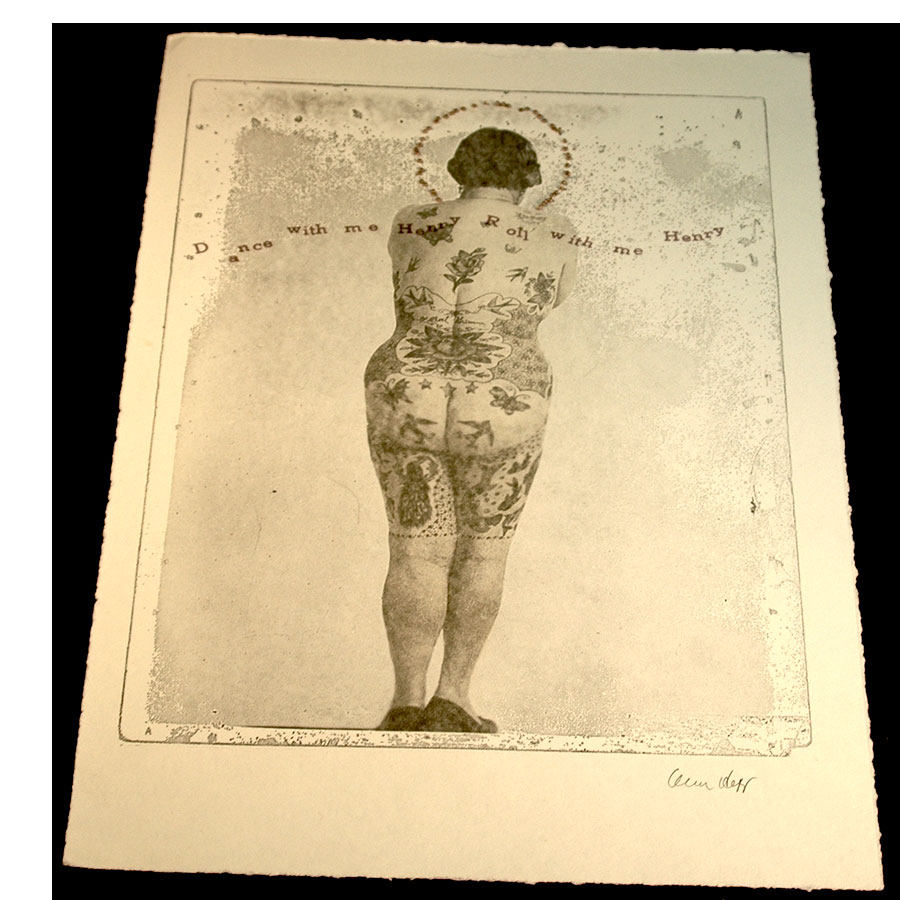 Click image to enlarge |
|
Page last update: 04.05.2025

Home | About Us | Contact Us | New Arrivals | Fine Press & Artists' Books | Broadsides |Resource Books | Order/Inquiry
Copyright © 2023 Vamp & Tramp, Booksellers, LLC. All rights reserved.