
| Beata Wehr ~ Arizona, via Poland | Share this page: |
| After years of painting, Wehr was drawn to making books in 1993 because of their more intimate format. In her recent work, she explores themes related to her experience as a Pole living in the United States. She writes: "I came here 15 years ago with no intention to stay. Since my connection to Poland is very strong I feel I am in between the two cultures." While her visual texts are drawn from personal material, she taps into a universal immigrant experience. Most of her books begin as unique, mixed-media works from which she has, in some cases, produced ink-jet printed editions for wider distribution. Wehr's ability to narrate in a purely visual format is exceptional. |
|
Immigration, identity, and dislocation |
|
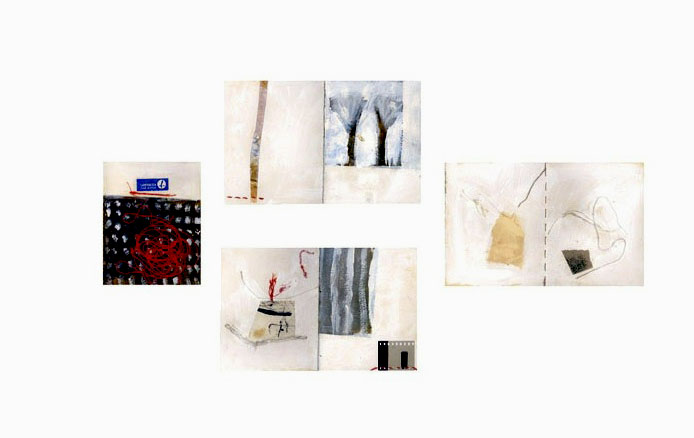
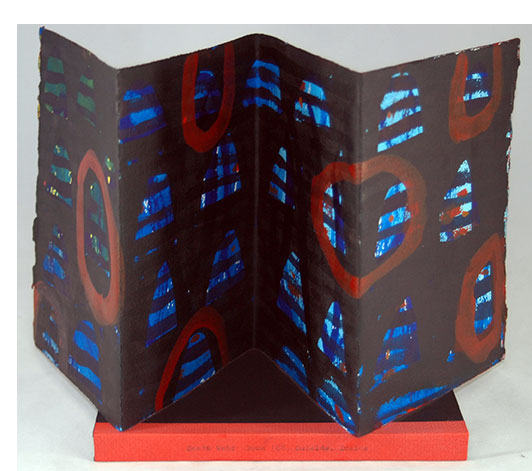
Memento Mori 6 x 8"; 16 pages including cover pages. Inkjet printed onto handmade paper. Pamphlet bound. Signed and numbered by the artist. Beata Wehr: "'Memento Mori' presents ideas of death and life from various perspectives in a simple symbolic way. It was created for the 8th Triennial of Artist's Books in Lithuania on a theme Memento Mori." The images in muted colors are “apparently” all of one dying plant in a timeworn container. The point of view changes but the content only looks slightly different. Dead is dead, no matter how you look at it? |
 Click image for more |
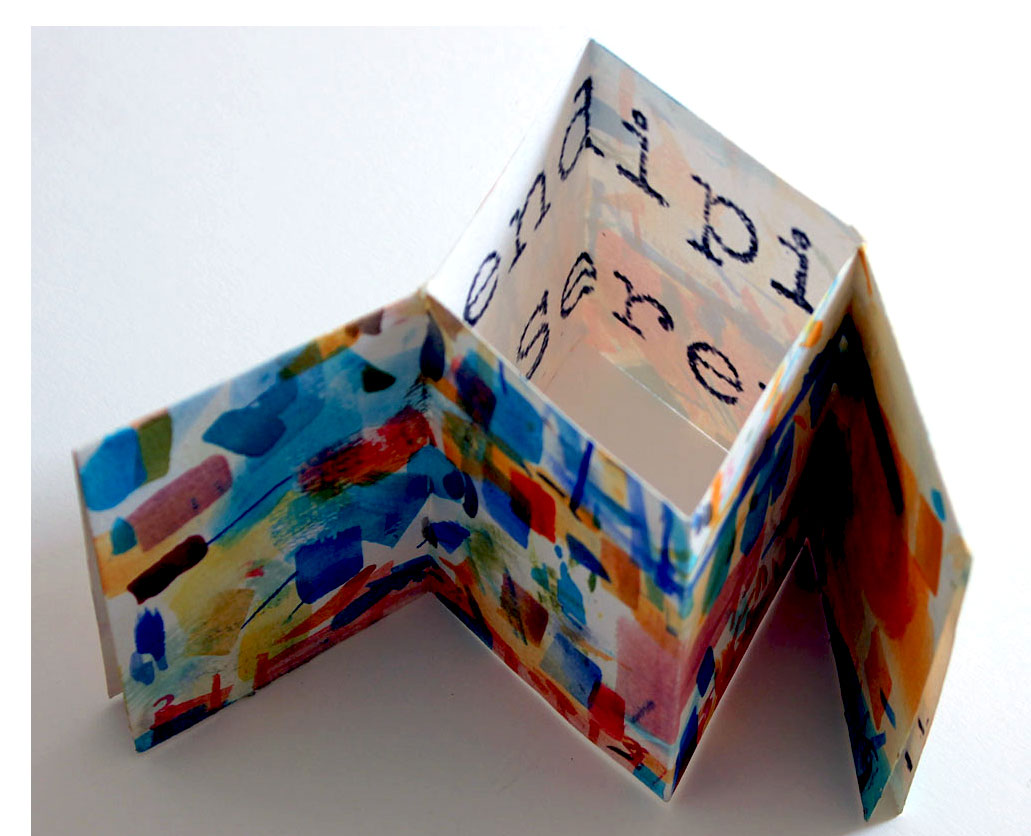
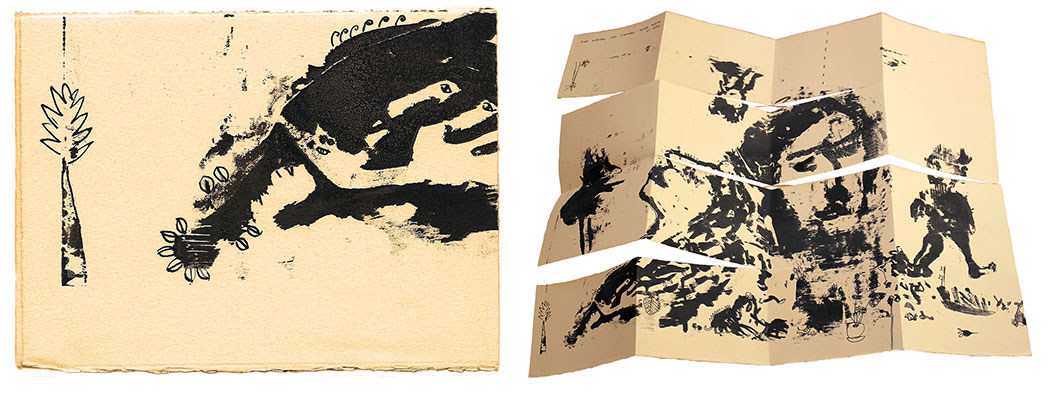
About Serendipity 3 x 4.25"; 6 pages. X-fold, a single sheet folded, opens to 8.5 x 11.25". Archival ink jet print. Signed and numbered Editioned book based on a one-of-a-kind by the artist. Beata Wehr: "As an artist I am dividing my time between making books and painting. "This project is a serendipitous combination of both of them. The random gouache marks became pages of abstract landscapes that we can travel through. After looking through all of them and unfolding the book viewers will find a repeated word 'serendipity.'" |
|
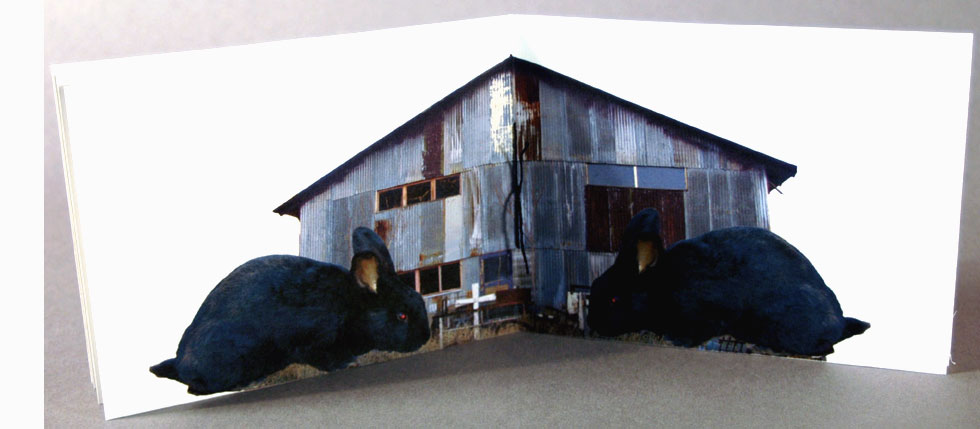
Hallo, Rabbit, isn't that you? 4.25 x 5.5"; 12 pages. Housed in letter envelope with printed title. Based on the theme of the Fourth International Artist's Book Triennial Vilnius 2006 - "Rabbit and House." |
 Click image for more |
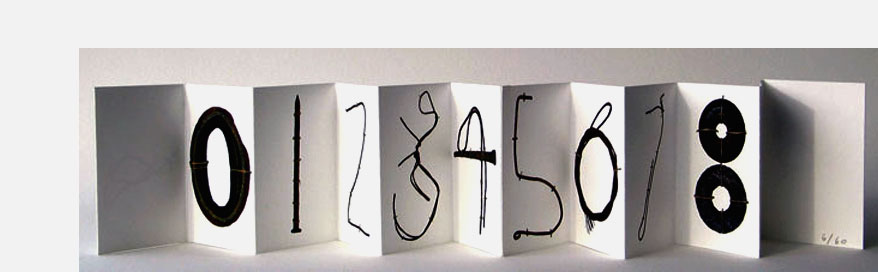
Infinity and Other Numbers 2.5 x 3.5"; 10 pages. Single-side accordion. Digitally printed. Numbered but unsigned. The numbers 0-9 — formed from old coins, nails, pieces of rusty wire, etc — burst from the bright white cardstock. |
 Click image to enlarge |
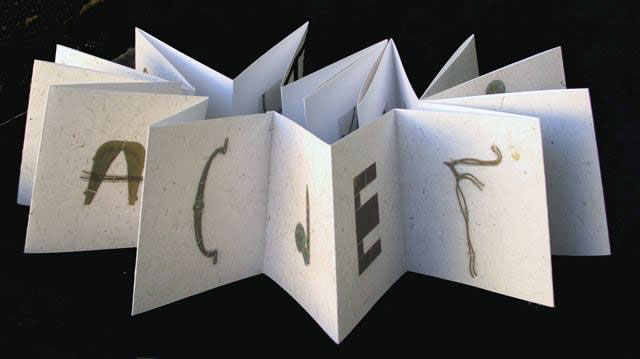
Abecedarium 4 x 4"; 28 pages. Archival inkjet print, accordion fold. An alphabet book based on Wehr's artwork. One side of the accordion displays each letter of the alphabet – in the form of a found object, like a length of barbed wire or a shard of rusted metal. The reverse shows a close-up view of a section of the letter, increasing the intimacy but destabilizing the context. |
 Click image to enlarge |
| Beata Wehr:"I am interested in recording the passage of time, obsessed by the changes happening in our life, changes of our fragile bodies, our minds. I am curious how the past determines the present and how what is happening now influences our thinking about the past. The rhythm of life is different depending on the place we live, our age, occupation, gender, role in a family and in a society ... My books are usually bilingual, or semi-bilingual and I often mix images with writing, pieces of newspapers, found objects and other elements reflecting the everyday life in Tucson as well as my links to Poland." | |
| Far Away By Beata Wehr Tucson, Arizona: Beta Wehr, 2010. Edition of 50. 2 x 2.5"; 14 pages. Miniature. Digital printing. Handsewn pamphlet style binding. Slipped into glassine envelope. Wehr creates unique pieces, often using found objects, often both from her native Poland and her current home in Arizona. She then creates digital editions of these unique pieces. This miniature edition is based on an earlier mixed media one-of-a-kind. Beata Wehr: "I found artists' books to be especially useful in talking about the issues of identity, immigration, and dislocation. I like their intimate format, and the fact that many media could be combined on the pages, creating layers of images. My books are usually bilingual, or semi-bilingual and I often mix images with writing, pieces of newspapers, found objects and other elements reflecting the everyday life in Tucson as well as my links to Poland. I try to combine two different experiences from two different worlds in this 'in between' situation. I do not know if it is ever possible, as my native life, language, landscape, culture are so different then my life here in Tucson. I want my viewers who will not understand part of the text to experience the difficulties with comprehension. I hope that those who are not from this culture can relate to the problem, and those who are from here will be more aware of it – especially in that it also relates to migration and the feeling of dislocation which is an experience many Americans encounter." $35 |
|
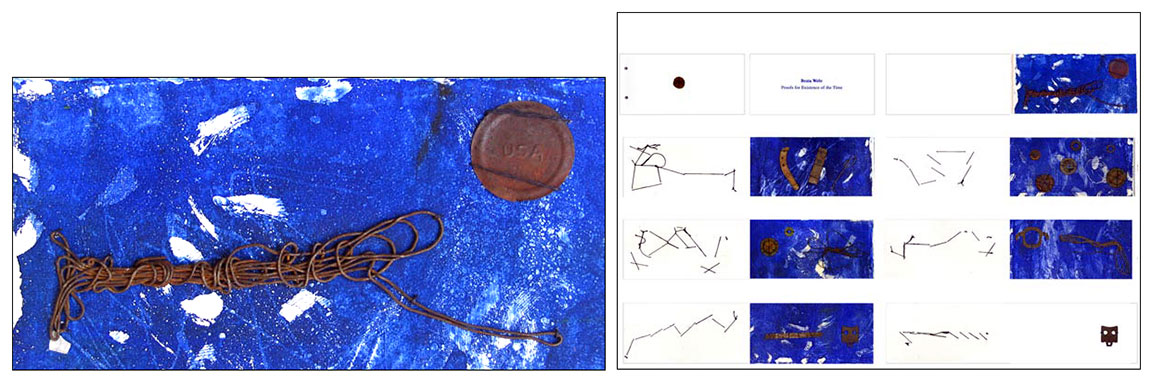
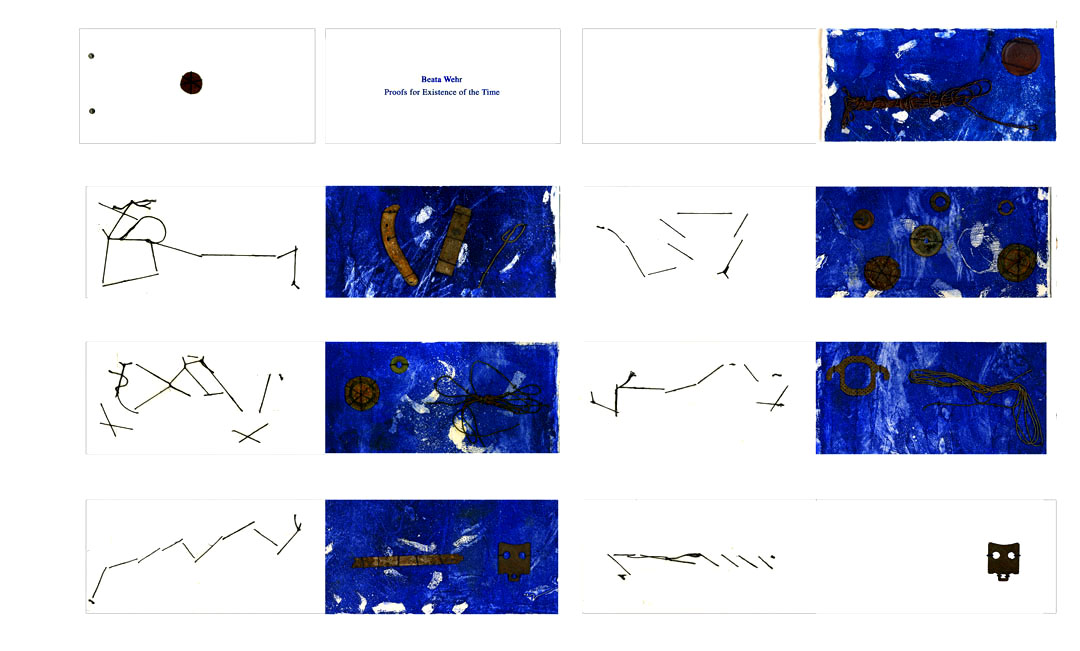
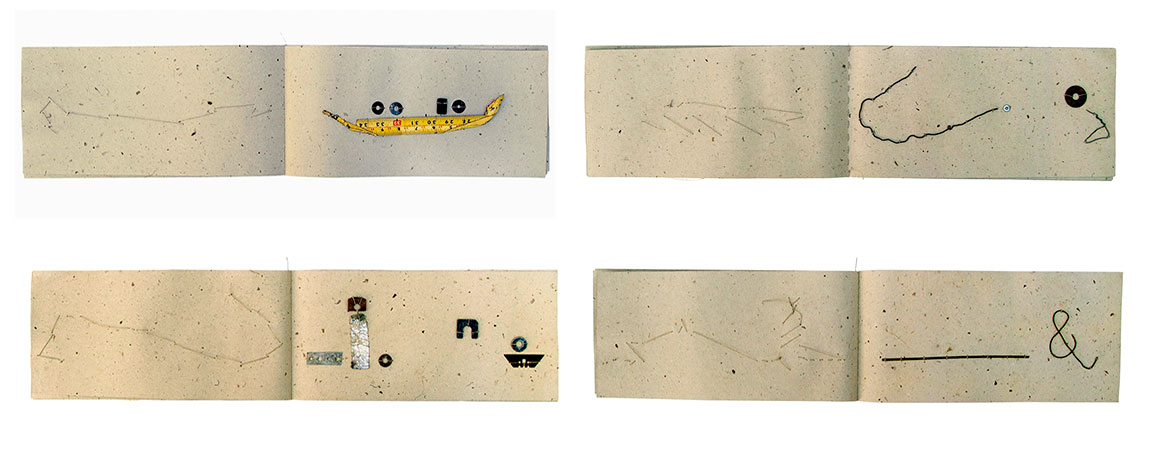
Proofs for Existence of the Time 4.25 x 1.75"; 16 pages. Miniature. Sewn binding. Miniature of Wehr's 2006 bookwork "Proofs for Existence of the Time." Each oblong page is an image of one or more found objects laid on a blue background. Beata Wehr: "I am interested in recording the passage of time, obsessed by the changes happening in our life, changes of our fragile bodies, our minds. I am curious how the past determines the present and how what is happening now influences our thinking about the past. The rhythm of life is different depending on the place we live, our age, occupation, gender, role in a family and in a society. I am trying to capture chunks of time comparing different periods of my life, recording transience by creating journal-like books, time lines, letters from the past, calendars. ... Some of the materials I am working with are found, so their history is unknown to me, and this mystery creates yet another layer of thinking about the time with all what is unknown and can only be guessed. Time and transience are very important factors in our life, and this why I am choosing them as a subject." |
|
Proofs for Existence of Time 5.75 x 12.75"; 16 pages. Bound with screw and bolt. Found object sewn to front cover. One of Wehr's art works of found images documented in book form. Each oblong page is an image of one or more found objects laid on a blue background. Beata Wehr: "I am interested in recording the passage of time, obsessed by the changes happening in our life, changes of our fragile bodies, our minds. I am curious how the past determines the present and how what is happening now influences our thinking about the past. The rhythm of life is different depending on the place we live, our age, occupation, gender, role in a family and in a society. I am trying to capture chunks of time comparing different periods of my life, recording transience by creating journal-like books, time lines, letters from the past, calendars.... Some of the materials I am working with are found, so their history is unknown to me, and this mystery creates yet another layer of thinking about the time with all what is unknown and can only be guessed. Time and transience are very important factors in our life, and this why I am choosing them as a subject." |
|
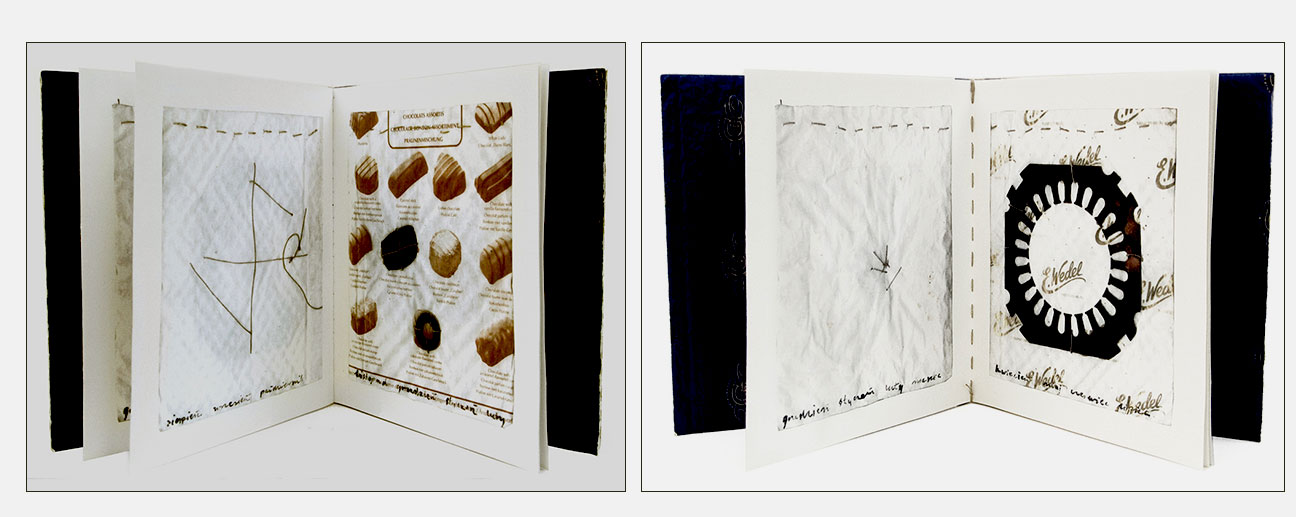
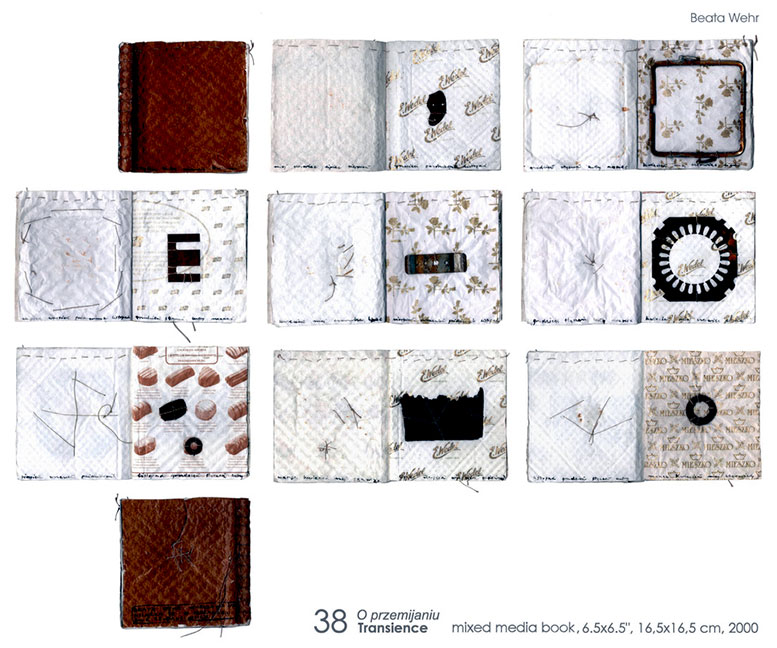
Transience Inkjet printed. Sewn into an assortment of padded covers such as brown and royal blue with a gold Ghiradelli logo pattern. La dolce vita! In an impermanent world, the sweet life gives way. And while this book reminds us of that fact, it also encourages us to partake of the sweetness, perhaps at the same moment. Covered in the familiar crinkly (sort-of-corrugated) pads that top boxed assortments to protect the candies, this book retains the inviting aroma of chocolate. The pages, scanned from an original mixed media version, depict images of such tray pads with found, rusted objects affixed to them - the simultaneous decay of life. The verso pages show the back stitching which secures the front object, and chocolate stains, reminding us that life is messy! |
|
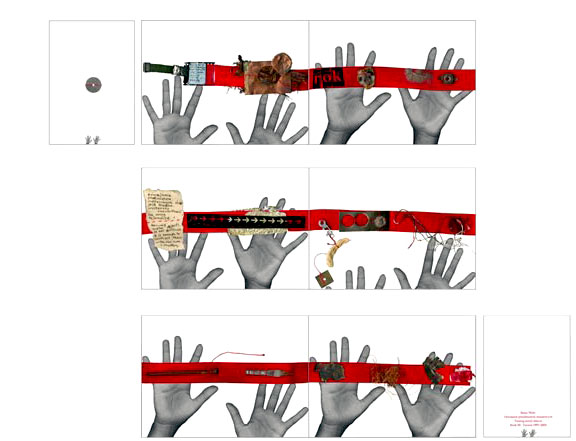
Taming Metal Objects 5.25 x 8”; 12 pages. Inkjet printed on Neenah Cover Laid paper. Self-enclosed carousel accordion. A metal object adorns front cover. In past works, Beata Wehr's fascination with metal objects and fragments has been evident. Thus, it is fitting that she now devotes a whole book to them. And the objects are fascinating. Disembodied as they are from other parts that would render them useful, that would explain their functions, some whisper secrets of mechanization. Others are more familiar, like a single mitten clip for a child's coat, a small pulley, a rusted nail. Like her previous edition, Passing Continued, a band of fabric bisects the spread horizontally. Metal and other objects—some natural like a pod, a feather—are sewn or otherwise anchored onto the red band and overflow into the white space. From the bottom of each spread, a pair of hands reaches up toward and behind the collage. The hands suggest creation, manipulation of the environment born of curiosity and need that grew, ultimately, into manufactured objects, literally manu factum in Latin, made by hand. Bound together as the objects are, on the band, in the book and through the artist's vision, they express a new story, one not intended at their genesis. Wehr points to this enigmatic quality in a brief text: "Taming metal objects in not difficult. It is enough to contrast them with our own mystery." Which she does. |
|
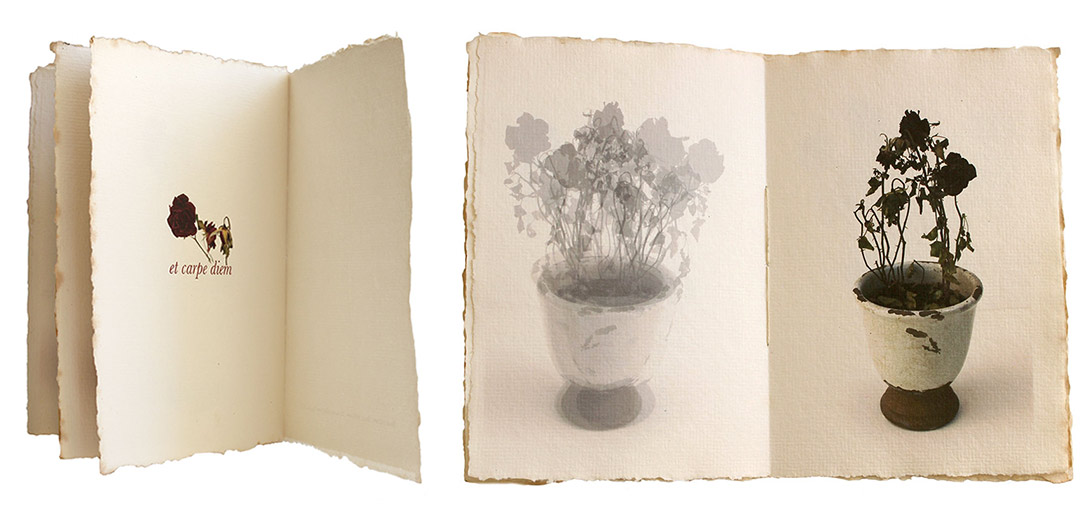
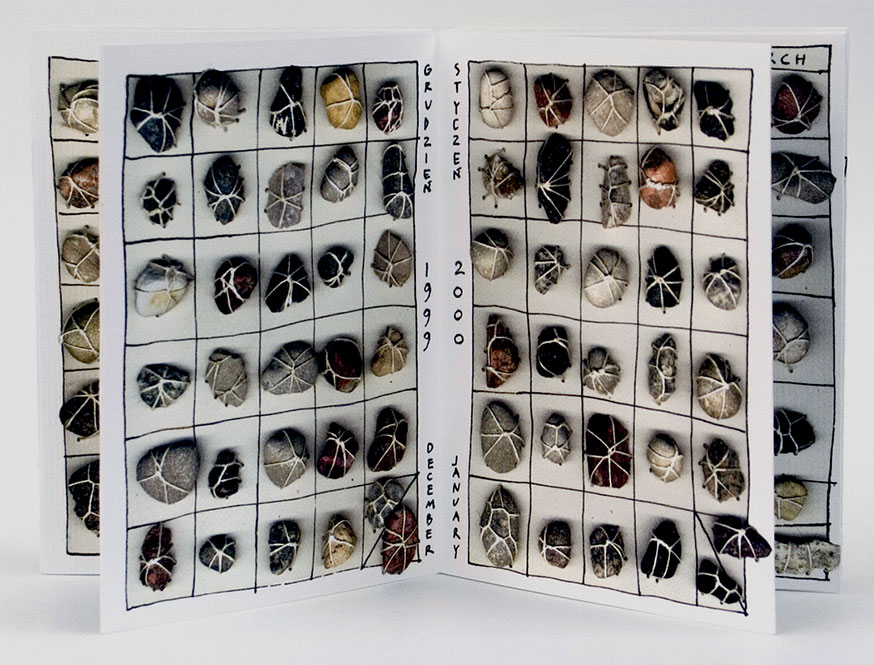
Carpe Diem: 4.5 x 6.25”. High quality color copies. Self-enclosed carousel accordion. Despite the dates — it begins in August 1999 and runs through July 2000—it is not too late for this small, intriguing "datebook." This calendar does not rely on individual dates as much as on the idea of a repetition of days. Each day herein is marked by a stone lashed onto a board, then photographed and placed on a grid. The colors of the stones and their macramé style lashings create a beautiful tapestry. The visually apparent tug of gravity on the rocks—some seem about to slip from their moorings—is a bit disorienting, but effectively so. Wehr has symbolically captured the weight and beauty that is each day. |
|
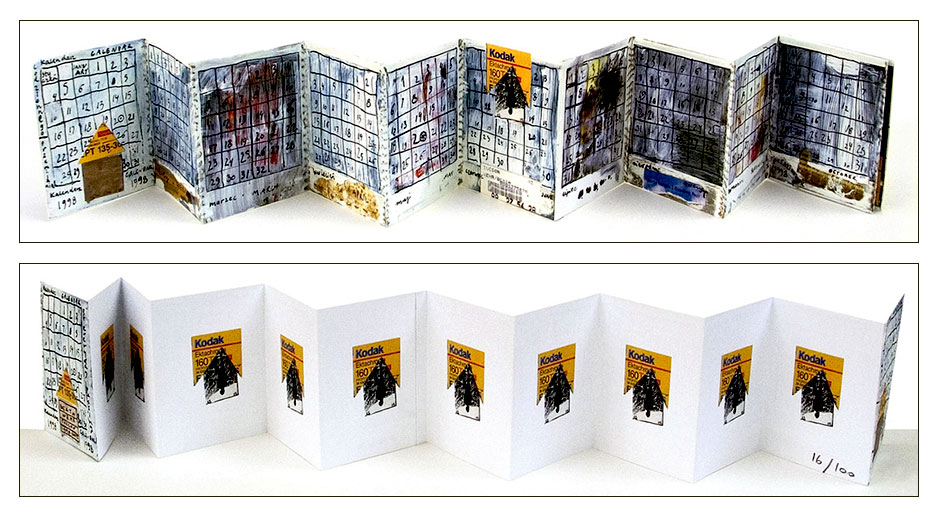
Calendar for Everyday Passing 2 x 2.5" miniature of archival inkjet print, accordian fold. Each page displays a monthly calendar of days. On the side are images of the end flap of a Kodak film box pierced by the image of a dark figure. This calendar book, based on a unique piece, plays the inexorable passing of time against our attempts to preserve the moment, to make time stop. Beata Wehr: "I am interested in recording the passage of time, obsessed by the changes happening in our life, changes of our fragile bodies, our minds. I am curious how the past determines the present and how what is happening now influences our thinking about the past. The rhythm of life is different depending on the place we live, our age, occupation, gender, role in a family and in a society. I am trying to capture chunks of time comparing different periods of my life, recording transience by creating journal-like books, time lines, letters from the past, calendars.” |
|
| Beata Wehr: "I found artists' books to be especially useful in talking about the issues of identity, immigration, and dislocation." | |
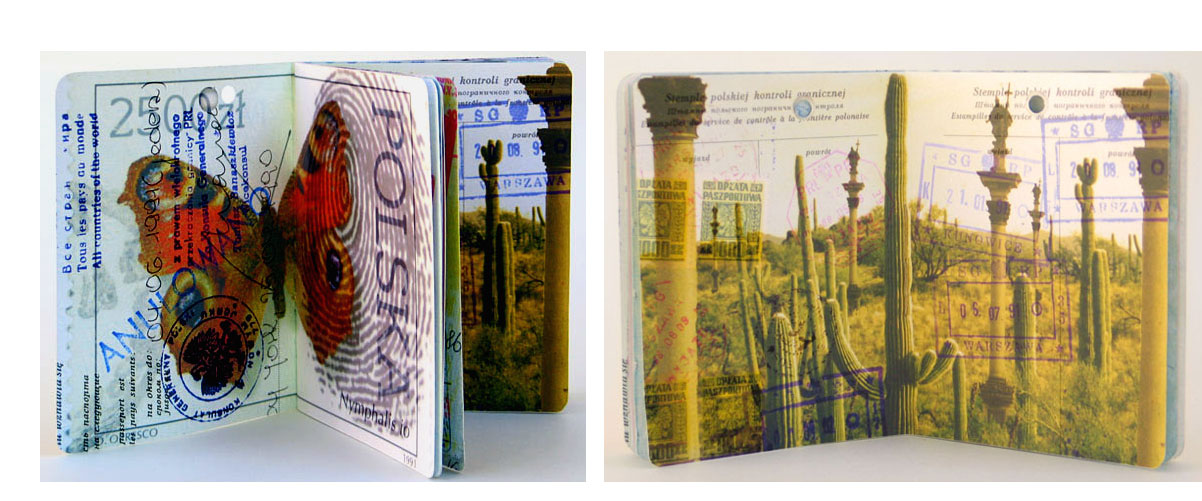
Paszport 4 x 5.25"; 22 pages. Archival inkjet print. Sewn binding. Covers simulate a passport. "Your Documents Please" exhibition called for artists from around the world to create Passport/ID documents for a traveling exhibition. Wehr's Paszport is one of more than 250 bookworks in the exhibition. Exhibition statement: "The lives of people are shaped by the legitimacy or illegitimacy of their status in the groups and institutions with whom they interact. As globalization proceeds and local bonds are eroded, identification documentation such as passports, credit cards, drivers' licenses and calling cards has become the physical medium in which the political, commercial, cultural and ultimately the spiritual disposition of the individual are negotiated. As new forms and criteria of identification are produced even the nature of identity is changed.... " The organizers asked participants to make a small artwork (the size of a conventional passport or less) that functions visually or conceptually as if it were an identification document....The resulting international traveling exhibition reflects a contemporary spectrum of issues of identity and the impact of its documentation." Paszport presents and re-presents Beata Wehr's nomadic life, encapsulating and juxtaposing her travels in time and distance. An presumably unchanging fingerprint is background and foreground to a stamp than shouts "Alien" and a series of photographs that document external and personal change. The center spread show a surreal landscape of columns topped by Polish (?) heroes amid saguaro cacti, which is frame for this artist's life, in both time and distance - from Poland to Tucson. |
|
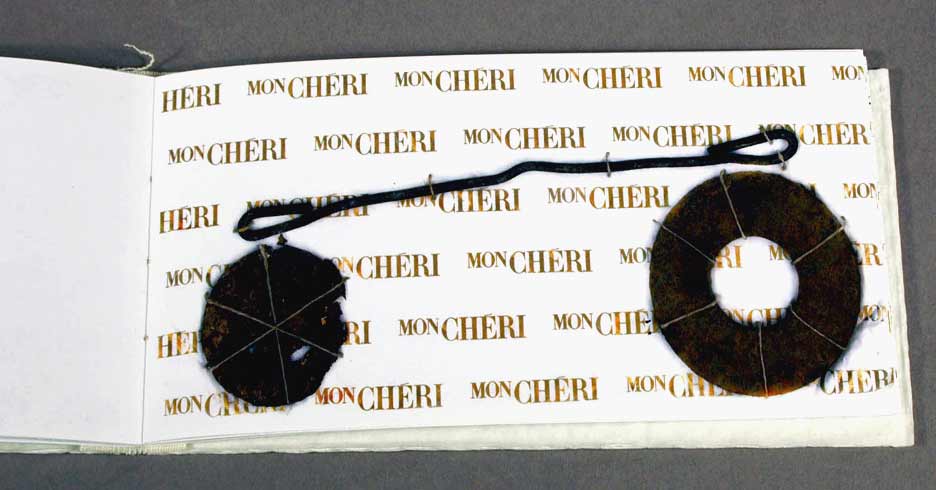
12 Short Stories for Mon Chéri 4.25 x 9"; 28 pages. Archival inkjet images sewn into two pieces of textured cover papers from a box of Mon Chéri candy. Mon Chéri, an internationally known candy made in Italy, is a single-wrapped, praline-sized confection, consisting of a "heart" of cherry, floating in a special liqueur and contained in a plain chocolate housing. It is popular as a gift particularly for special events. Twelve visual short stories by Wehr. The only text in each is its title, but all twelve titles – or do we just assume they are titles -- are listed only on the last page of this collection. The stories consist of found objects – a key, corroded rings, a rusty scrap of metal – sewn onto a rectangle of the candy box cover – a digitally flattened image of the covers that bind this book. Each story consists of 2 pages, on the recto the found objects, on the verso a pattern of heavy thread that appears to secure the found objects in place. This is a lesson in how very little can suggest so much: objects out of context; holding on; finding pleasure where we can; things apart from their origins – above all, our search for meaning? |
|
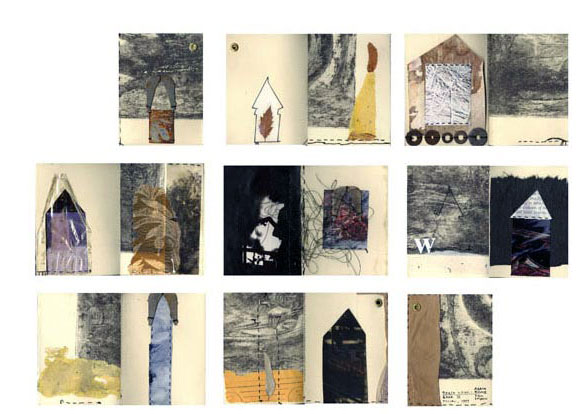
Again Home 5.25 x 7"; 16 pages. Inkjet printed on Neenah Cover Laid paper from mixed media original. Pamphlet stitched. Wehr recycles her older work into new books. This edition started with a fifteen-year old sketching cut into four pieces to create the pages. The etched image is a manipulated photograph of the personification of Anger from a column at the Romanesque Nobertine female abbey in StrzeIno, Poland. Leaves and other photographs are from places in which Wehr has had homes. Using found objects—including metal fragments of various and intriguing shapes, bits of paper, cloth and leaves—Wehr constructs collage images that resemble a child's rendering of a house. But to say only that is to oversimplify her visual language. Yes, triangles sit atop rectangles, but composed as they are of frayed cloth and other fragments, they suggest the fragility of what we experience as home. A plastic chocolate wrapper, curled at the top into a rooflike peak, speaks of other means toward comfort. A dark photographic silhouette and a torn piece of what appears to be wallpaper suggest interior spaces. An inverted section of a cancelled postal envelope recalls from Wehr's previous work the connection to her natal home in Poland. |
|
| How to Connect Two Different Wor(l)ds in Our Nomadic Life | |
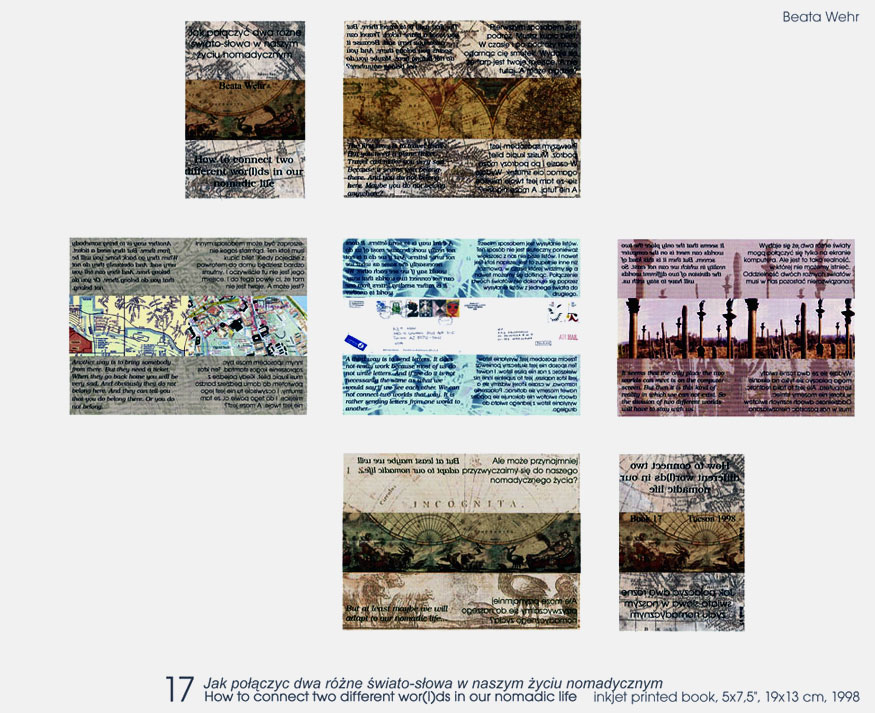
By Beata Wehr 5 x 7.5”. Self-enclosed carousel. Bilingual artist's book by Beata Wehr investigates the dilemma of being a person from two places trying to bring those worlds together. She suggests connecting through travel: "But you need a plane ticket." Or sending letters, but "most of us do not write letters." Illustrations, as well as text, tell the story. A map of the world gives way to maps of two cities, followed by dual envelopes with return addresses in Warsaw and Tucson. Finally, she attempts to wed the two worlds via computer graphics. Fusing photographs of each locale, she places architectural columns amidst the spires of cacti near her desert home—a virtual reality that is, of course, uninhabitable. The final resolve: adapt to a nomadic life. Pages are divided in three vertical sections with central images crossing the spreads. Text is printed in English and Polish, from left to right, then backwards, as a distorted mirror to translated counterparts—perhaps a "literalization" of that peculiar travel discomfort of not knowing whether you are coming or going. |
|
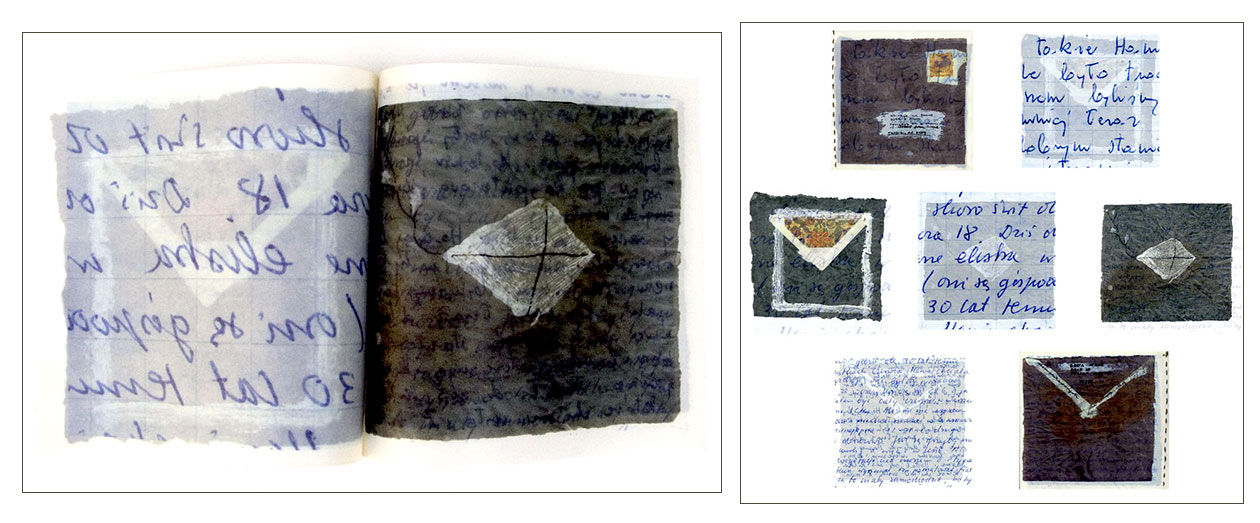
Variation on a Theme of Letters from Poland 8.5 x 9”. Inkjet printed on translucent Neenah paper. Wehr uses letters from her parents in Poland as the basis for this book. The front cover is an image of an envelope. The first page, an excerpt from a letter, is a fragment of text rendered as visual object through enlargement. The image draws our attention to the natural shapes of handwritten letterforms—the essence of communication—which to all but Polish speakers will be contextually meaningless. But there is more to meaning here than understanding a single language. The stamped front of an envelope and the back flap are universally evocative, as is the image of a kite as symbol of both being airborne and of the ether that inextricably unites us no matter the distance. A palimpsest page of text on reversed text recalls how writing on two-sides of airmail paper merges and obscures the words. Indeed the translucent Neenah paper the book is printed on is like the onion skin paper of international communiqués. A pale-blue background grid even suggests the guide sheet that slips below the airmail sheet. The variations of the title are the letters themselves, the correspondence between parent and child moving back and forth across ocean and continents. They are hands or hugs comprised of air and ink and paper through which Wehr suggests at once the fragility and endurance of our bonds. |
|
Self-Portrait in Sixteen Pieces 8.5" x 7" with hand-sewn binding in tan thread. Images of cancelled stamps; address labels; half tickets; maps - all those things one associates with going and coming. Wehr has had eleven homes. She is originally from Poland but has been in the United States thirteen years. Her work reflects that adjustment between two worlds and visions of life. |
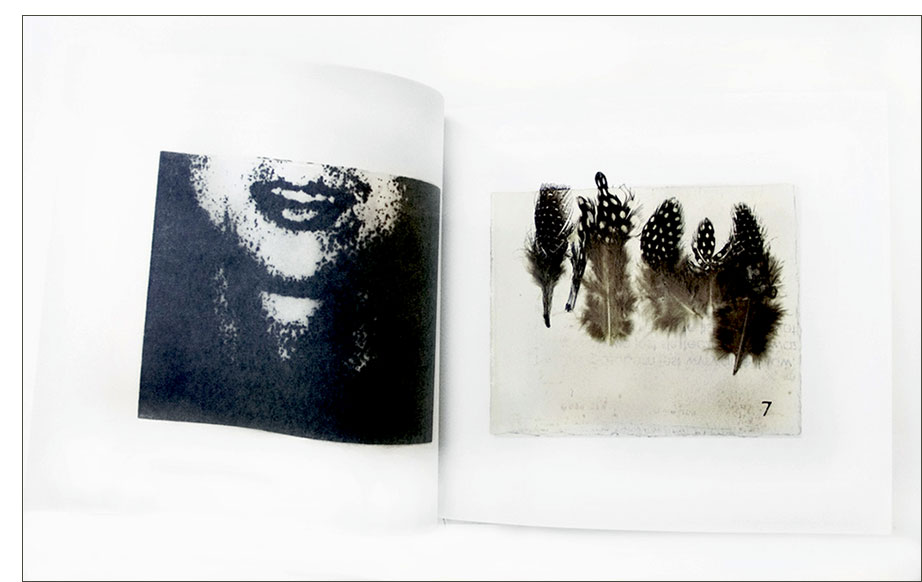 Click image for more |
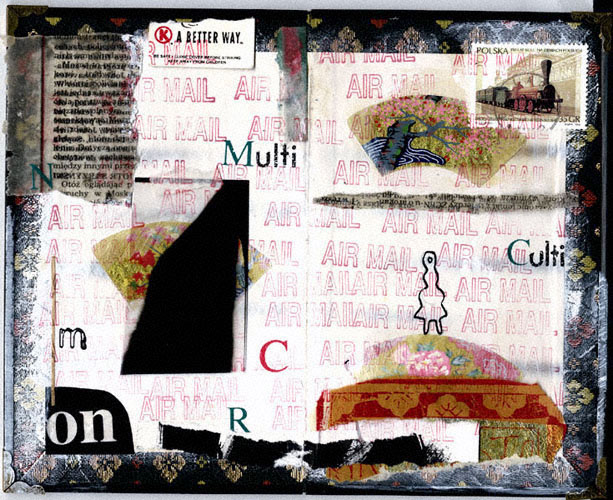
Multi-culti 7 x 4.4" archival inkjet print on Laid Cover Neenah, semi-book card. Produced from the original mixed media version of "Multi-culti." Reminiscent of a greeting card one would receive in the mail - images of a Polish letter stamp and an US post stamp, of the postal office "AIR MAIL" stamp, and bits and pieces of text that might be found on packages or letters. In this instance Wehr uses these images to link the two cultures that she bridges - her origins in Poland and her current home in Arizona. |
|
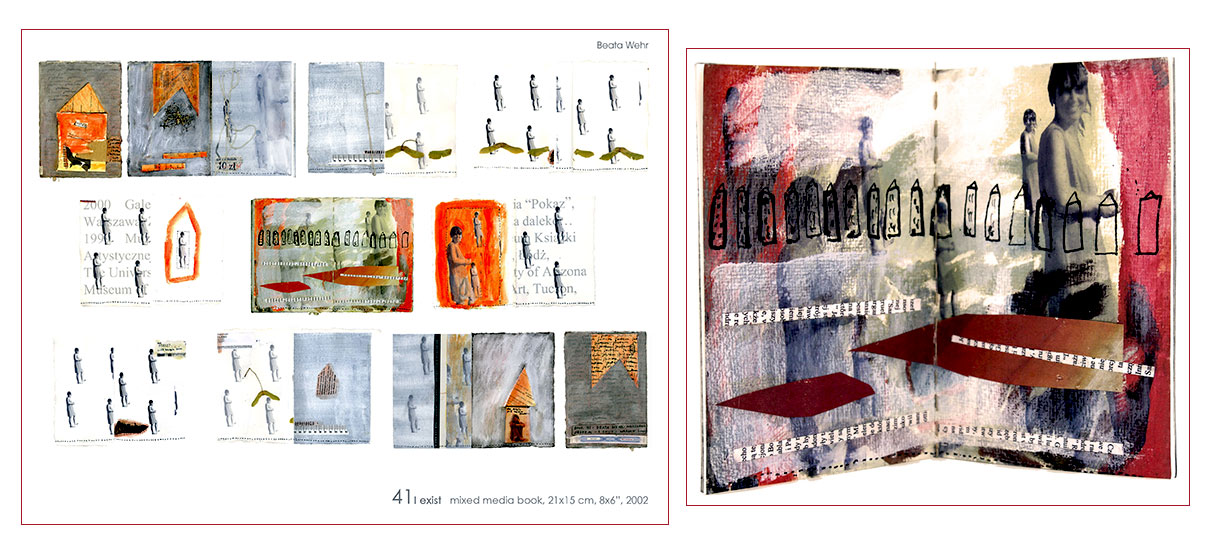
I Exist 8 x 6" archival inkjet printed on Exact Index Wausau paper, single signature. In this book of retrospect, Wehr brings together bits and pieces from her life in two worlds. She pulls in images from previous works such as "Passing Continued" to provide a collage. These layers of images provoke the reader to perhaps bring forth their own fragments of life experience. Wehr pulls the reader into the worlds of language and culture. Beata Wehr: "I try to combine two different experiences from two different worlds in this "in between" situation. I do not know if it is ever possible, as my native life, language, landscape, culture are so different than my life here in Tucson. I want my viewers who will not understand part of the text to experience the difficulties with comprehension. I hope that those who are not from this culture can relate to the problem, and those who are from here will be more aware of it – especially that it also relates to migration and feeling of dislocation which is an experience many Americans encounter." Based on an original one-of-a-kind mixed media book "I Exist / Jestem." |
|
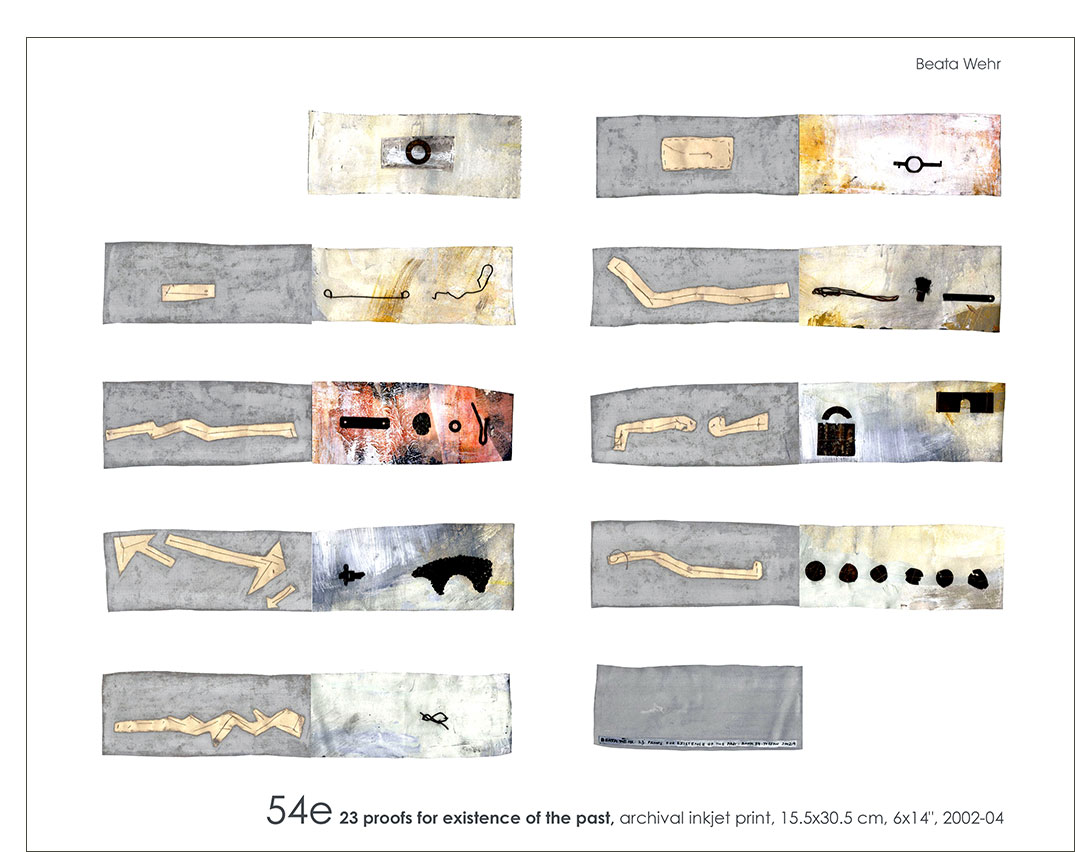
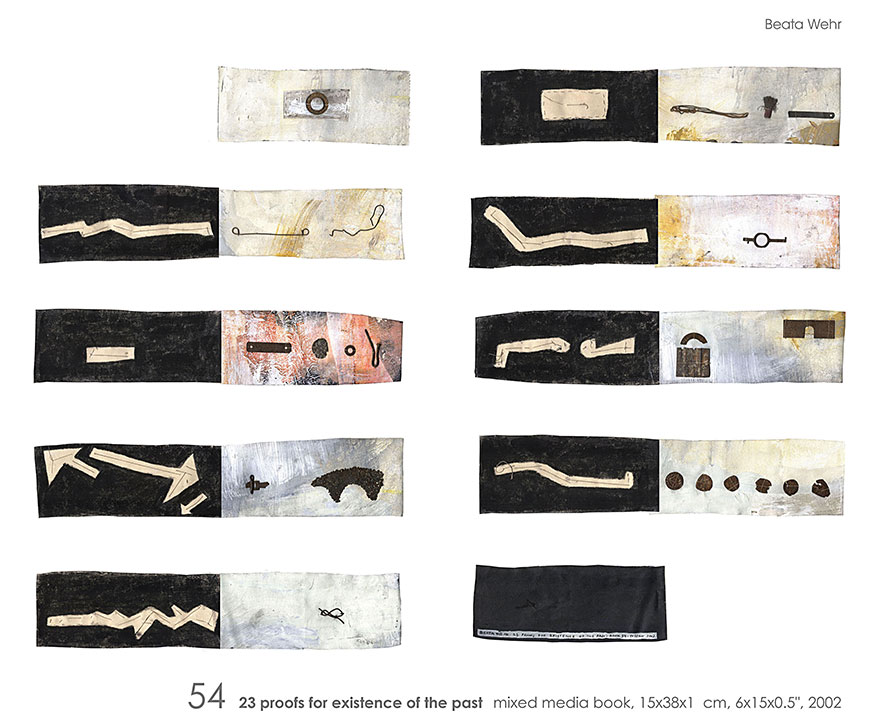
23 proofs for existence of the past 6 x 14" with 14 pages with hand sewn binding. Archival inkjet print on Exact Index Wausau paper. Looking at this book is like looking at an archaeological dig. There are images of twenty-three metal objects that solicit questions from the reader – what are these, where did they come from, what is their history? Beata Wehr: "Some of the materials I am working with are found, so their history is unknown to me, and this mystery creates yet another layer of thinking about the time with all that is unknown and can only be guessed. " This limited edition digital version was based on Wehr's original one-of-a-kind piece created in 2002. |
|
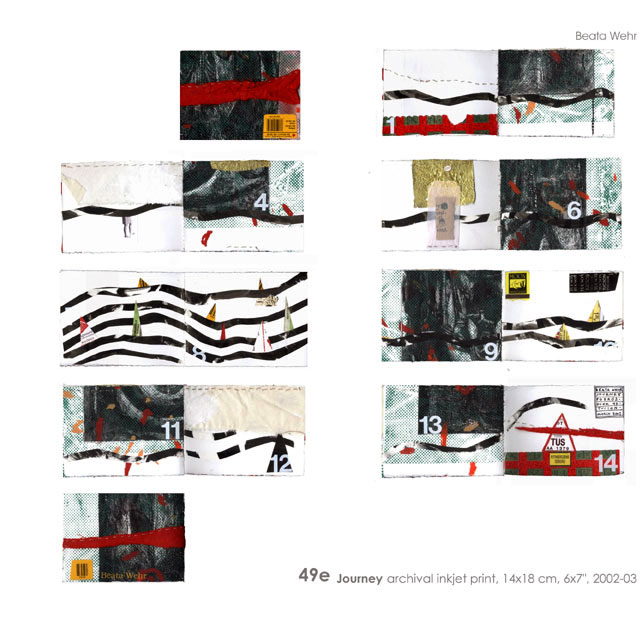
Journey 5.5 x 7.5" archival inkjet print on Exact Index Wausau paper, single signature. Beata Wehr: "I feel that experiencing influences of the two different cultures - Polish and American - shapes my identity and perception of life, and this is what I want to communicate to a viewer." This book brings together several images from other works that let us share her journey through her work and life. We get a glimpse of the "unchanging self" in "Passing Continued." There is the gold crinkly reminder of "Transience" reminding us to partake of the sweetness even though it may be fleeting. The cover brings forth the mystery of life from "Taming Metal Objects." And so it goes. We are taken on a "Journey" with Wehr of her life and her work. |
|
| Beata Wehr: "I am interested in recording the passage of time, obsessed by the changes happening in our life, changes of our fragile bodies, our minds. I am curious how the past determines the present and how what is happening now influences our thinking about the past. The rhythm of life is different depending on the place we live, our age, occupation, gender, and role in a family and in a society. I am trying to capture chunks of time comparing different periods of my life, recording transience by creating journal-like books, time lines, letters from the past, calendars. In my work the past is mixed with the present, experiences from Poland with those from here. Some of the materials I am working with are found, so their history is unknown to me, and this mystery creates yet another layer of thinking about the time with all what is unknown and can only be guessed. Time and transience are very important factors in our life, and this why I am choosing them as a subject." | |
| Outside. Inside. Book 168 By Beata Wehr Tucson, Arizona: Beta Wehr, 2015. One-of-a-Kind. 5.5 x 7.5"; 4 pages each side. Double-sided accordion. Mixed media. In lightweight paper slipcase. Signature, title, and date handprinted by the artist. Beata Wehr: "This book explores the dichotomy of the inside and outside. It may be interpreted as a description of a person - what we see and what is hidden from the view, or looking at the outside world and our internal landscape." $400 |
|
Dreams 7.5 x 5.5" closed, extends to 22 x 30"; one-page book open, 16 pages closed. Silkscreen on paper. Mixed media. Hand-printed title, artist name and other information on back page. Closed book slips into 9 x 11 x 2" linen pillow case with button closure (pillow case contains both book and a pillow). Beata Wehr: "Most of the night we spend sleeping, that is why I selected the subject of dreams. Many years ago I made a big black and white silkscreen print called 'Dream'. I decided to use it as my material, as I often recycle older work into a new one. I folded my print into an accordion structure adding little drawings with pen and ink on each page to create new dreams. When fully open the book still shows one big image. "My book is housed in or can be presented on a pillow covered with white linen that I especially made for it. This was an interesting experience as the feathers were flying all over my studio!" |
|
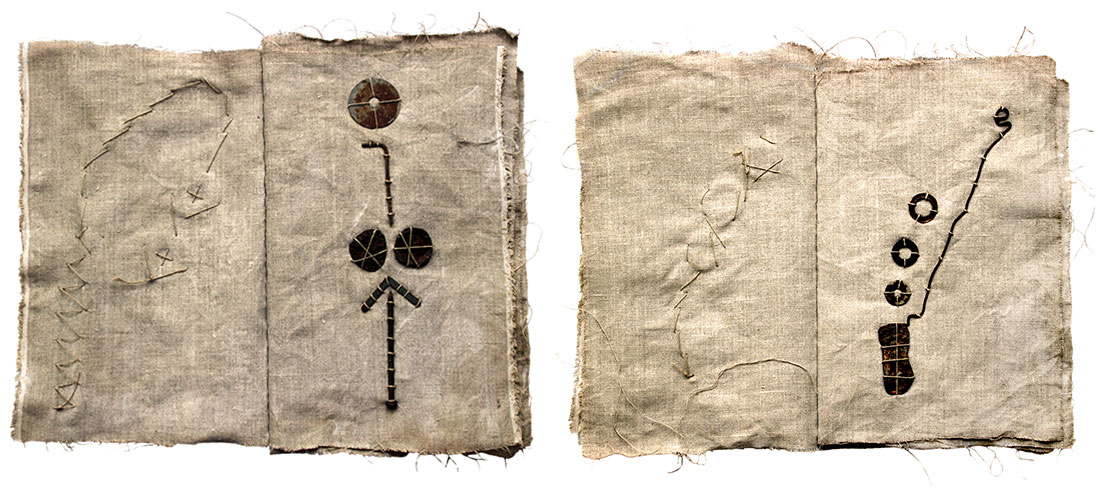
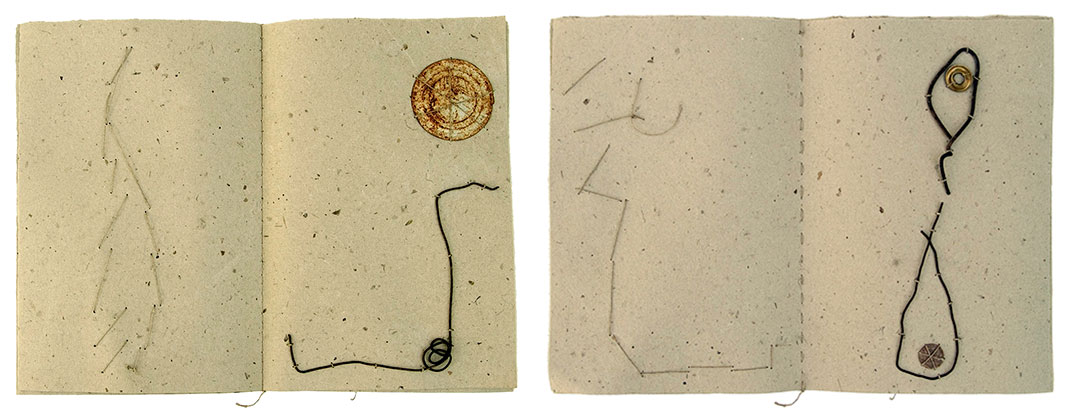
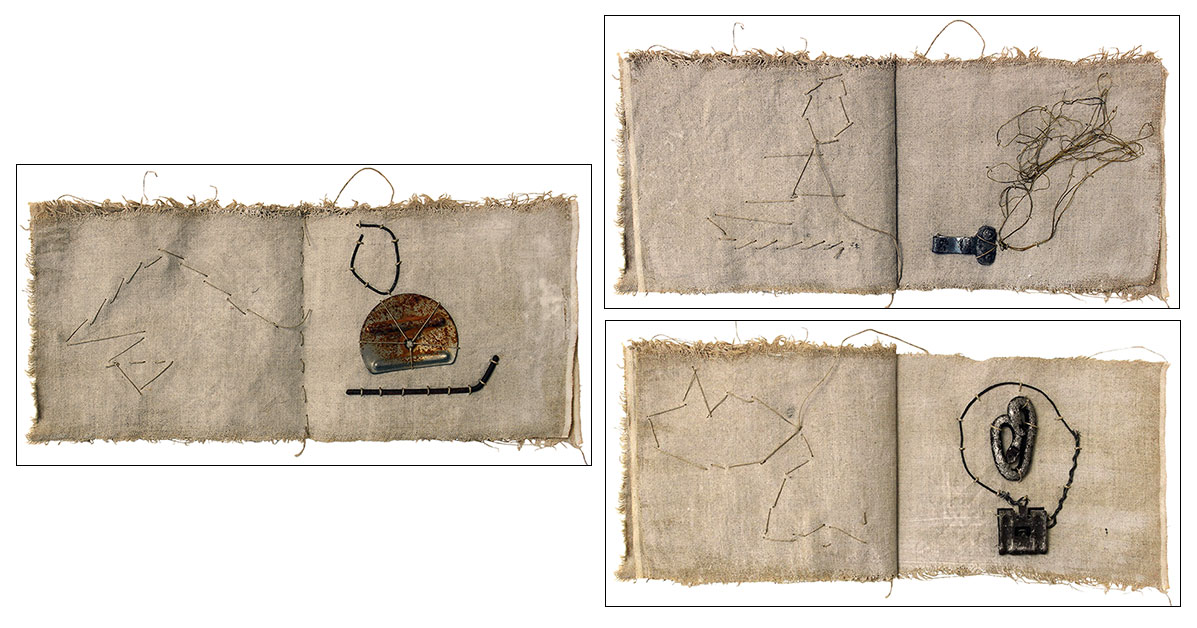
Horizontal stories 8 x 15"; 6 leaves including covers. Hand stitched pamphlet style binding. Found metal objects hand sewn onto paper pages. Signed and dated by the artist on the back cover. In handmade paper envelope, hand stitched at ends. Signed and dated by the artist on the envelope. Beata Wehr: "In recent years I have made many mixed media artist's books and pages that are 'allusions to a narrative.' I used metal objects found on the ground and stitched them to pages made out of linen canvas to create visual stories. They are sometimes not easy to understand, and the viewers have to construct them themselves. I carefully selected the materials to work with: found metal pieces speak about time, transience, and place. I created a second, related book at the same time entitled 'Vertical Stories.'" |
|
Vertical Stories 11.5 x 8"; 16 pages including exterior pages. Mixed media. Paper pages with metal objects attached by thread. Hand sewn binding. Signed and dated by the artist on the back cover page. In handmade paper envelope with hand stitched sides. Signed and dated by the artist on the bottom of the envelope. Beata Wehr: "In recent years I have made many mixed media artist's books that are 'allusions to a narrative.' I used metal objects found on the ground and stitched them to pages made out of linen canvas to create visual stories. They are sometimes not easy to understand, and the viewers have to construct them themselves. I carefully selected the materials to work with: found metal pieces peak about time, transience and place. I created a second, related book at the same time entitled 'Horizontal Stories.'" |
|
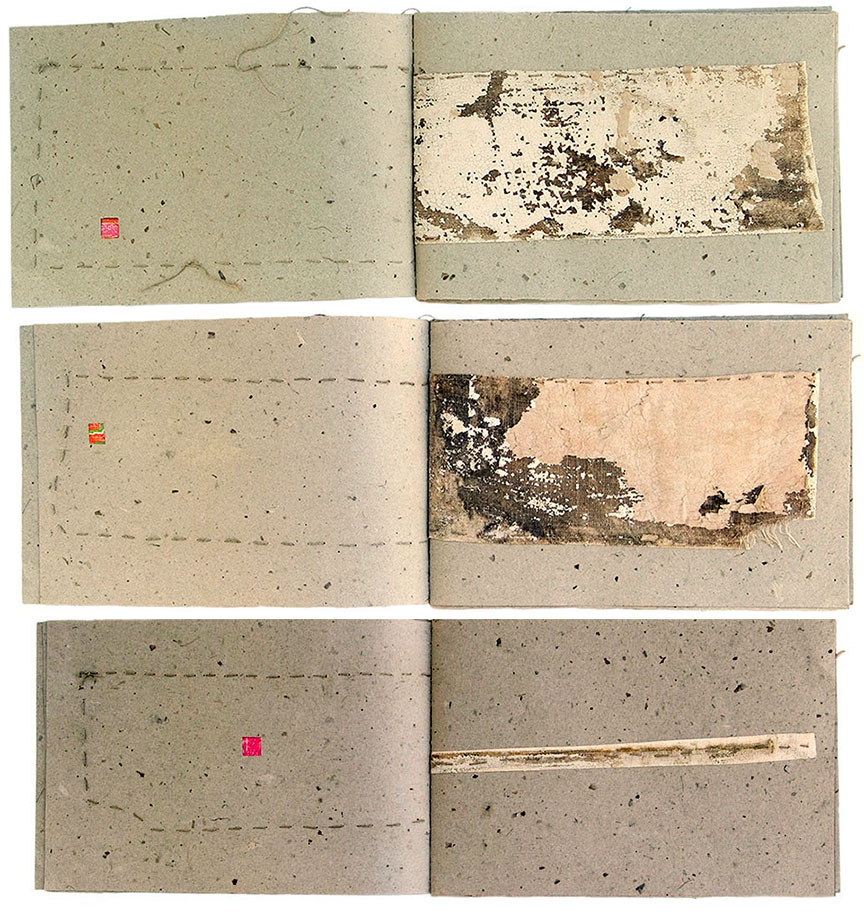
On the Other Side of the Wallpaper 8 x 11"; 16 pages including exterior pages. Mixed media. Wallpaper attached by hand sewing. Hand sewn binding. Signed and dated by the artist on the back page. In Polish linen envelope with hand stitched sides. Paper clip closure. Signed and dated by the artist on the envelope. Beata Wehr: "The book contains a wallpaper from a closet in my first own house. My husband and I bought it in Tucson, Arizona, in 1997 after 16 years of moving from one rental place to another on two different continents. I had to tame the house to make it my home. "I was curious about all the people who lived here before me and the story of the house. One day I removed the intensely colored seventies wallpaper and examined what was on a backside. It could be read [like] a story and with a little bit of imagination some of the secrets seem to be revealed." |
|
| 23 proofs for existence of the past By Beata Wehr Tucson, Arizona: Beata Wehr, 2002. One-of-a-Kind. 6 x 14" with 18 pages including front and back covers. Found objects attached by thread to painted canvas. Bound by three metal screws. Title, date, and artist's name hand-printed on back cover by Wehr. Slipped into matching handmade canvas envelope signed on the back by the artist. Artists' book as archaeological dig. Twenty-three metal objects — Where did they come from? What is their history? What story do they tell? The pages of this artists' book started as a large abstract wall-hanging. Wehr cut the canvas into oblong pieces that became the pages of this artists' book and used thread to attach metals objects she had found in the desert near her home in Tucson. From this one-of-a-kind piece Wehr produced a digital limited edition version in 2002. She has now decided to part with some these unique originals. Beata Wehr: "Some of the materials I am working with are found, so their history is unknown to me, and this mystery creates yet another layer of thinking about time with all that is unknown and can only be guessed. Time and transience are very important factors in our life, and this why I am choosing them as a subject." $1,200 |
|
| Wehr began an ongoing series of Polish linen books in 2006 | |
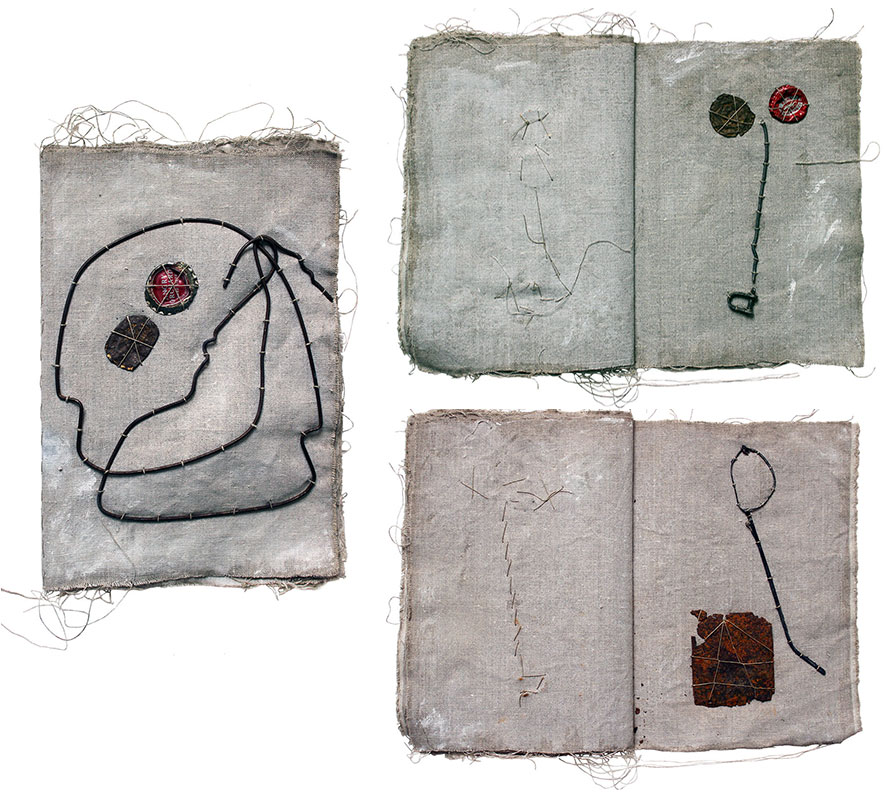
Stories from Fremont Street 8 pages including covers. Sewn binding. Polish linen treated with gesso. Metal objects attached by sewing. Signed and dated by the artist on the back cover page. In matching Polish linen envelope with metal paper clip closure and handsewn sides. Signed and dated by the artist on the envelope. Beata Wehr: "This book is from an ongoing series 'Polish Linen Books' which I started in 2006. In recent years I have made many mixed media artist's books that are 'allusions to a narrative.' I used metal objects found on the ground and stitched them to pages made out of linen canvas to create visual stories. They are sometimes not easy to understand, and the viewers have to construct them themselves. I carefully selected the materials to work with: found metal pieces speak about time, transience, and place, and linen canvas that I brought from my native Poland symbolizes my roots and immigration. "In the Spring of 2015 I taught a mixed media book class at the University of Arizona in Tucson in an amazing and mysterious Corleone Building. Each time when I walked on Fremont Street from my car to the class I picked small metal objects on my way. While making a book I thought about my teaching and my students. The suggested narrative on each page relates to them as well as to the street." |
 Click image for more |
Souvenir from Berkeley 11.5 x 7.5"; 16 pages including wraps. Pages and wrapper of Polish linen. Found metal objects. Hand sewing and gesso applied. Inserted into Polish linen sack with rusted paper clip closure. Printed titles, name, and date on book and sack by the artist. Beata Wehr: "In recent years I have made many mixed media artist's books and pages that are 'allusions to a narrative'. I used metal objects found on the ground and stitched them to pages made out of linen canvas to create visual stories. They are sometimes not easy to understand, and the viewers have to construct them themselves. I carefully selected the materials to work with: found metal pieces speak about time, transience and place, and linen canvas that I brought from my native Poland symbolizes my roots and immigration. I collected the metal objects used in this book in Berkeley where I lived for several months in 2015." |
|
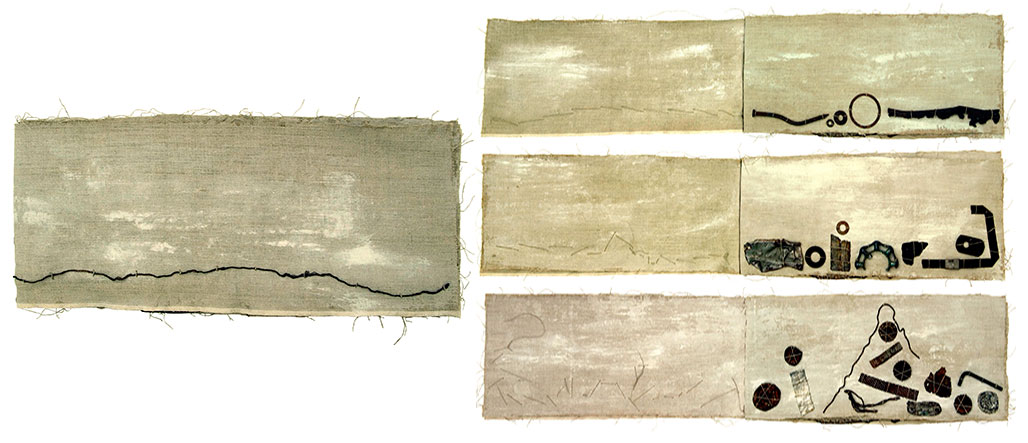
More 7 x 17"; 12 pages including exterior pages. Mixed media on Polish linen. Found metal objects attached by hand sewing with thread. Gesso applied. Hand sewn binding. Signed and dated by the artist on the back cover page. Slipped in hand sewn Polish linen envelope with paper clip closure. Signed and dated by the artist on the envelope. Beata Wehr: "The pages of this elongated book are made out of linen canvas. The format relates to the landscape and linen to the land (as well to my Polish background). As in my other linen books, I used a variety of found metal objects. A group of them is stitched next to each other on the first page, to cover its bottom, creating a landscape of discarded items. The number of items stitched on the following pages is gradually growing, eventually covering the whole last page. The book is a comment on the human urge of producing more and more objects that are periodically discarded to change a part of the land into a gigantic accumulation of garbage." |
|
| Beata Wehr Out of Print Title: | |
| About Serendipity By Beata Wehr Tucson, Arizona: Beta Wehr, 2013. One-of-a-Kind. 3 x 4.25"; 6 pages. X-fold, a single sheet folded, opens to 8.5 x 11.25". Watercolor, collage, typewriter. Beata Wehr: "As an artist I am dividing my time between making books and painting. "This project is a serendipitous combination of both of them. The random gouache marks became pages of abstract landscapes that we can travel through. After looking through all of them and unfolding the book viewers will find a repeated word 'serendipity.'" (SOLD) |
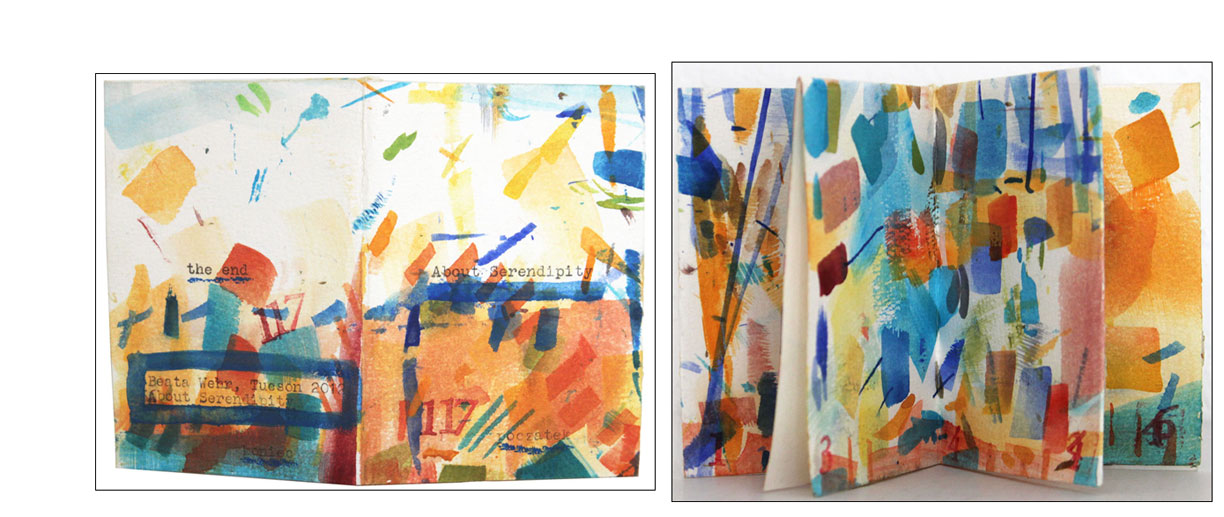 Click image for more |
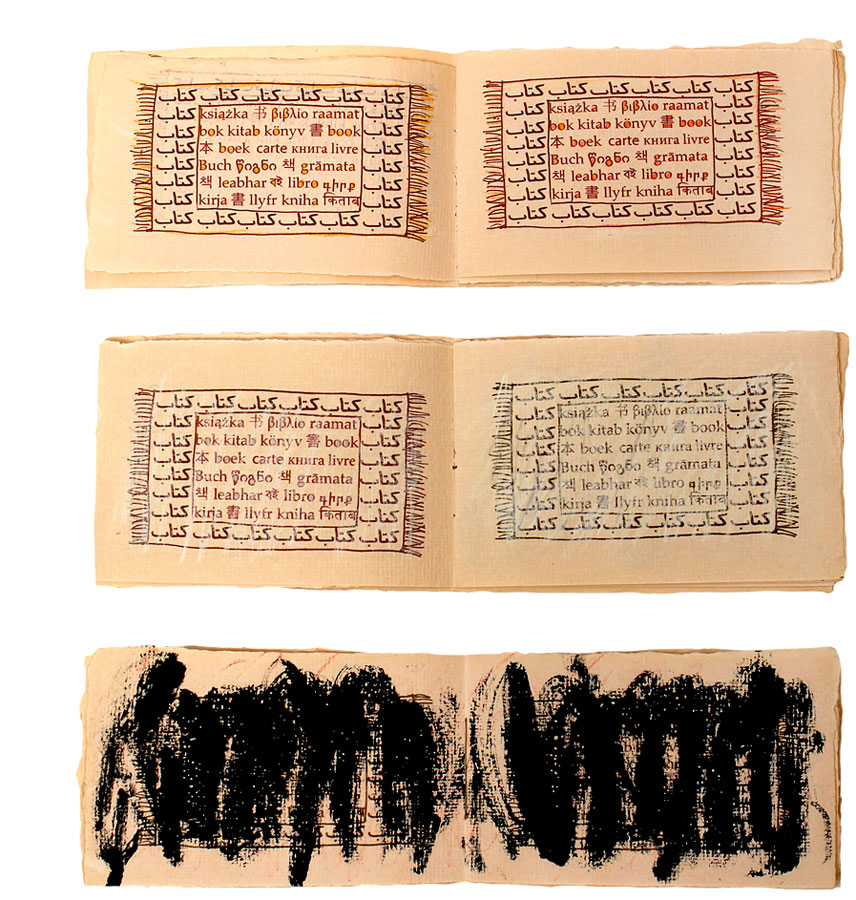
| Al-Mutanabbi Street By Beata Wehr Tucson, Arizona: Beta Wehr, 2012. Edition of 12. 8 x 5"; 12 pages. Single signature pamphlet. Archival inkjet print, color pencils, black ink. In hand-stitched envelope with title on cover. Signed and numbered by the artist. Single 7 x 4.25" double-sided informational page included. Beata Wehr: "This book was created in response to the tragic bombing in Baghdad. The street that was a heart of literary and intellectual community was destroyed in 2007 and many people were killed or injured. "The pages contain carpets covered with the pattern of words in different languages and alphabets - all of them mean 'a book'. It is a story of Al-Mutanabbi Street – from a flourishing place full of books through the attack to rebirth. It can be read from left to right and from right to left depending on the cultural origin of the reader. My book is a tribute to the people killed or injured there. It is also a statement of my belief in importance of books that despite disasters continue to accompany us through our lives." (SOLD) |
|
| Between the Lines Book 166 By Beata Wehr Tucson, Arizona: Beta Wehr, 2015. One-of-a-Kind. 3.75 x 2.75" closed, extends to 22.5"; 8 pages. Double-sided accordion. Mixed media. In lightweight paper slipcase. Signature, title, and date handprinted by the artist. Beata Wehr: "The meaning of what appears 'between the lines' can be only guessed. I grew up in Poland, where until 1989 all of the published texts were censored. The ability to read between the lines was then an important skill. I believe it is still valid in most countries." (SOLD) |
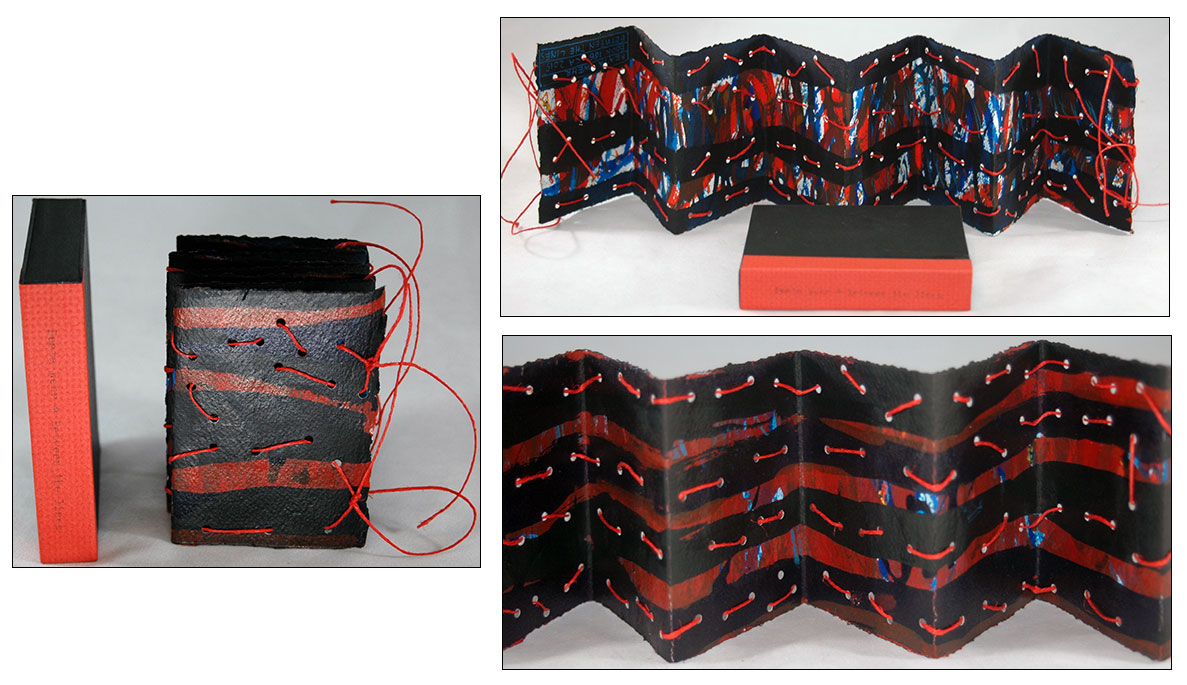 Click image for more |
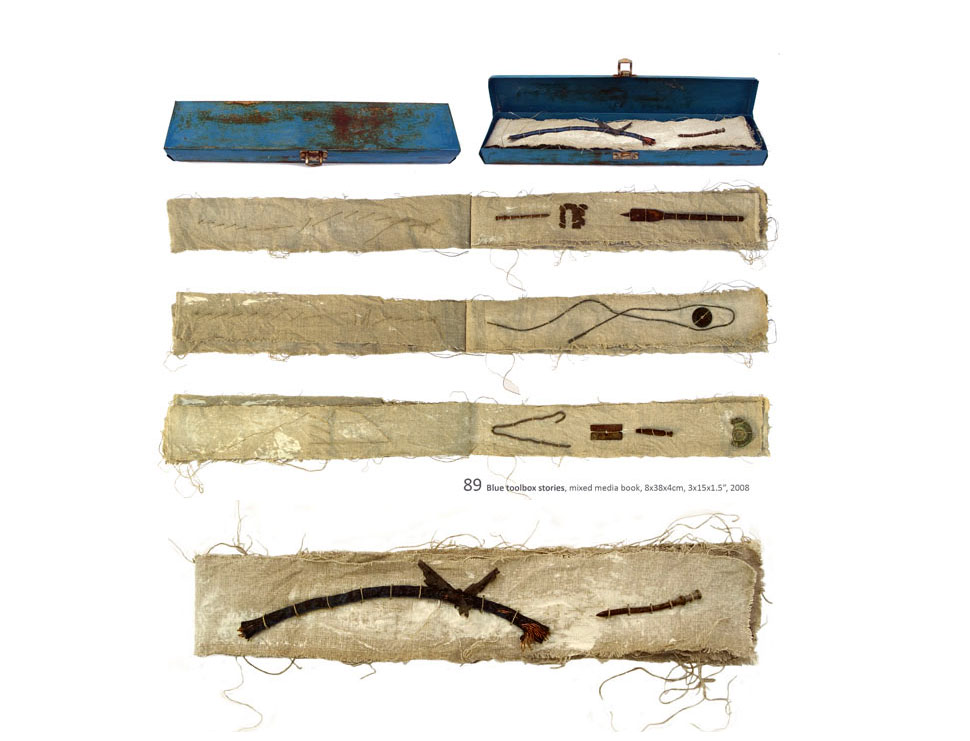
Blue Toolbox Stories 3 x 15 x 1.5"; 8 leaves. Oblong linen book. Mixed media with found metal objects sewn with linen thread onto linen (from Poland) pages. Other materials: gesso and ink. Laid in oblong blue metal toolbox with hinged lid and metal clasp closure. Beata Wehr: "Elongated book whose pages are made out of Polish linen is housed in an old, rusted blue toolbox. Found metal object are stitched to each odd page - some were probably used as tools or supplies, while purpose of the others is unclear. Many of them are old, incomplete, and their history is unknown to us. Each page can be read as a separate short story, but they all evoke passage of time and transience." |
|
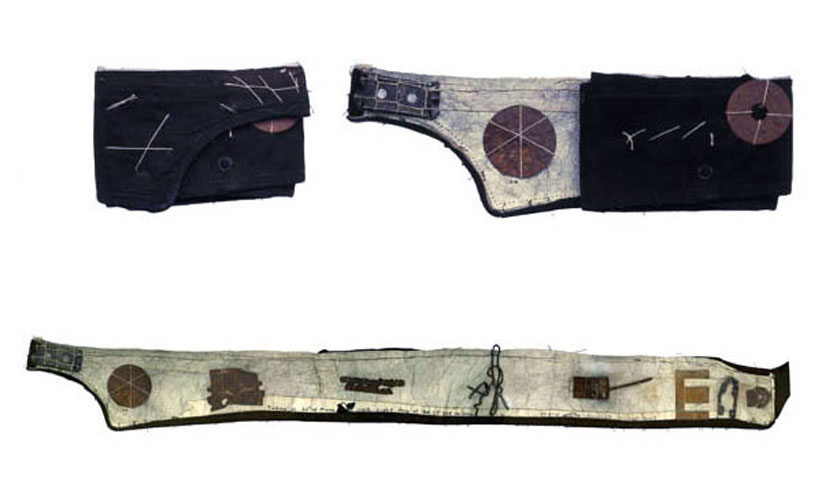
END 4.5 x 7" closed; 4.5 x 40" open. Mixed media: found metal objects, found suede, Polish linen, linen thread, gesso, ink. Magnet closure. Beata Wehr: "The folded object, a book, was done at the beginning of the War [the Second Persian Gulf or Iraq War]. The hand written text says:'Today is 26th of March 2003, eight day of the US war on Iraq.' I grew up in Poland, a country that was devastated by the World War II. However I was born 13 years after the end of the war, its shadow was still present. I felt strong reaction against the war on Iraq. The book is an abstracted version of this emotion, juxtaposing piece of soft suede coat which is the background and has a resemblance of a skin and a fragile body, with found metal objects whose sharpness may be associated with destruction and weapons. On the right of the piece I stitched the metal pieces, which became the word END - I see it as a wish for immediate END of the war or a fear of the END of the world." |
|
| Far Away Daleko Book 71 By Beata Wehr Tucson, Arizona: Beta Wehr, 2005. One-of-a-Kind. 5 x 6.25"; 14 pages. Mixed media. Materials include: thread, found objects; paint; film; papers. Handsewn binding. Signed and dated. Slipped into red envelope with title handprinted. Beata Wehr: "Some of the materials I am working with are found, so their history is unknown to me, and this mystery creates yet another layer of thinking about the time with all what is unknown and can only be guessed. Time and transience are very important factors in our life, and this why I am choosing them as a subject. … In my work I also comment on human behavior and events happening here and far away. These subjects together with immigration and transience are present on the pages, often in a somewhat cryptic way, waiting for the viewer to discover them." (SOLD) |
|
| I Exist Jestem, By Beata Wehr Warsaw: Beta Wehr, 2000. One-of-a-Kind. 8 x 6"; 16 pages. Mixed media: collage, painting. Found objects. Signed on the back cover by the artist. Slipped in hand stitched paper envelope. In this book of retrospect Wehr brings together bits and pieces from her life in two worlds. This collage of images provokes the reader to perhaps bring forth their own fragments of life experience. Wehr pulls the reader into the world of two languages, two cultures. Beata Wehr: ""The book, I Exist, was conceived during a year I spent in Poland. It is contemplation on one’s identity and existence, transience and repetitive elements in life. Multiplied silhouettes are combined with handwritten words, drawings, leaves and ephemera found in Warsaw, and texts are a fragmented resume and lists of my artist’s books." Wehr produced this unique piece in 2000. She did not want to part with the original so decided to produce a digital edition of it in 2002. (SOLD) |
|
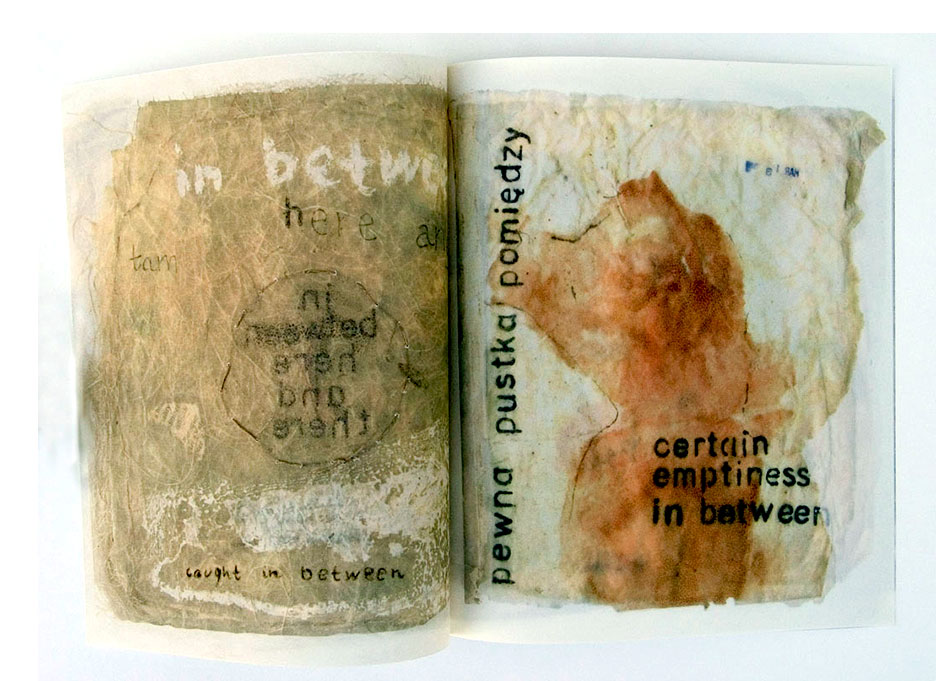
in between here and there 9 x 8" with 8 pages printed inkjet on translucent Neenah paper. Sewn binding. This is another of Wehr's explorations of self that is in suspension between two cultures - not totally a part of either but not totally independent of either. Beata Wehr: "I focus on issues related to my experience as a Pole living in the U.S. I came here 13 years ago with no intention to stay, but I am still here. Since my connection with Poland is very strong, I feel I am in between the two cultures. In my work, I address the problems of emigration with a view to both verbal and non-verbal communication, issues of adaptation, nostalgia, isolation, dislocation and identity. I have moved many times - I've had 11 homes - so I started to redefine for myself the idea and the meaning of the home, examining my own nomadic life. It is very hard to feel a part of the local culture if you move so often; life feels even more unstable; you experience transience much more strongly." |
|
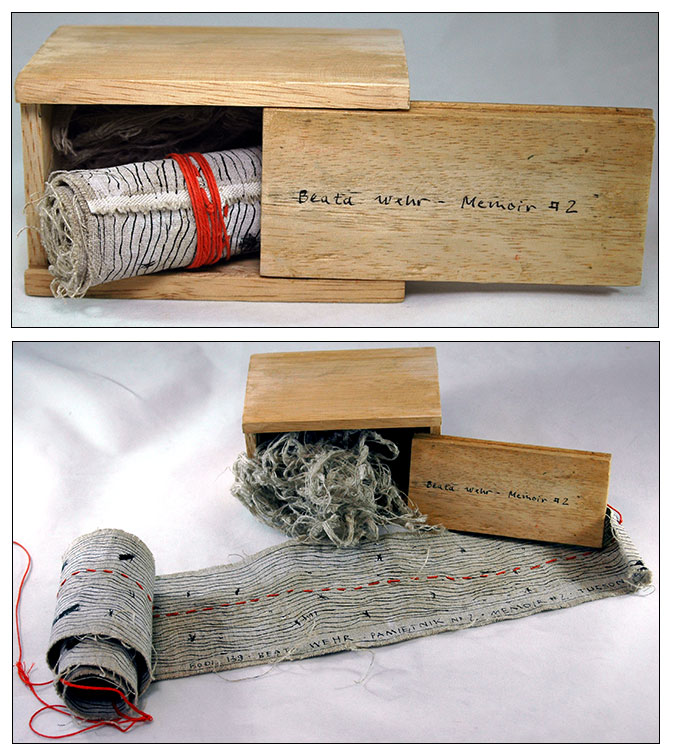
| Memoir #2 Book 139 By Beata Wehr Tucson, Arizona: Beta Wehr, 2014. One-of-a-Kind. Polish linen scroll extends to 29". Laid in 3 x 5 x 3.5" wooden box with sliding lid. Materials: Polish linen, linen thread, ink, gesso, wooden box. Title and signature handprinted on box lid by artist. Handprinted title in both English and Polish on scroll. Beata Wehr: "Memoir 2 is a book on a subject of memory that recently became one of the main topics that interest me. This small scroll is made of Polish linen that symbolizes my native country. The lines allude to the text recording thoughts and events. It is abstracted, so viewers can fill the lines with their own ideas and memories." (SOLD) |
|
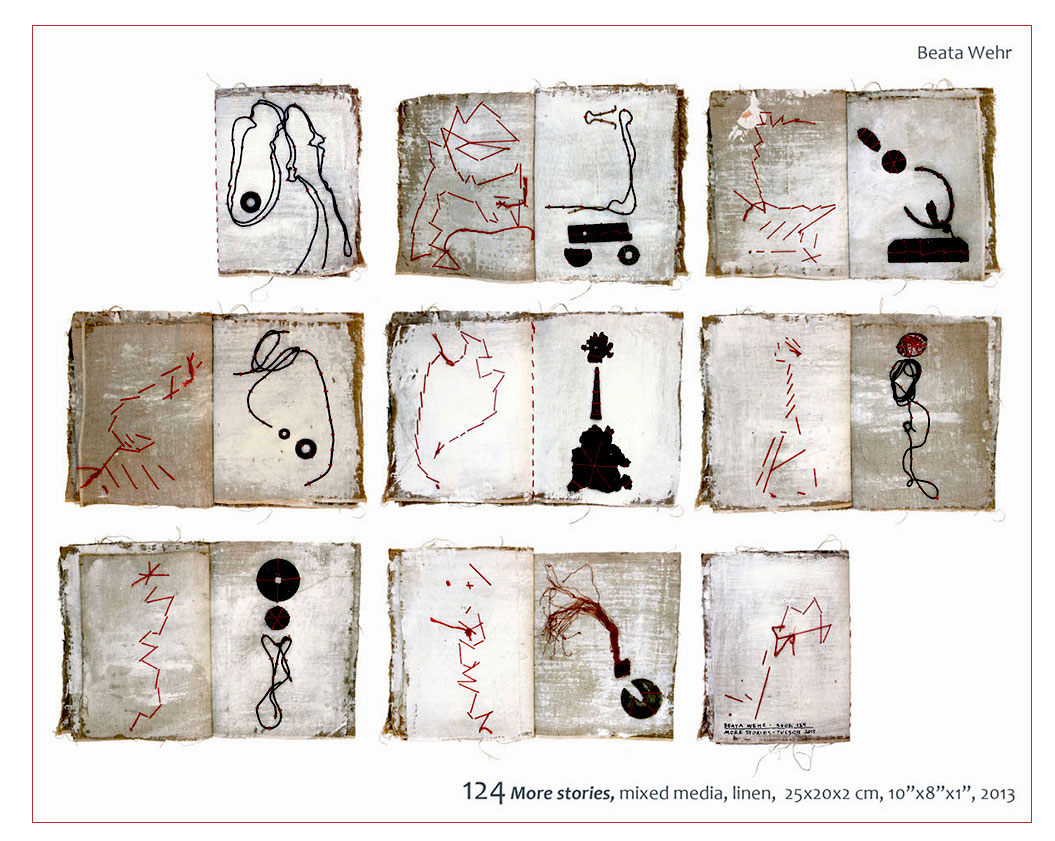
| More Stories By Beata Wehr Tucson, Arizona: Beta Wehr, 2014. One-of-a-Kind. 7.5 x 9.5"; 12 pages including covers. Polish linen pages. Gesso, ink, found objects. Handsewn. Signed and dated by the artist on the back cover. In Polish linen handmade envelope with found paper clip closure. Beata Wehr: "In recent years I have made many mixed media artist's books and pages that are 'allusions to a narrative.' I used metal objects found on the ground and stitched them to pages made out of linen canvas to create visual stories. They are sometimes not easy to understand, and the viewers have to construct them themselves. I carefully selected the materials to work with: found metal pieces speak about time, transience, and place, and linen canvas that I brought from my native Poland symbolizes my roots and immigration." (SOLD) |
|
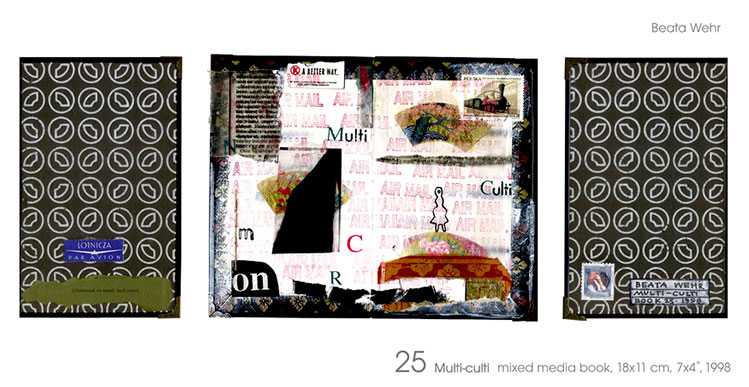
| Multi-culti By Beata Wehr [Tucson, Arizona]: Beta Wehr, 1998. One-of-a-Kind. 7 x 4", one opening. Mixed media folio. Paper covered boards with metal edging. Signed and dated by the artist. Reminiscent of a greeting card one would receive in the mail – collages of a Polish letter stamp and an US post stamp, of the postal office "AIR MAIL" stamp, and bits and pieces of text that might be found on packages or letters. Wehr uses these images to link the two cultures that she bridges - her origins in Poland and her current home in Arizona. Beata Wehr: "I found artists' books to be especially useful in talking about the issues of identity, immigration, and dislocation. I like their intimate format, and the fact that many media could be combined on the pages, creating layers of images. My books are usually bilingual, or semi-bilingual and I often mix images with writing, pieces of newspapers, found objects and other elements reflecting the everyday life in Tucson as well as my links to Poland. I try to combine two different experiences from two different worlds in this 'in between' situation. I do not know if it is ever possible, as my native life, language, landscape, culture are so different then my life here in Tucson. I want my viewers who will not understand part of the text to experience the difficulties with comprehension. I hope that those who are not from this culture can relate to the problem, and those who are from here will be more aware of it – especially in that it also relates to migration and the feeling of dislocation which is an experience many Americans encounter." (SOLD) |
|
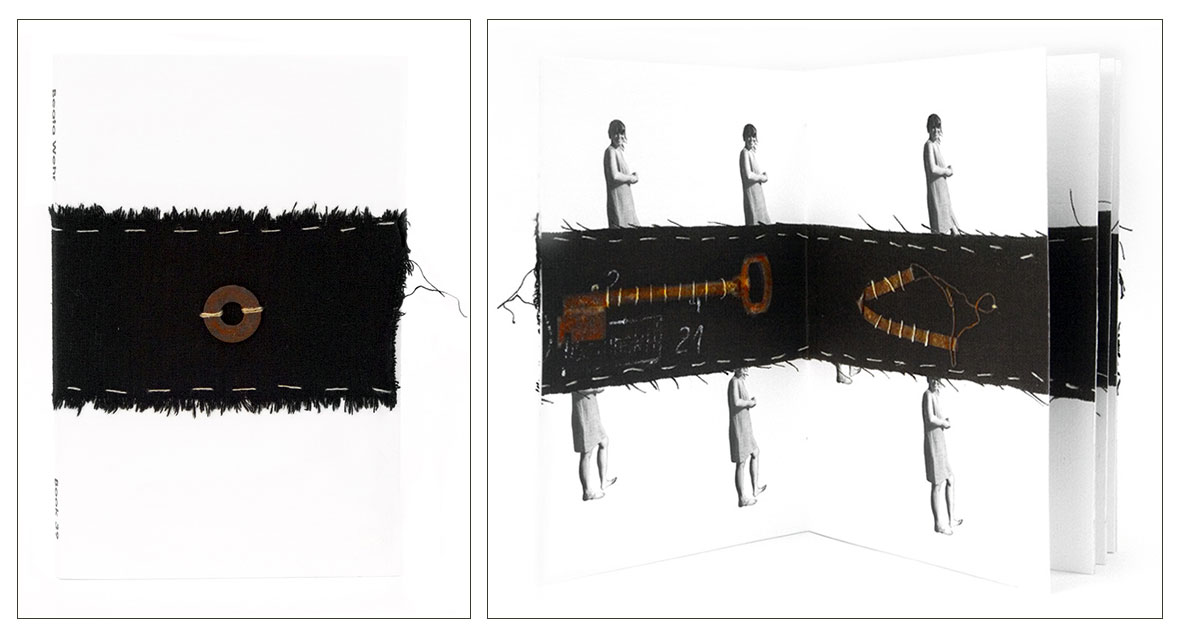
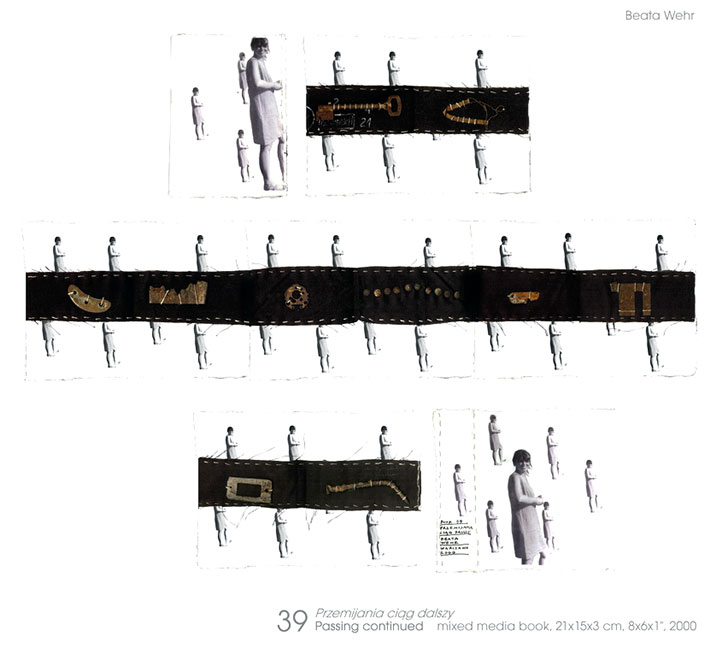
Passing Continued 5.25 x 8”; 10 pages. Accordion structure. Based on the original mixed media one-of-a-kind created in 2000. A black cloth band, wrapped from front to back cover and stitched in place, recalls an armband worn for mourning. In the center of the frayed cloth, secured with large stitches, is a rusted artifact. The accordion pages that follow are a photographic continuation of the cover, as the image of the black band and various found and rusted objects runs through the entire horizontal center of the book. The objects are fragments—miscellaneous, disembodied machine parts, nails, thumbtacks, etc.—that have outlived their use. The interior pages also feature a recurring black-and-white photographic cutout of a woman (Wehr), face turned, smiling toward the camera as she steps forward like a mantra. The images are divided unevenly—torso and head above; torso, legs and feet below. This collaged visual text suggests the path of life and what is lost or rendered obsolete along the way; that which we mourn in its passing; the unchanging self that continues on in spite of inevitable loss. Inkjet printed, carousel accordion. Each cover features a different found object. Subtle and powerful. |
|
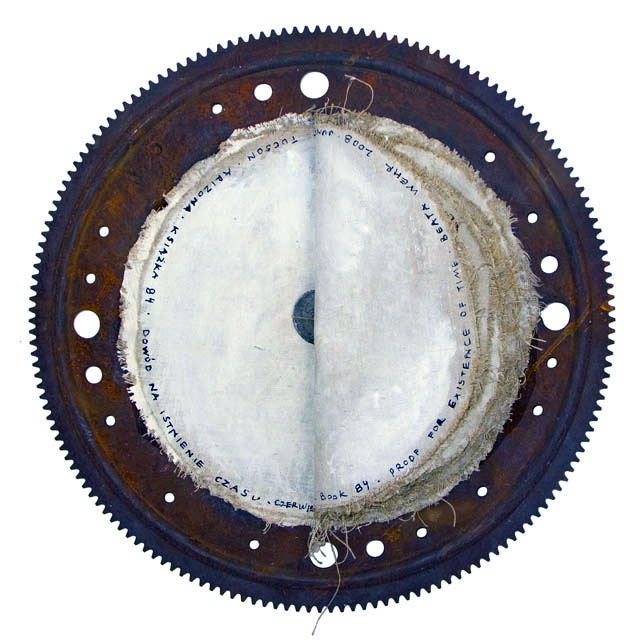
Proof for Existence of Time 12.25" diameter; 24 pages. Round metal gear frame. Linen (Polish linen) pages. Found metal objects. Sewing with linen thread. Other materials: gesso and ink. Beata Wehr: "This circular work has a very simple idea: it is a book about time and it is also a clock. [An] [o]ld metal part, perhaps remnant of a wheel, became a frame for this book. Each spread contains one or two metal objects indicating the hour. When the viewer turns the pages time passes and the hours change. Found old metal pieces evoke history and transience." |
 Click image to enlarge |
| Przemijania Ciag Dalszy Passing Continued By Beata Wehr Tucson, Arizona: Beta Wehr, 2000. One-of-a-Kind. 8 x 6"; 10 pages. Flutter book construction. Found objects. Digital images. In matching paper wrapper sewn at fore edges. Signed and dated by the artist. A black cloth band that extends from the front page to back page and is stitched in place recalls an armband worn for mourning. In the center of the frayed cloth, secured with large stitches, are rusted artifacts. The accordion pages that follow are a photographic continuation of the cover, as the image of the black band and various found and rusted objects runs through the entire horizontal center of the book. The objects are fragments – miscellaneous, disembodied machine parts, nails, thumbtacks, etc. – that have outlived their use. The interior pages also feature a recurring black-and-white photographic cutout of a woman (Wehr), face turned, smiling toward the camera as she steps forward. The images are divided unevenly – torso and head above; torso, legs and feet below. This collaged visual text suggests the path of life and what is lost or rendered obsolete along the way, that which we mourn in its passing, the unchanging self that continues on in spite of inevitable loss. (SOLD) |
|
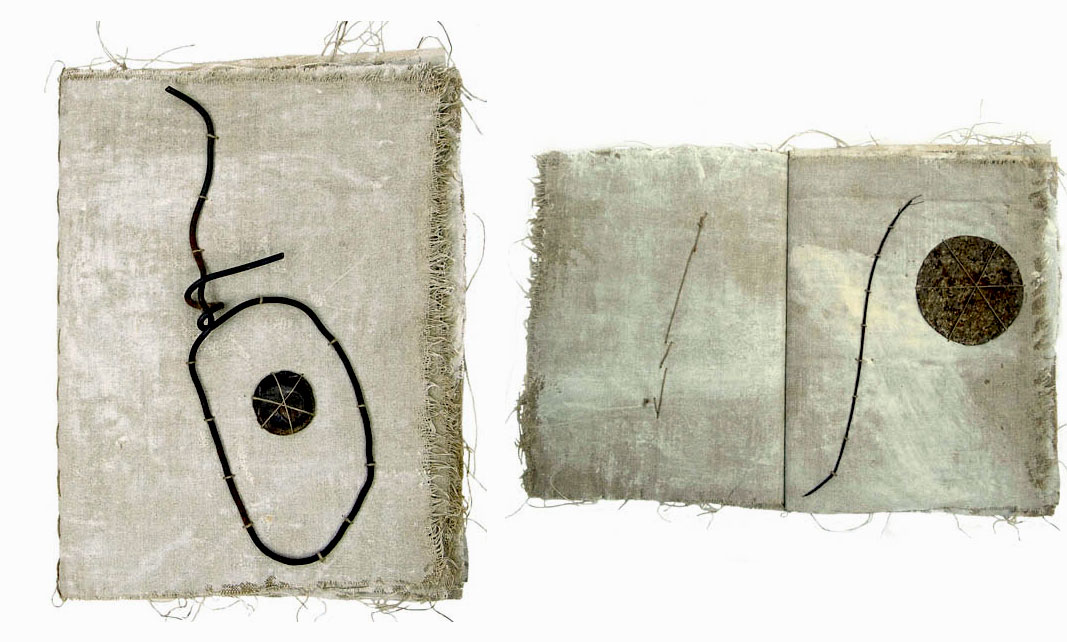
Something Round in the Picture 10 x 7.5"; 14 unnumbered pages. Linen pages. Sewing. Found metal objects.Housed in linen pocket. Beata Wehr: "For a long time I have been collecting found little metal objects, whose history and sometimes purpose were unknown to me. I have used these pieces in many of my works dealing with issues of time and transience. In this book, whose pages are made out of Polish linen, I have stitched one or two objects to each odd page suggesting a narrative. Each one contains something round, and a story can be invented by the viewer." |
 Click image for more |
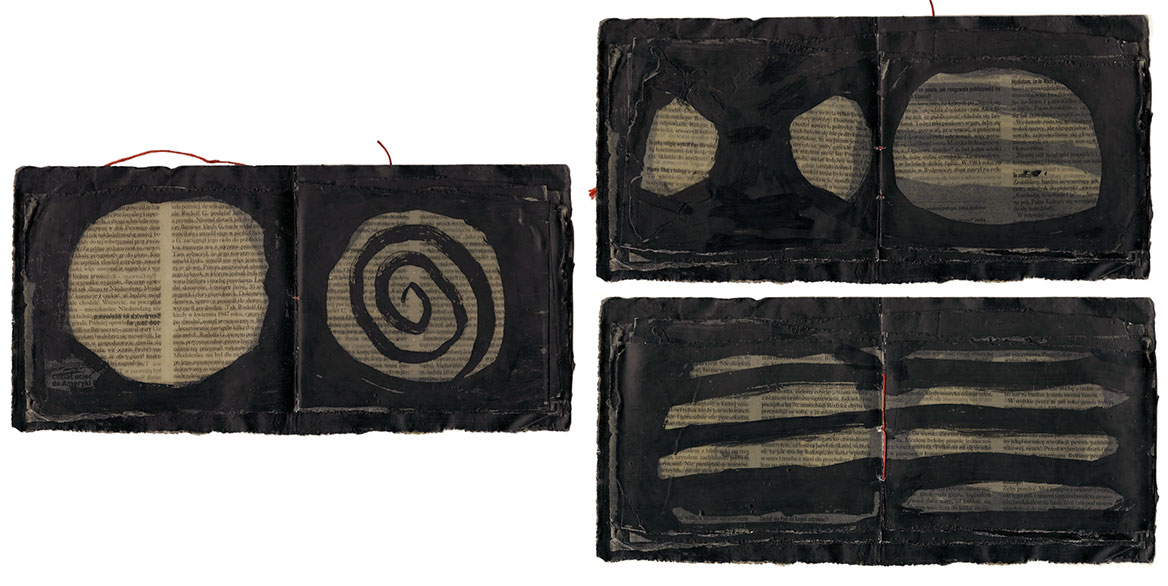
Stories from a Polish newspaper 5.5 x 5.8"; 16 pages. Materials: newspaper, India ink, thread. Process: encaustic medium. Handsewn binding in encaustic wrappers. Hand printed titles, date, and artist name on back cover. Beata Wehr: "Pages of this book are made out of 'Gazeta Wyborcza', a newspaper published in my native Warsaw. Text is mostly obscured, fragmented, and difficult to grasp. Although after living in the US for 31 years I mostly adapted to my new country, I still experience nostalgia and a somewhat sad feeling that I do not fully understand everything that is happening currently in Poland." |
|
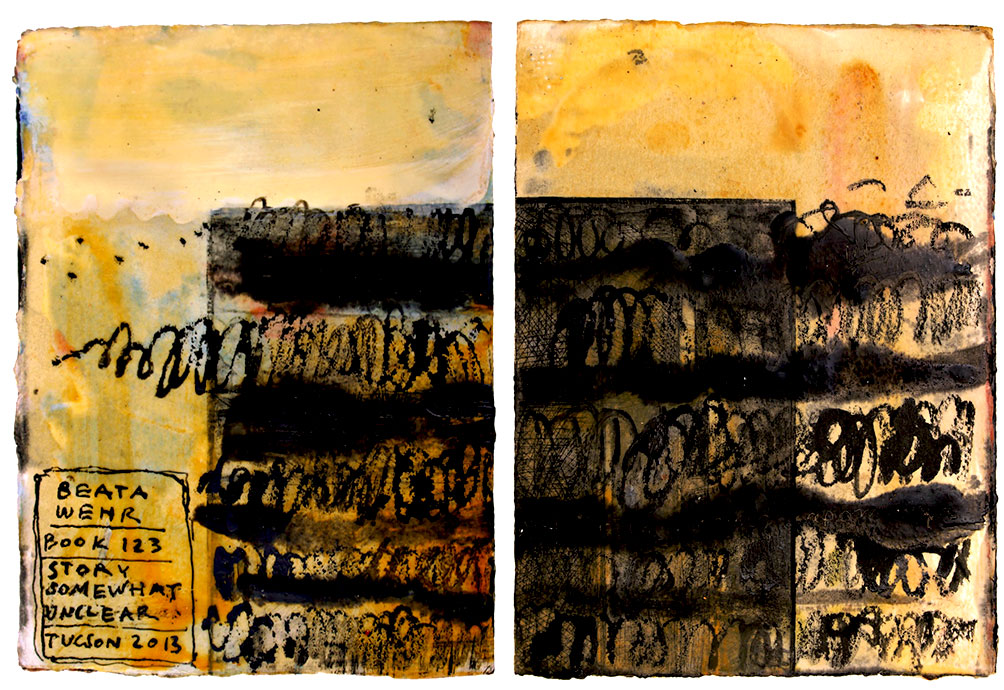
| Story Somewhat Unclear By Beata Wehr Tucson, Arizona: Beta Wehr, 2013. One-of-a-Kind. 7.5 x 5.5" closed, extends to 22"; 4 panels. Accordion. Intaglio, encaustic, and ink. Signed and dated by the artist. Beata Wehr: "This accordion book is created out of an intaglio print I made in the eighties. I added the layer of encaustic paint with black … to create a new abstracted image representing text. … I grew up in Poland, where until 1989 all of the published texts were censored. The ability to read between the lines was then an important skill. I believe this is still true in most countries." (SOLD) |
 Click image for more |
| Transience Book 38 By Beata Wehr Tucson, Arizona: Beta Wehr, 2000. One-of-a-Kind. 7 x 6.5"; 16 pages. Crinkly pad pages. Found objects. Mixed media. Signed and dated by the artist. Laid in Ghirardelli Chocolate box with Baronie Belgian Chocolate pad protector. La dolce vita! In an impermanent world, the sweet life gives way. And while this book reminds us of that fact, it also encourages us to partake of the sweetness, perhaps at the same moment. Covered in the familiar crinkly (sort-of-corrugated) pads that top boxed assortments to protect the candies, this book retains the inviting aroma of chocolate. The pages depict images of such tray pads with found, rusted objects affixed to them - the simultaneous decay of life. The verso pages show the back stitching which secures the front object, and chocolate stains, reminding us that life is messy. (SOLD) |
|
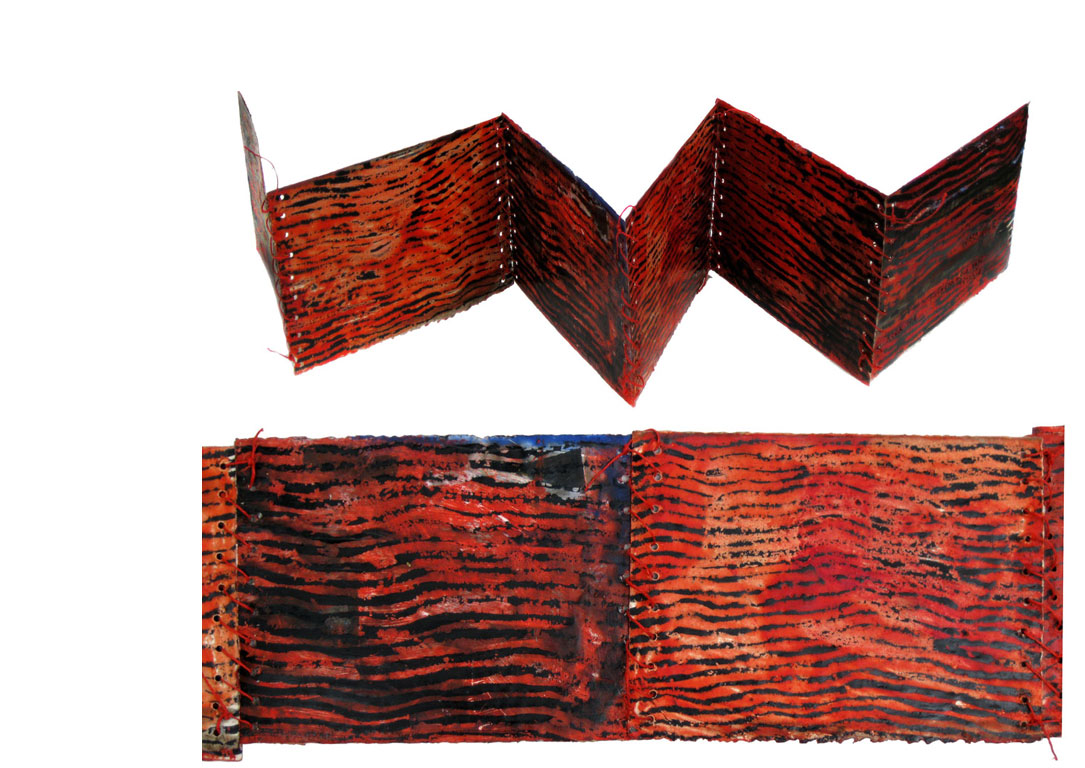
Unspeakable Heat Beata Wehr: "This book is a record of unspeakable long-lasting heat. I live in Tucson, in the Sonoran Desert, where for half of a year we experience hot weather. Since I grew up in Poland where the climate is different, I react strongly to the extreme temperatures. The repeating red pages suggest unavoidable repetitive weeks of heat" |
 Click image for more |
Very Short Stories 6 x 7"; 12 pages including wrappers. Materials: Polish linen, gesso, found objects, India ink, linen thread. Handsewn binding. Hand printed titles, date, and artist's name on back cover. Inserted in handsewn linen bag with handprinted artist name and title. Beata Wehr: "In recent years I have made many mixed media artist's books and pages that are 'allusions to a narrative'. I used metal objects found on the ground and stitched them to pages made out of linen canvas to create visual stories. They are sometimes not easy to understand, and the viewers have to construct them themselves. I carefully selected the materials to work with: found metal pieces speak about time, transience and place, and linen canvas that I brought from my native Poland symbolizes my roots and immigration. This is a small version of my Polish linen books." |
|

Page last update: 04.14.2024

Home | About Us | Contact Us | New Arrivals | Fine Press & Artists' Books | Broadsides |Resource Books | Order/Inquiry
Copyright © 2021 Vamp & Tramp, Booksellers, LLC. All rights reserved.